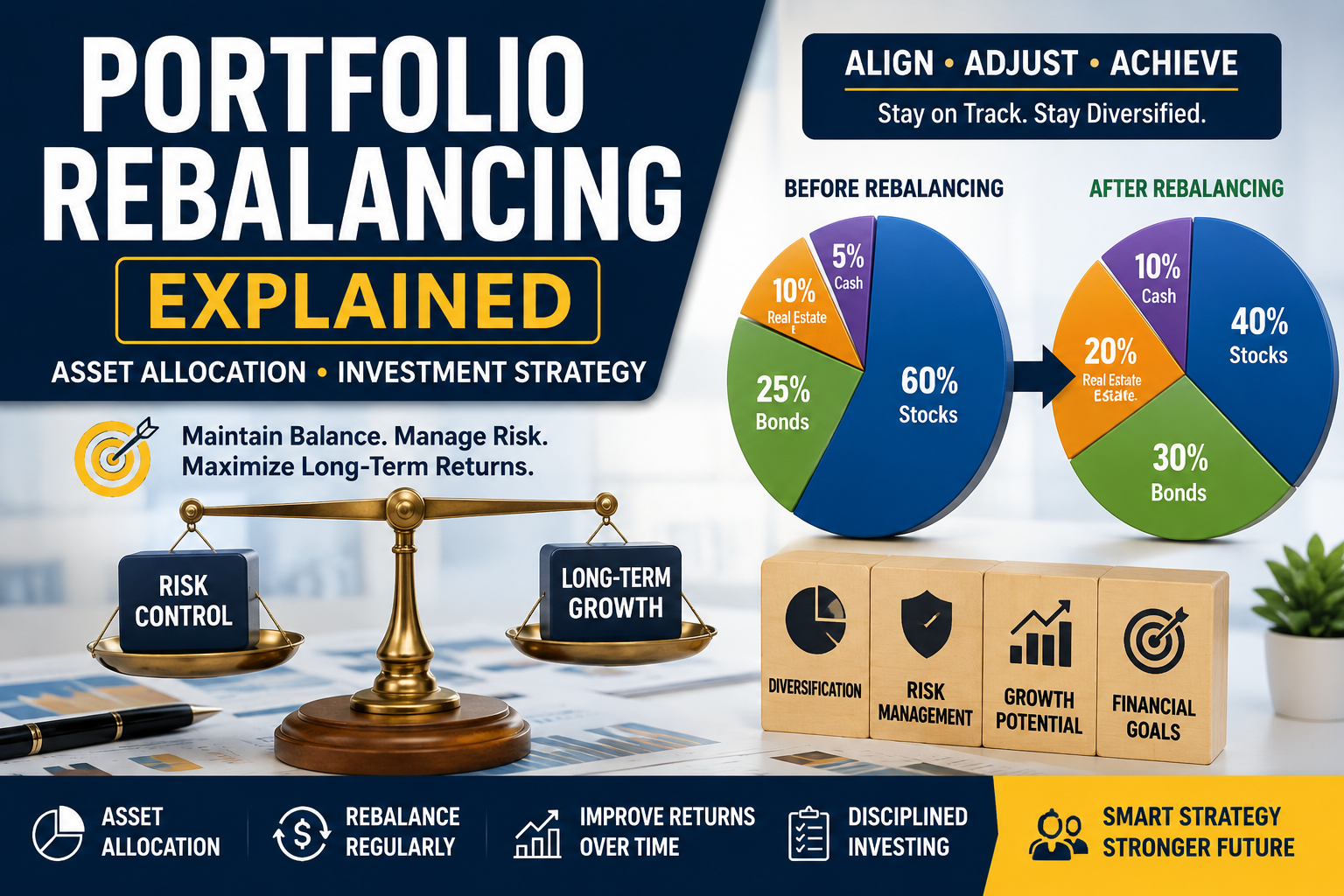
Portfolio Rebalancing Explained
Portfolio Rebalancing Explained is one of the most important concepts in long-term investing. It helps investors maintain their target asset allocation, control portfolio risk, and improve investment discipline during changing market conditions.
This comprehensive guide explains portfolio rebalancing, how it works, why it matters, common strategies, real-world examples, and case studies from major investment markets including the United States, Canada, Australia, and the United Kingdom.
A portfolio that is not rebalanced can slowly become far riskier than intended. For example, an investor who originally wanted a “moderate-risk” portfolio may accidentally end up with an “aggressive-growth” portfolio after years of stock market gains.
This article explains portfolio rebalancing in detail, including:
- What portfolio rebalancing means
- Why it matters
- Types of rebalancing strategies
- Rebalancing frequency
- Tax implications
- Behavioral finance principles
- Retirement portfolio management
- ETF and index fund rebalancing
- Case studies from Tier-1 countries
- Common mistakes
- Real-world examples
What Is Portfolio Rebalancing?
Portfolio rebalancing is the process of adjusting investments back to their intended allocation after market movements change the weight of assets inside a portfolio.
A portfolio usually contains multiple asset classes such as:
- Stocks
- Bonds
- Cash
- Real estate
- Commodities
- International equities
When markets move, some investments grow faster than others.
For example:
| Asset | Original Allocation | After Market Growth |
|---|---|---|
| Stocks | 60% | 75% |
| Bonds | 40% | 25% |
This means the portfolio now carries more stock market risk than originally planned.
Rebalancing restores the intended allocation.
The investor may:
- Sell some stocks
- Buy more bonds
- Return to 60/40 allocation
Understanding Asset Allocation
Portfolio rebalancing cannot be understood without understanding asset allocation.
Asset allocation refers to how investments are distributed across asset categories.
A common retirement portfolio in the USA might look like:
| Asset Class | Allocation |
|---|---|
| US Stocks | 50% |
| International Stocks | 20% |
| Bonds | 25% |
| Cash | 5% |
Each asset behaves differently under economic conditions.
Stocks
Stocks represent ownership in companies.
Examples include:
- Apple
- Microsoft
- Amazon
Stocks generally provide:
- Higher growth
- Higher volatility
- Inflation protection
Bonds
Bonds are loans to governments or corporations.
Examples:
- US Treasury bonds
- Corporate bonds
- Municipal bonds
Bonds generally provide:
- Lower volatility
- Stable income
- Capital preservation
Cash
Cash includes:
- Savings accounts
- Money market funds
- Treasury bills
Cash provides:
- Liquidity
- Stability
- Emergency reserves
Why Portfolio Rebalancing Matters
1. Risk Control
The primary purpose of rebalancing is risk management.
Without rebalancing, a portfolio can drift far away from the investor’s original risk tolerance.
Example:
An investor aged 60 nearing retirement may begin with:
- 50% stocks
- 50% bonds
After a strong bull market:
- Stocks rise to 70%
- Bonds fall to 30%
Now the investor faces substantially greater downside risk before retirement.
Rebalancing restores safety.
2. Emotional Discipline
Rebalancing creates a rules-based investing system.
This reduces emotional decisions caused by:
- Fear
- Greed
- Panic selling
- Euphoria
Rebalancing forces investors to:
- Sell assets after large gains
- Buy assets after declines
This is psychologically difficult but financially beneficial over long periods.
3. Buy Low, Sell High
One hidden advantage of rebalancing is that it naturally encourages buying undervalued assets and trimming overvalued ones.
Example:
During a stock market crash:
- Stock allocation falls
- Bond allocation rises proportionally
Rebalancing requires:
- Selling some bonds
- Buying cheaper stocks
This creates disciplined contrarian investing.
4. Retirement Stability
Retirees need predictable risk exposure.
Without rebalancing:
- Large stock exposure may cause major losses
- Withdrawals during downturns become dangerous
This is known as sequence-of-returns risk.
Rebalancing helps retirees preserve wealth during market volatility.
How Portfolio Drift Happens
Portfolio drift occurs when market performance changes the percentage allocation of investments.
Example:
Initial portfolio:
- $100,000 total
- 60% stocks = $60,000
- 40% bonds = $40,000
After several years:
- Stocks grow to $120,000
- Bonds grow to $45,000
New portfolio:
- Total = $165,000
- Stocks = 73%
- Bonds = 27%
Even though the investor never changed strategy, risk increased dramatically.
Types of Portfolio Rebalancing
There are several major rebalancing methods.
1. Calendar Rebalancing
This means rebalancing at fixed time intervals.
Examples:
- Monthly
- Quarterly
- Semi-annually
- Annually
Most long-term investors rebalance:
- Once or twice per year
Advantages:
- Simple
- Easy to automate
- Reduces overtrading
Disadvantages:
- May ignore major market changes between dates
2. Threshold Rebalancing
Threshold rebalancing occurs when allocations move beyond a predefined percentage.
Example:
- Target stock allocation = 60%
- Rebalance if stocks exceed 65% or fall below 55%
Advantages:
- More responsive to market conditions
- Better risk control
Disadvantages:
- Requires monitoring
3. Hybrid Rebalancing
Many institutional investors use hybrid systems.
Example:
- Check quarterly
- Rebalance only if deviation exceeds 5%
This reduces unnecessary trades while maintaining discipline.
Strategic Asset Allocation
Strategic asset allocation uses long-term target percentages based on:
- Risk tolerance
- Age
- Goals
- Time horizon
Example for a 30-year-old investor:
| Asset | Allocation |
|---|---|
| US Stocks | 70% |
| International Stocks | 20% |
| Bonds | 10% |
Rebalancing maintains these targets over decades.
Tactical Asset Allocation
Tactical allocation temporarily adjusts portfolio weights based on market expectations.
Example:
- Increasing bonds before recession
- Increasing stocks during economic recovery
This approach is more active and requires forecasting skill.
Many professional investors fail to consistently outperform simple strategic rebalancing.
The Psychology of Rebalancing
Behavioral finance plays a major role in investing.
Humans naturally:
- Chase performance
- Buy during bubbles
- Sell during crashes
Rebalancing counters these biases.
Recency Bias
Investors assume recent performance will continue forever.
Example:
- Technology stocks soar
- Investors keep buying more tech
Rebalancing forces reduction in overweight sectors.
Loss Aversion
People fear losses more than they value gains.
During bear markets:
- Investors panic
- Sell at lows
Rebalancing encourages disciplined buying during downturns.
Rebalancing and Modern Portfolio Theory
Harry Markowitz developed Modern Portfolio Theory (MPT).
MPT argues investors can maximize returns for a given level of risk through diversification.
Portfolio rebalancing is essential to maintaining:
- Efficient diversification
- Target risk exposure
- Optimal risk-return balance
The 60/40 Portfolio
One of the most famous rebalanced portfolios is the 60/40 portfolio.
Typical allocation:
- 60% stocks
- 40% bonds
Historically:
- Stocks provide growth
- Bonds reduce volatility
Example:
| Market Condition | Stocks | Bonds |
|---|---|---|
| Bull Market | Strong | Moderate |
| Recession | Weak | Strong |
| Inflation Shock | Mixed | Weak |
Rebalancing keeps the portfolio aligned with intended risk.
Rebalancing with Index Funds and ETFs
Many investors today rebalance using:
- Index funds
- Exchange-traded funds (ETFs)
Popular examples include:
- Vanguard index funds
- BlackRock iShares ETFs
- Fidelity Investments mutual funds
Advantages:
- Low fees
- Broad diversification
- Tax efficiency
- Easy rebalancing
Example of ETF Rebalancing
Portfolio:
| ETF | Allocation |
|---|---|
| S&P 500 ETF | 50% |
| International ETF | 20% |
| Bond ETF | 30% |
After a tech rally:
- S&P ETF rises sharply
- Allocation becomes 65%
Investor sells part of S&P ETF and buys bond ETF.
This restores balance.
Tax Implications of Rebalancing
Taxes are extremely important in Tier-1 countries.
Selling appreciated investments may trigger:
- Capital gains tax
- Income tax consequences
United States Tax Rules
In the United States:
- Short-term gains taxed at ordinary income rates
- Long-term gains taxed at preferential rates
Investors often rebalance inside:
- 401(k)
- IRA
- Roth IRA
These accounts reduce tax impact.
United Kingdom Tax Rules
In the United Kingdom:
- Capital Gains Tax applies above annual allowance
- ISAs provide tax-free investing
Many UK investors rebalance within Stocks & Shares ISAs.
Canada Tax Rules
In Canada:
- 50% of capital gains are taxable
- TFSAs and RRSPs provide tax advantages
Australia Tax Rules
In Australia:
- Capital gains discounts apply after 12 months
- Superannuation accounts provide tax benefits
Tax-Efficient Rebalancing Strategies
1. Use New Contributions
Instead of selling winners:
- Direct new money into underweighted assets
Example:
- Stocks overweight
- Buy bonds with new contributions
This reduces taxes.
2. Rebalance in Retirement Accounts
Tax-sheltered accounts are ideal for rebalancing.
Examples:
- 401(k)
- IRA
- RRSP
- Superannuation
3. Harvest Tax Losses
Tax-loss harvesting involves:
- Selling investments at losses
- Offsetting gains
This strategy is popular among high-income investors.
Rebalancing Frequency
How often should investors rebalance?
Research suggests:
- Over-rebalancing may reduce returns
- Under-rebalancing increases risk
Most experts recommend:
- Annual review
- Threshold-based adjustments
Case Study: The Tech Bubble
During the late 1990s:
- Technology stocks surged
- Investors abandoned diversification
When the dot-com crash occurred:
- Many concentrated portfolios collapsed
Investors who rebalanced:
- Reduced tech exposure
- Preserved more capital
This demonstrates how rebalancing protects against bubbles.
Case Study: The 2008 Financial Crisis
Before 2008:
- Stocks dominated portfolios
- Real estate boomed
After the crisis:
- Equity markets crashed
Disciplined rebalancing helped investors:
- Buy equities at depressed prices
- Participate in the recovery
Those who panicked often locked in permanent losses.
Case Study: COVID-19 Market Crash
In March 2020:
- Global markets fell sharply
- Fear dominated investors
Balanced portfolios required:
- Buying equities during panic
Investors who rebalanced benefited enormously during the recovery rally.
Rebalancing for Different Age Groups
Investors in Their 20s
Goals:
- Growth
- Long time horizon
Possible allocation:
- 80–90% equities
Rebalancing still matters because:
- Tech concentration risk can become excessive
Investors in Their 30s and 40s
Focus:
- Wealth accumulation
- Retirement planning
- Family financial goals
Balanced diversification becomes more important.
Investors in Their 50s and 60s
Focus shifts toward:
- Capital preservation
- Income generation
Rebalancing protects retirement savings from large drawdowns.
Glide Paths and Target-Date Funds
Target-date funds automatically rebalance portfolios over time.
Example:
- Younger investors hold more stocks
- Allocation gradually shifts toward bonds
Major providers include:
- Vanguard
- Fidelity Investments
- Charles Schwab
These funds simplify retirement investing.
Rebalancing During Inflation
Inflation affects asset classes differently.
High inflation may hurt:
- Bonds
- Cash purchasing power
Assets that may perform better:
- Stocks
- Commodities
- Real estate
Rebalancing prevents portfolios from becoming overly exposed to inflation-sensitive assets.
Common Rebalancing Mistakes
1. Rebalancing Too Frequently
Constant trading:
- Increases taxes
- Raises fees
- Reduces efficiency
2. Ignoring Taxes
Selling appreciated assets carelessly can create large tax bills.
3. Emotional Decision-Making
Many investors stop rebalancing during crises because fear overrides discipline.
4. Chasing Winners
Investors often increase allocations to recently successful sectors.
This creates concentration risk.
Institutional Rebalancing
Large pension funds and endowments regularly rebalance portfolios.
Examples include:
- University endowments
- Sovereign wealth funds
- Pension systems
Institutional investors use:
- Risk models
- Allocation bands
- Automated systems
Automated Rebalancing and Robo-Advisors
Modern technology allows automatic rebalancing.
Popular robo-advisors include:
- Betterment
- Wealthfront
Benefits:
- Automation
- Low emotional interference
- Tax optimization
- Consistency
Example of Full Portfolio Rebalancing
Initial portfolio:
| Asset | Amount | Allocation |
|---|---|---|
| US Stocks | $300,000 | 60% |
| Bonds | $150,000 | 30% |
| International Stocks | $50,000 | 10% |
After bull market:
| Asset | New Value |
|---|---|
| US Stocks | $450,000 |
| Bonds | $155,000 |
| International Stocks | $70,000 |
Total portfolio:
= $675,000
New allocation:
- US Stocks = 67%
- Bonds = 23%
- International = 10%
Investor sells part of US stocks and buys bonds.
Risk returns to intended level.
Rebalancing vs Market Timing
Rebalancing differs from market timing.
Market Timing
Attempts to predict:
- Tops
- Bottoms
- Economic cycles
Very difficult even for professionals.
Rebalancing
Uses:
- Rules
- Allocation targets
- Risk management
No prediction required.
This makes rebalancing more reliable for most investors.
Does Rebalancing Improve Returns?
Research shows:
- Rebalancing primarily improves risk-adjusted returns
- It may slightly reduce maximum returns during bull markets
- It significantly reduces catastrophic risk
For retirement investors, risk reduction is often more important than maximizing gains.
Real-World Example: American Retirement Investor
John, age 45 in the United States:
Initial portfolio:
- 70% US equities
- 20% international
- 10% bonds
After strong tech growth:
- US equities become 82%
John rebalances:
- Sells some US stock funds
- Buys bonds and international funds
Benefits:
- Reduces concentration risk
- Locks in gains
- Restores diversification
Real-World Example: Canadian Retiree
Sarah, age 67 in Canada:
Goal:
- Stable retirement income
Portfolio drift caused:
- Equity exposure to rise sharply
Sarah rebalanced toward:
- Bonds
- Dividend-paying stocks
- Cash reserves
This reduced volatility during retirement withdrawals.
Real-World Example: Australian Superannuation Investor
Michael in Australia uses automatic rebalancing inside his superannuation account.
Advantages:
- Minimal taxes
- Professional management
- Lower emotional investing mistakes
Mathematical Perspective of Rebalancing
Portfolio risk is often measured using:
- Standard deviation
- Correlation
- Volatility
Diversified portfolios reduce unsystematic risk.
A simple representation of portfolio return:
R_p = \sum_{i=1}^{n} w_i R_i
Where:
- (R_p) = portfolio return
- (w_i) = asset weight
- (R_i) = asset return
Rebalancing adjusts asset weights (w_i) back to target levels.
Volatility and Risk Control
Portfolio volatility depends on asset mix.
A simplified risk equation:
\sigma_p = \sqrt{w_1^2\sigma_1^2 + w_2^2\sigma_2^2 + 2w_1w_2\sigma_1\sigma_2\rho_{12}}
This formula shows:
- Portfolio risk depends on allocation
- Correlation matters
- Diversification reduces volatility
Rebalancing maintains intended risk characteristics.
Key Benefits of Portfolio Rebalancing
| Benefit | Explanation |
|---|---|
| Risk Management | Prevents excessive exposure |
| Emotional Discipline | Reduces panic decisions |
| Diversification | Maintains balance |
| Tax Planning | Supports efficient investing |
| Retirement Stability | Controls withdrawal risk |
| Long-Term Consistency | Keeps strategy aligned |
Final Thoughts
Portfolio rebalancing is not about predicting markets. It is about maintaining discipline, controlling risk, and staying aligned with long-term financial goals.
Many investors focus entirely on:
- Finding winning stocks
- Timing the market
- Following financial news
But long-term wealth creation often depends more on:
- Asset allocation
- Consistency
- Risk management
- Rebalancing discipline
For investors in the United States, United Kingdom, Canada, and Australia, portfolio rebalancing remains a foundational strategy for retirement planning, capital preservation, and sustainable wealth building.
A well-rebalanced portfolio:
- Prevents excessive risk
- Encourages disciplined investing
- Helps investors survive market crashes
- Supports steady long-term growth
In investing, success is often less about finding the perfect investment and more about managing risk intelligently over decades.