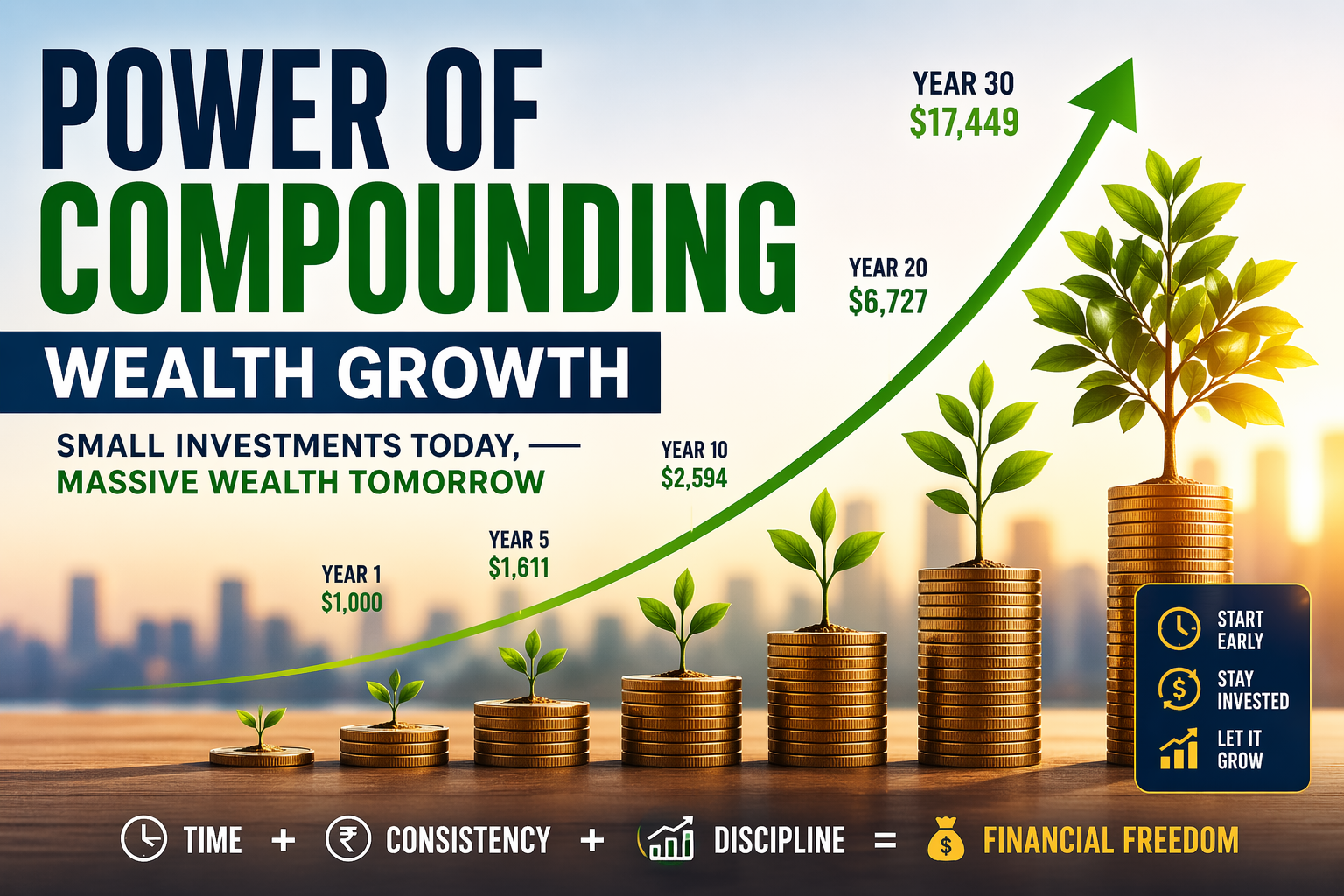
1. Introduction: Why Compounding Is Called the “Eighth Wonder of the World”
Power of Compounding is the most powerful wealth-building principle that turns small investments into massive wealth over time. There’s a famous quote often attributed to Albert Einstein:
“Compound interest is the eighth wonder of the world. He who understands it, earns it. He who doesn’t, pays it.”
Whether or not he said it exactly that way, the message is timeless.
Compounding is the single most powerful force in long-term wealth creation. It quietly transforms small, consistent investments into life-changing sums — not overnight, not in a year, but over decades.
If you truly understand compounding, you will:
- Invest earlier
- Stay invested longer
- Avoid panic selling
- Think in decades, not days
And over 30 years? The results can be extraordinary.
This guide will:
- Define and explain every key term
- Break down the mathematics
- Show real-world case studies
- Demonstrate 30-year wealth examples
- Compare early vs late investing
- Reveal common mistakes
- Connect compounding to real market history
Let’s start from the foundation. Research by Vanguard Group shows that long-term investing benefits significantly from compounding.
2. What Is Compounding?
📌 Definition
The power of compounding is the process of earning returns not only on your original investment but also on the returns your investment has already generated. Over long periods, these returns compound upon each other, creating exponential wealth growth and making time one of the most valuable factors in investing.
Compounding is the process where:
Your investment earns returns, and then those returns start earning their own returns.
In simple words:
Money → earns profit → that profit also earns profit → and so on.
This creates exponential growth.
3. Key Terms Explained
1. Principal
The principal is your original investment amount.
Example:
If you invest $10,000, that $10,000 is your principal.
2. Interest (or Return)
Interest is the money earned on your principal.
If you earn 10% annually:
- 10% of $10,000 = $1,000
Your total becomes:
$11,000
3. Compound Interest
Compound interest is interest earned on both your original investment and any previously earned interest. Unlike simple interest, it creates a snowball effect where your money earns returns, and those returns continue generating additional returns over time.
In year 2, you earn interest on:
- The original $10,000
- PLUS the $1,000 profit
So now:
10% of $11,000 = $1,100
Total = $12,100
That extra $100 is compounding in action.
4. Rate of Return
The rate of return is the percentage gain on your investment.
Example:
- 7% = conservative long-term bond return
- 10% = historical stock market average
- 12% = strong equity portfolio
Over 30 years, even 2% difference changes everything.
5. Time Horizon
Time horizon means how long your money stays invested.
Compounding loves time.
30 years > 20 years > 10 years
Time matters more than the amount invested.
6. Frequency of Compounding
Compounding can occur:
- Annually
- Quarterly
- Monthly
- Daily
The more frequent, the faster growth (though the difference becomes smaller over long periods).
4. The Mathematics of Compounding
The Rule of 72 is a simple formula used to estimate how long an investment takes to double. Divide 72 by your expected annual rate of return to estimate the approximate number of years required for your money to double.
The compound interest formula:
[
A = P(1 + r)^t
]
Where:
- A = Final Amount
- P = Principal
- r = Rate of return
- t = Time (years)
Let’s break this down clearly.
If:
- P = $10,000
- r = 10% (0.10)
- t = 30 years
Then:
[
A = 10,000(1.10)^{30}
]
[
A = 10,000 × 17.45
]
[
A ≈ 174,500
]
$10,000 becomes $174,500.
You didn’t add more money.
Time did the heavy lifting.
To understand compounding in depth, you can learn more from Investopedia.
5. Factors That Influence Compounding
Although compound growth follows a mathematical formula, the final outcome depends on several important variables. Two investors starting with the same amount of money can end up with dramatically different results because of differences in investment returns, time horizon, fees, taxes, and investing behavior. Understanding these factors helps you maximize the power of compounding over the long term.
Rate of Return
- Annual return drives long-term growth.
- Small increases have a huge impact over decades.
- Compare 6%, 8%, 10%, and 12% returns.
- Higher expected returns usually come with greater investment risk.
- Long-term investors should focus on sustainable, diversified returns rather than chasing unrealistic performance.
Time Invested
Time is the most powerful driver of compounding because every additional year allows previous investment gains to generate new gains. The longer your money remains invested, the more exponential its growth becomes, even if annual returns remain unchanged.
- Time is the most powerful component of compounding.
- Every additional year allows previous gains to generate new gains.
- The first decade often feels slow.
- Growth accelerates after 20–30 years because returns are earned on a much larger balance.
- Delaying investing by even a few years can significantly reduce long-term wealth.
Investment Frequency
- Monthly investing
- Bi-weekly investing
- Quarterly investing
- Annual investing
- Dollar-cost averaging
- Why regular contributions can improve investing discipline and help build wealth over time.
Dividend Reinvestment
Dividend reinvestment means using dividend payments to purchase additional shares instead of taking the cash. Those new shares generate future dividends, creating a powerful compounding cycle that can significantly increase long-term investment returns.
- Cash dividends
- Automatic dividend reinvestment
- Buying additional shares
- Snowball effect
- Total return versus price return
- Why reinvesting dividends has historically contributed significantly to long-term equity returns.
Taxes
- Capital gains taxes
- Dividend taxes
- Tax drag
- Tax-deferred accounts
- Tax-free accounts
- Why reducing annual taxes can leave more money invested and compounding.
Fees
- Expense ratios
- Mutual fund fees
- ETF fees
- Advisory fees
- Trading costs
- How a seemingly small annual fee difference can reduce portfolio value substantially over decades.
Inflation
- Nominal returns versus real returns.
- Purchasing power.
- Inflation reduces what your future money can buy.
- Long-term investing should aim to outpace inflation.
- Why investors should evaluate real wealth growth, not just account balances.
6. Real Wealth Example #1: One-Time Investment Over 30 Years
Scenario:
Rahul invests $20,000 at age 30.
He earns 10% annually.
He never adds more money.
After 30 years:
[
20,000 × (1.10)^{30}
]
= 20,000 × 17.45
= $349,000
He invested only $20,000.
He earned $329,000 from compounding alone.
That’s the power of exponential growth.
7. Real Wealth Example #2: The Power of Staying Invested
Begin by explaining that many investors believe success depends on buying at exactly the right time. In reality, long-term wealth is more often created by remaining invested through different market conditions rather than repeatedly attempting to predict short-term price movements. Compounding needs uninterrupted time to work, and every unnecessary exit from the market interrupts that process.
Why Staying Invested Matters
Explain that investment markets naturally experience periods of growth, corrections, bear markets, and recoveries. These fluctuations are normal and have occurred throughout financial history. Investors who remain invested allow their portfolios to participate in both recoveries and future growth, while those who frequently move in and out of the market risk missing some of the strongest performing periods.
Key ideas:
- Market declines are temporary.
- Recoveries are often rapid.
- Long-term investors benefit from both downturns and recoveries.
- Time in the market generally contributes more to long-term wealth than attempts to perfectly time market entry and exit.
Investor A vs. Investor B
Present a simple comparison.
Investor A
- Invests once.
- Maintains a diversified portfolio.
- Reinvests dividends.
- Ignores short-term market headlines.
- Holds investments for 30 years.
Investor B
- Invests the same amount.
- Frequently buys and sells based on news and emotions.
- Moves to cash during market declines.
- Waits for the “perfect” time to reinvest.
- Misses portions of market recoveries.
Both investors begin with the same capital, yet Investor A generally accumulates greater long-term wealth because uninterrupted compounding allows investment gains to continue building on previous gains.
The Cost of Missing the Best Market Days
Explain that some of the strongest daily market gains historically have occurred shortly after periods of significant declines. Investors who exit the market during uncertainty may miss these recovery days, reducing long-term portfolio growth.
Important concepts:
- Recoveries often begin unexpectedly.
- Missing only a small number of strong market days can noticeably reduce long-term returns.
- Staying invested increases the likelihood of participating in both recoveries and future growth.
Avoid exact numerical statistics unless you plan to cite a reliable source.
8. Case Study: Early Investor vs Late Investor
Person A: Starts at 25
Invests $400/month
Stops at 35 (only 10 years investing)
Leaves money untouched until 55
Total invested:
$400 × 12 × 10 = $48,000
Value at 55 (10% return):
≈ $750,000
Person B: Starts at 35
Invests $400/month
Continues until 55 (20 years investing)
Total invested:
$400 × 12 × 20 = $96,000
Value at 55:
≈ $505,000
Person A invested HALF the money.
But ended with MORE wealth.
Why?
Because time > contribution size.
9. Real Market Example: S&P 500 Over 30 Years
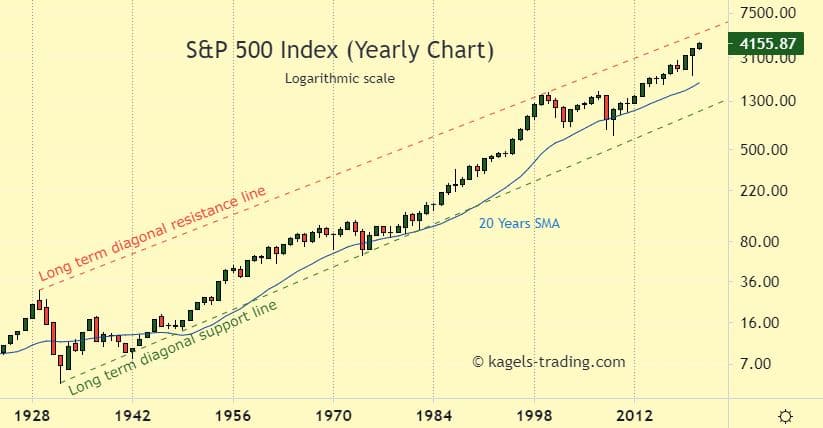
The S&P 500 has returned approximately 9–10% annually over long periods.
If someone invested:
$10,000 in 1993
By 2023:
It would be worth roughly $170,000–$200,000 (with dividends reinvested).
This includes:
- Dot-com crash
- 2008 financial crisis
- COVID crash
Compounding works despite volatility.
10. Why Compounding Becomes Explosive After 20 Years
📊 Growth Comparison Table: Power of Compounding Over Time
| Years | Investment Value (₹1,00,000 @ 10%) | Growth | Insight |
|---|---|---|---|
| 10 Years | ₹2,59,000 | +₹1,59,000 | Slow but steady growth phase |
| 20 Years | ₹6,72,000 | +₹5,72,000 | Compounding starts accelerating |
| 30 Years | ₹17,44,000 | +₹16,44,000 | Explosive growth phase |
This table clearly demonstrates the power of compounding and how long-term investing creates exponential wealth.
📈 Key Takeaways
- First 10 years build the foundation of compounding
- Maximum wealth is created in the last 10 years
- Growth from 20 → 30 years alone is massive
- This clearly shows the power of compounding over time
🔹 The hidden truth
Compounding doesn’t show big results immediately. It works quietly in the background for years before suddenly creating massive growth.
🔹 First 10 years feel slow
In the early years, returns are calculated on a smaller amount, so growth looks limited. Many people lose patience here and stop investing.
🔹 Years 20–30 feel unbelievable
After a long period, your investment base becomes large. Now even small percentage returns generate huge gains, making growth look very fast.
🔹 Example: $100,000 at 10%
This example shows how the same investment grows over time. The return rate stays the same, but the amount increases dramatically due to compounding.
🔹 Year 10: $259,000
In the first decade, your money grows steadily but not dramatically. This phase builds the foundation for future growth.
🔹 Year 20: $672,000
By 20 years, growth becomes faster because returns are now applied to a much larger amount.
🔹 Year 30: $1,744,000
In the final decade, growth accelerates significantly. The investment more than doubles due to compounding.
🔹 Growth from year 20–30 alone = over $1 million
Most of the wealth is created in the last 10 years. This shows that patience is critical to fully benefit from compounding.
🔹 Compounding accelerates over time
The longer you stay invested, the faster your money grows. Time increases the speed and power of compounding exponentially.
11. Dividends: The Secret Multiplier
🔹 What are dividends?
Dividends are a portion of a company’s profits paid to shareholders. When you reinvest them (buy more shares), those new shares also start earning returns—this boosts compounding over time.
🔹 Why reinvesting dividends matters
Instead of taking dividends as cash, reinvesting increases your total investment automatically. Over 20–30 years, this creates a snowball effect, significantly increasing your final wealth.
🔹 Example companies with strong dividend history
- Coca-Cola
Known for consistently paying and increasing dividends for decades, making it a favorite for long-term investors. - Johnson & Johnson
A stable healthcare giant with a strong track record of reliable and growing dividend payments. - Procter & Gamble
Offers steady dividends due to its strong global brands and consistent cash flow.
🔹 Impact on total returns
A large portion of long-term stock market returns comes from reinvested dividends, not just price growth. Ignoring dividends means missing a major part of wealth creation.
🔹 What happens if you don’t reinvest?
If you spend dividends instead of reinvesting, your compounding slows down. Over 30 years, this can reduce your final portfolio value by a huge margin (sometimes 30–50% less).
12. The Dark Side: Compounding Works Against You Too
🔹 Compounding is not always positive
Compounding works both ways—if you earn returns, it builds wealth, but if you owe money, it increases your debt. Interest keeps getting added to your outstanding balance, making it grow faster over time.
🔹 Credit card debt
Credit cards usually have very high interest rates (18–30%). If you don’t pay the full amount, interest is added monthly, and you start paying interest on interest—causing your debt to grow rapidly.
🔹 Personal loans
Personal loans also charge interest, often higher than home loans. If EMIs are delayed or unpaid, penalties and compounded interest increase the total repayment amount significantly.
🔹 Mortgages (home loans)
Home loans have lower interest rates, but the long duration (15–30 years) means you pay a large amount of total interest. Early years mostly go toward interest, not principal, due to compounding.
🔹 Example: $10,000 credit card debt at 20%
At 20% annual interest, your debt grows quickly if unpaid. Within 3–4 years, the amount can double because interest keeps compounding on the growing balance.
🔹 What is negative compounding?
Negative compounding means debt increasing over time instead of wealth. The longer you delay repayment, the harder it becomes to clear the balance.
🔹 Why understanding this matters
Knowing how compounding works on debt helps you avoid financial traps. Paying dues early and avoiding high-interest debt can save you from long-term financial stress.
13. Inflation vs Compounding
🔹 What is inflation?
Inflation means the general rise in prices over time. As prices increase, the same amount of money buys fewer goods and services than before.
🔹 Inflation reduces purchasing power
If inflation is high, your money’s value decreases. For example, ₹100 today may only buy goods worth ₹70–₹80 in the future.
🔹 Average inflation (~2–3%)
In many stable economies, inflation averages around 2–3% annually. Even at this rate, money loses significant value over long periods like 20–30 years.
🔹 If you don’t invest
Keeping money idle (like in cash or low-interest savings) means it doesn’t grow enough to beat inflation. Over time, your real wealth actually decreases.
🔹 Investing at 8–10% returns
If your investments earn 8–10% annually, you are growing faster than inflation. This helps increase your actual (real) wealth, not just nominal numbers.
🔹 Real wealth growth
Real wealth = returns after adjusting for inflation. For example, 10% return minus 3% inflation = ~7% real growth, which increases your purchasing power over time.
You outpace inflation and grow real wealth.
14. Building Wealth with the Power of Compounding
Investors who consistently save, reinvest dividends, and remain invested for several decades give compounding enough time to produce exponential growth. While the exact outcome depends on investment returns, contribution amounts, and market performance, the underlying principle remains the same: time is the greatest multiplier.
14.1 Why Consistency Matters
successful investing is less about making perfect decisions and more about maintaining a disciplined investment habit over many years. Consistent investing allows new contributions and accumulated returns to work together through compounding, even during periods of market volatility.
Key points to include:
- Invest regularly regardless of market conditions.
- Avoid trying to time market highs and lows.
- Small, repeated investments often outperform irregular large investments made inconsistently.
- Dollar-cost averaging encourages disciplined investing and reduces emotional decision-making.
Include an internal link to How Compound Interest Turns Small Investments into Millions for readers wanting practical contribution scenarios.
14.2 Why Time Matters
Emphasize that time is the single greatest multiplier in compounding.
- Every additional year increases the base on which future returns are earned.
- The first decade often appears slow because the portfolio is still relatively small.
- After 20–30 years, returns on accumulated gains begin to exceed annual contributions.
- Starting early provides a significant advantage, even when initial contributions are modest.
14.3 Why Reinvesting Matters
Explain how reinvesting earnings strengthens compounding.
- Dividend reinvestment plans (DRIPs).
- Reinvesting bond interest.
- Reinvesting rental income from investment properties.
- Rolling investment gains back into the portfolio instead of withdrawing them.
14.4 Why Patience Matters
compounding rewards investors who remain committed through multiple market cycles.
- Market downturns are a normal part of long-term investing.
- Emotional reactions such as panic selling interrupt compounding.
- Wealth accumulation usually appears gradual before becoming more noticeable later.
- Long-term success is often driven by discipline rather than exceptional investment skill.
15. Real-Life Inspired Case Study: Warren Buffett



Warren Buffett started investing as a teenager.
🔹 Started investing as a teenager
Warren Buffett began investing at a very young age, around 11 years old. Starting early gave him a massive advantage, allowing compounding to work for a much longer time.
🔹 Long time horizon
He stayed invested for over 70 years, which is the biggest reason for his wealth. The longer your money stays invested, the more powerful compounding becomes.
🔹 High return (~20% historically)
Buffett achieved an average return of around 20% annually through smart investing. Even a slightly higher return rate can dramatically increase wealth over long periods.
🔹 Letting compounding work for 70+ years
Instead of frequently buying and selling, he held investments for decades. This allowed his returns to continuously compound without interruption.
🔹 Most wealth came AFTER age 50
A large portion of Buffett’s wealth was created later in life. This shows that compounding accelerates significantly in the later years.
🔹 Time + return = exponential growth
His success is a combination of long time and strong returns. Together, they created exponential growth, turning small early investments into massive wealth.
For official investor education, visit U.S. Securities and Exchange Commission.
16. Common Myths About the Power of Compounding
Myth 1
Compounding only works for rich people.
Reality:
Even small investments can grow substantially when given enough time.
Myth 2
You need perfect market timing.
Reality:
Time in the market matters far more than timing the market.
Myth 3
Compounding produces quick results.
Reality:
Compounding rewards patience and usually accelerates after decades.
Myth 4
Missing one year doesn’t matter.
Reality:
Interrupting compounding can reduce long-term returns significantly.
17. The 30-Year Wealth Comparison Table
| Strategy | Monthly Investment | Return | 30-Year Value |
|---|---|---|---|
| Conservative | $500 | 6% | ~$500,000 |
| Balanced | $500 | 8% | ~$750,000 |
| Growth | $500 | 10% | ~$1,130,000 |
| Aggressive | $500 | 12% | ~$1,750,000 |
A 4% difference more than triples wealth.
18. The Psychological Challenge
Compounding requires:
🔹 Patience
Compounding takes time to show real results. In the early years, growth looks slow, so you need patience to stay invested and let your money grow over decades.
🔹 Discipline
Regular investing (monthly or yearly) requires consistency, even when markets are uncertain. Discipline helps you continue investing without skipping or timing the market.
🔹 Emotional control
Markets go up and down, and emotions like fear and greed can lead to bad decisions. Controlling emotions helps you avoid panic selling or impulsive buying.
🔹 Markets crash
Stock markets experience crashes and corrections regularly. These are normal and temporary, but they can scare investors who are not prepared.
🔹 News panics
Media often exaggerates negative news, creating fear in the market. This can influence investors to make decisions based on short-term noise instead of long-term goals.
🔹 People sell
During downturns, many investors sell their investments to avoid further losses. This locks in losses and prevents them from benefiting when the market recovers.
🔹 Long-term investors win
Investors who stay invested through ups and downs benefit from recovery and long-term growth. Time in the market is more important than timing the market.
🔹 Quote by Warren Buffett
“The stock market transfers money from the impatient to the patient.”
This means those who stay calm and invested over time are more likely to build wealth than those who react emotionally.
19. Key Lessons From 30 Years of Compounding
🔹 Start early
The earlier you begin investing, the more time compounding has to work. Even small amounts can grow into large wealth over decades.
🔹 Stay consistent
Regular investing (monthly or yearly) builds momentum. Consistency matters more than timing the market or investing large amounts occasionally.
🔹 Reinvest dividends
Instead of taking dividends as cash, reinvest them to buy more shares. This increases your investment base and accelerates compounding.
🔹 Avoid high-interest debt
High-interest debt (like credit cards) grows quickly due to compounding against you. Paying it off early protects your financial growth.
🔹 Ignore short-term noise
Market fluctuations and daily news can distract you. Focus on long-term goals instead of reacting to short-term ups and downs.
🔹 Increase investments as income grows
As your salary increases, gradually invest more. This boosts your total contributions and significantly increases long-term wealth.
🔹 Focus on long-term returns
Short-term gains are unpredictable, but long-term returns are more stable. Staying invested for years allows compounding to deliver real results.
20. Final Thought: Compounding Is Slow Then Sudden
🔹 Compounding feels boring for 10–15 years
In the beginning, growth looks small because returns are building on a smaller base. Many people quit here because they don’t see big results early.
🔹 The growth curve turns vertical
After many years, your returns start earning larger returns, causing rapid growth. This creates a steep upward curve where wealth increases quickly.
🔹 That’s when wealth becomes real
Most of your money is built in the later years, not the early ones. This is when you truly see the power of long-term investing.
🔹 Not because you worked harder
Your effort doesn’t increase significantly, but your money keeps growing. Wealth comes from time in the market, not extra hard work.
🔹 But because your money worked longer
The longer your money stays invested, the more it compounds. Time is the biggest factor in multiplying wealth.
Compounding feels boring for 10–15 years.
Then one day you look back and realize:
The growth curve turned vertical.
That’s when wealth becomes real.
Not because you worked harder —
But because your money worked longer.
21. Common Mistakes That Reduce the Power of Compounding
- Starting too late
- Selling during market crashes
- Ignoring dividend reinvestment
- Paying high investment fees
- Trying to time the market
- Holding too much cash
- Taking unnecessary investment risks
22. Frequently Asked Questions (FAQs)
Q1: What is the power of compounding?
The power of compounding is the process of earning returns on both your investment and previously earned returns over time.
Q2: How long does compounding take to show results?
Compounding usually shows noticeable results after 10–15 years and becomes powerful after 20+ years.
Q3: Is compounding safe?
Compounding itself is safe, but investment risk depends on asset type. Diversified long-term investing reduces risk.
23. The Ultimate Truth
If you invest:
- Consistently
- Patiently
- For 30 years
Compounding can turn ordinary income into extraordinary wealth.
It is not luck.
It is mathematics + discipline + time.
And the best part?
You don’t need to be brilliant.
You just need to start.
Want to see exactly how small monthly investments can grow into $1 million? Read our guide How Compound Interest Turns Small Investments into Millions (2026) for practical investment scenarios, contribution tables, and real-world calculations.
Stocks vs ETFs vs Mutual Funds: What’s Best for Long-Term Wealth? (Complete 2026 Guide)