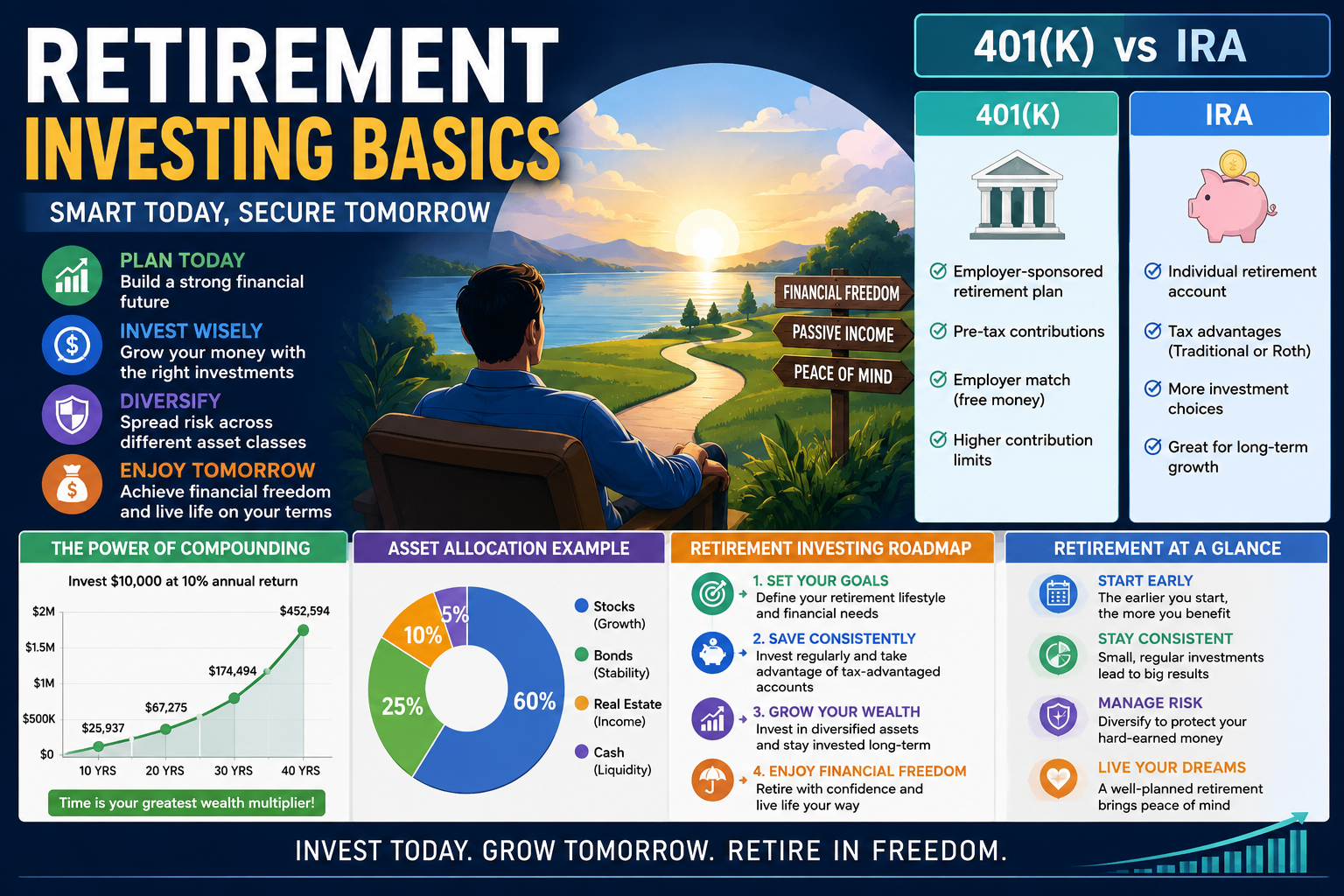
Retirement Investing Basics: The Complete Beginner’s Guide
Retirement investing basics are the foundation of long-term financial security, wealth creation, and financial independence. Whether you live in the United States, Canada, the United Kingdom, Australia, or another developed economy, understanding retirement investing basics can help you build a portfolio that generates income long after you stop working.
Many people believe retirement planning starts in their 50s or 60s. In reality, the most successful retirement investors begin decades earlier. Time—not just money—is the biggest advantage you have because of the power of compound growth.
Imagine reaching retirement without worrying about monthly bills, depending on government pensions, or relying on family members for financial support. Instead, your investments continue working for you by generating dividends, capital appreciation, and passive income. That is the ultimate goal of retirement investing.
This comprehensive guide explains every important concept in simple language. You’ll learn:
- What retirement investing really means
- Why retirement investing is essential
- How compound growth builds wealth
- How inflation affects your purchasing power
- The relationship between risk and return
- Why asset allocation matters
- Practical examples and beginner-friendly case studies
Whether you’re investing your first $100 or managing a six-figure portfolio, mastering these retirement investing basics can help you make better financial decisions for decades to come.
Retirement investing is one of the most important steps toward achieving long-term financial security. If you’re completely new to investing, start with our Start Investing guide before learning retirement-specific strategies.
This guide is designed for educational purposes and reflects widely accepted long-term investing principles. Throughout the article, you’ll find practical retirement examples featuring beginners, mid-career professionals, and retirees to illustrate how investing concepts can apply in real-world situations. These examples are illustrative only and are not personalized financial advice.
What Is Retirement Investing?
Retirement investing is the process of investing money throughout your working years so it grows into a large portfolio capable of supporting your lifestyle after retirement.
Unlike ordinary saving, retirement investing focuses on long-term growth rather than short-term security.
When you deposit money into a savings account, it earns relatively low interest. While savings accounts are useful for emergencies, they usually do not generate returns that consistently outpace inflation over several decades.
Retirement investing, on the other hand, uses assets such as:
- Stocks
- Bonds
- Mutual funds
- Index funds
- Exchange-Traded Funds (ETFs)
- Real estate
- Retirement accounts
These investments aim to grow your money faster than inflation while generating wealth over many years.
Think of retirement investing as planting a tree.
- Saving money is like storing seeds in a box.
- Investing is planting those seeds so they grow into a forest.
The earlier you plant, the larger your forest becomes.
For an introduction to investing fundamentals and investor protection, explore the educational resources from the U.S. Securities and Exchange Commission (SEC) and Investor.gov.
Key Retirement Investing Terms
Before moving forward, it’s important to understand some essential financial terms.
Retirement
Retirement is the stage of life when you stop working full-time and rely on investments, pensions, savings, or other income sources instead of employment income.
For many people, retirement occurs between ages 60 and 70, but financial independence can allow earlier retirement.
Investing
Investing means purchasing assets that have the potential to increase in value or generate income over time.
Examples include:
- Buying shares of companies
- Purchasing index funds
- Investing in bonds
- Owning rental properties
Unlike spending money, investing allows your money to work on your behalf.
Return
A return is the profit earned from an investment.
Returns generally come from three sources:
- Capital appreciation (price increases)
- Dividends
- Interest payments
For example:
You buy stock worth $1,000.
One year later:
- Stock value = $1,080
- Dividend received = $20
Total investment value = $1,100
Total return = 10%.
Passive Income
Passive income is money earned without actively working every day.
Examples include:
- Dividend payments
- Rental income
- Bond interest
- Investment withdrawals during retirement
One major objective of retirement investing is converting employment income into passive income.
Mini Glossary of Retirement Investing Terms
Understanding these common financial terms will make it easier to follow the retirement investing concepts explained throughout this guide.
Diversification
Diversification is the practice of spreading your investments across different asset classes, industries, companies, and geographic regions to reduce the impact of poor performance from any single investment. While diversification cannot eliminate investment risk, it can help reduce overall portfolio volatility.
Volatility
Volatility refers to how much the price of an investment rises or falls over time. Investments with high volatility, such as individual stocks, often experience larger price swings, while lower-volatility investments, such as high-quality bonds, generally have more stable prices. Higher volatility does not always mean higher long-term returns, but it usually indicates greater short-term risk.
Liquidity
Liquidity measures how quickly an investment can be converted into cash without significantly affecting its market value. Cash and publicly traded stocks are generally considered highly liquid, whereas real estate and certain private investments may take longer to sell.
Asset Allocation
Asset allocation is the process of dividing your investment portfolio among different asset classes, such as stocks, bonds, cash, and real estate. A well-planned asset allocation helps balance potential returns with an investor’s risk tolerance, financial goals, and investment time horizon.
Capital Gains
Capital gains are the profits earned when an investment is sold for more than its purchase price. Depending on your country and holding period, capital gains may be subject to different tax rules. Long-term investors often benefit from favorable tax treatment compared with short-term trading in some jurisdictions.
Expense Ratio
An expense ratio is the annual fee charged by a mutual fund or exchange-traded fund (ETF) to cover operating and management expenses. It is expressed as a percentage of the fund’s assets. Lower expense ratios can improve long-term investment returns because less of your money is used to pay ongoing management costs.
Tax-Deferred
A tax-deferred investment account allows your investments to grow without paying taxes on earnings each year. Taxes are generally paid when money is withdrawn during retirement, subject to the rules of the specific account and your country’s tax laws. Examples include many employer-sponsored retirement plans and Traditional IRAs in the United States.
Tax-Free
A tax-free account allows qualified investment earnings and withdrawals to be received without additional taxes, provided certain eligibility requirements are met. Examples include Roth IRAs in the United States and Stocks and Shares ISAs in the United Kingdom, subject to applicable regulations and contribution limits.
Rebalancing
Rebalancing is the process of adjusting your portfolio back to its intended asset allocation after market movements change the weight of different investments. For example, if stocks grow faster than bonds, rebalancing may involve selling a portion of the stock holdings and buying more bonds to restore the original allocation. Many long-term investors review their portfolios once or twice a year to determine whether rebalancing is appropriate.
Why Retirement Investing Is Important
Retirement investing isn’t simply about becoming wealthy.
It’s about protecting your future.
Modern life expectancy continues increasing, meaning many retirees may need their investments to support them for 20–35 years after leaving the workforce.
Without proper investing, retirees often depend on:
- Salary (which stops after retirement)
- Government pensions
- Social Security
- Family support
- Personal savings
Each of these has limitations.
Investments provide another source of financial stability.
Benefits
Benefits include:
- Financial independence
- Long-term wealth growth
- Protection against inflation
- Lower financial stress
- Greater lifestyle flexibility
- Legacy planning for future generations
The biggest advantage retirement investors have is time. Learn more about the Compound Interest effect and why building an Emergency Fund should come before aggressive investing.
Example: Saving vs Investing
Suppose Sarah saves $500 every month for 30 years.
Scenario A: Savings Account
Average annual interest: 2%
After 30 years: Approximately $246,000
Scenario B: Stock Index Fund
Average annual return: 9%
After 30 years: More than $900,000
Although Sarah invested exactly the same amount of money, higher long-term returns dramatically increased her retirement savings.
This illustrates why understanding retirement investing basics is so important.
Retirement investing focuses on long-term wealth creation rather than simply accumulating cash. If you’re unsure how investing differs from saving, read our Saving vs Investing guide. Building retirement wealth is also an essential part of a broader Wealth Building Guide.
Official resources: Investor education materials from the SEC and Investor.gov explain how long-term investing, diversification, and compound growth can support retirement planning.
Historical market returns do not guarantee future performance. Actual investment results vary depending on market conditions, investment choices, fees, taxes, and the investor’s time horizon.
Core Concepts Every Investor Must Understand
Successful retirement investing is built upon several fundamental principles. Learning these concepts first makes every future investment decision easier.
1. Compounding
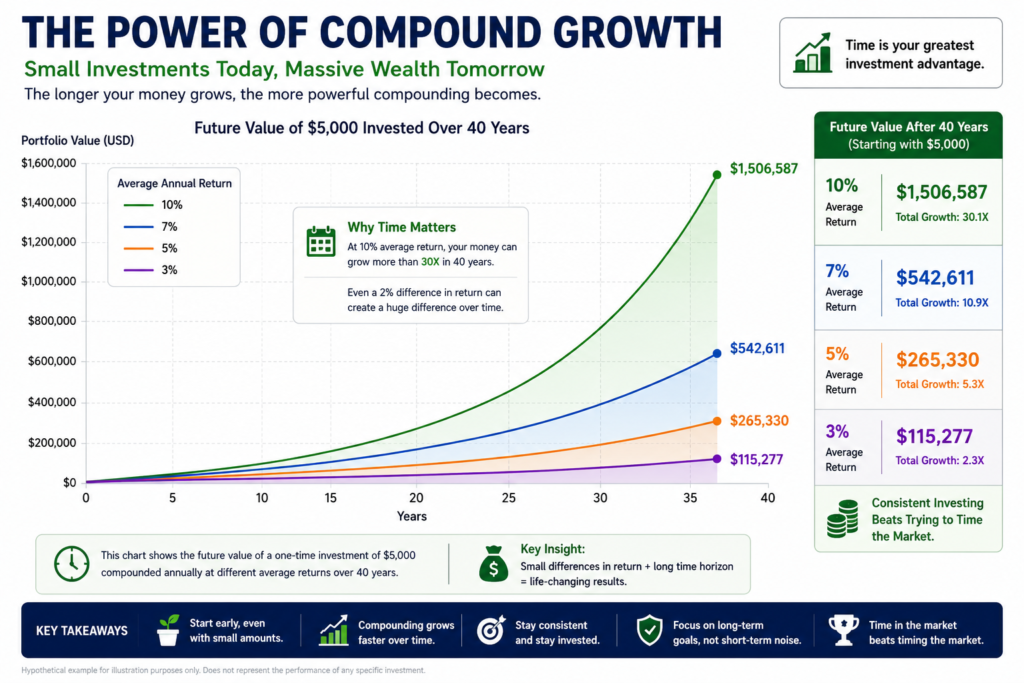
Compounding is often called the eighth wonder of the world because it allows investment earnings to generate additional earnings.
Instead of earning returns only on your original investment, you also earn returns on previous profits.
The basic compound growth relationship is illustrated below:
genui{“finance_accounting_operations_learning_block”:{“type_id”:”COMPOUND_INTEREST”,”content”:”FV=PV(1+r)^n”}}
Here’s a simple example.
Initial investment: $10,000
Annual return: 10%
Year 1: $11,000
Year 2: 10% return on $11,000
Portfolio: $12,100
Year 3: Portfolio: $13,310
Notice something important.
The investment isn’t increasing by exactly $1,000 each year.
The annual growth becomes larger because each year’s earnings begin earning their own returns.
This is called compound growth.
Why Starting Early Matters
Consider two investors.
Emma
Starts investing at age 25.
Invests $400 every month.
Stops investing at age 35.
Many investors combine compounding with Dollar-Cost Averaging for consistent long-term growth.
James
Starts investing at age 35.
Invests $400 monthly until age 65.
Even though James invests much more money overall, Emma may still finish with similar—or even greater—wealth because her investments had an additional decade to compound.
Time is often more valuable than the amount invested.
2. Inflation
Inflation is the gradual increase in prices over time.
As inflation rises, each dollar buys fewer goods and services.
Suppose:
Today:
A weekly grocery bill costs: $100
Twenty years later:
The same groceries might cost: $180–$220
Nothing changed except purchasing power.
That means money sitting in cash slowly loses value.
Why Inflation Matters
Imagine keeping $500,000 in cash for retirement.
If inflation averages 3% annually for twenty years, the purchasing power of that money declines substantially.
Although your account balance remains the same, your lifestyle may not.
This is why retirement portfolios generally include growth investments capable of exceeding inflation over long periods.
3. Risk vs Return
Every investment carries some level of risk.
Generally speaking:
Higher potential returns come with higher risk.
Lower risk usually means lower expected returns.
For example:
| Investment | Risk | Potential Return |
|---|---|---|
| Savings Account | Very Low | Low |
| Government Bonds | Low | Moderate |
| Corporate Bonds | Moderate | Moderate |
| Index Funds | Moderate | High (long term) |
| Individual Stocks | High | Very High or Very Low |
Understanding this relationship helps investors avoid unrealistic expectations.
A portfolio promising very high returns with zero risk simply doesn’t exist.
The goal is not eliminating risk.
The goal is managing it wisely.
Example
Imagine two investors.
Investor A places every dollar into one technology company.
Investor B owns 500 companies through an index fund.
If one company struggles, Investor B remains diversified.
Diversification reduces unnecessary risk.
Every investment involves some level of uncertainty. Learn more about Risk Management and the fundamentals of the Stock Market before choosing investments.
4. Asset Allocation
Asset allocation refers to dividing investments among different asset classes.
Rather than investing everything into one investment, investors spread money across multiple categories.
Common asset classes include:
- Stocks
- Bonds
- Cash
- Real Estate
- International Investments
Each behaves differently during changing economic conditions.
A diversified portfolio is generally more stable over long periods than a portfolio concentrated in a single investment.
Example Asset Allocation
Imagine a 35-year-old investor with a $100,000 retirement portfolio.
Instead of investing everything in technology stocks, they choose:
- 70% Global Stocks
- 20% Bonds
- 5% Real Estate Investment Trusts (REITs)
- 5% Cash
If stocks experience temporary declines, bonds and cash may help reduce overall portfolio volatility.
This balanced approach supports long-term investing while managing risk.
Asset allocation works together with Portfolio Diversification to reduce overall portfolio risk. Our dedicated Asset Allocation guide explains how to build an investment mix based on your age and goals.
Beginner-Friendly Example: Building a Retirement Portfolio
Imagine Emily, a 28-year-old software engineer earning $70,000 annually.
She decides to invest 15% of her salary every year.
Her plan includes:
- Contributing regularly to her employer-sponsored retirement account.
- Investing in a diversified index fund.
- Keeping an emergency fund separate from retirement savings.
- Increasing contributions whenever she receives a raise.
- Rebalancing her portfolio once a year.
Emily does not try to predict market highs and lows. Instead, she invests consistently over decades. While markets fluctuate in the short term, her disciplined approach allows compound growth to work in her favor.
This example highlights a key principle of retirement investing: consistency often matters more than perfection.
Retirement Accounts: Where Should You Invest?
A retirement account is a special investment account created by governments to help people save for retirement. These accounts usually offer tax benefits that encourage long-term investing.
Unlike a regular brokerage account, retirement accounts often allow investments to grow tax-deferred or tax-free, depending on the account type and local tax laws.
Let’s look at the most common retirement accounts used in Tier-1 countries.
1. 401(k) – United States
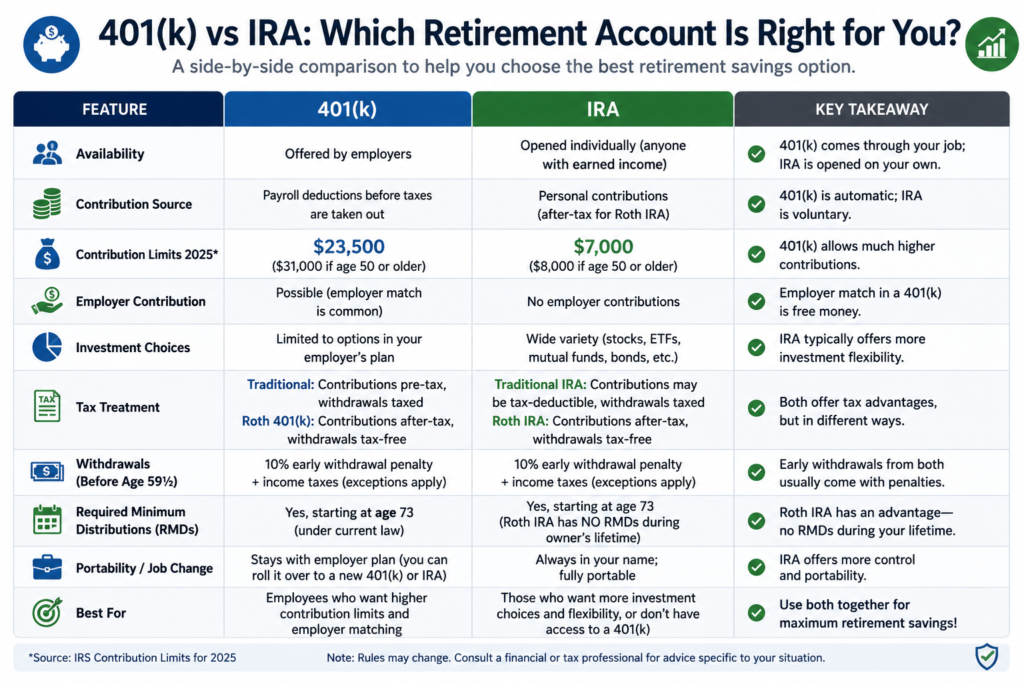
A 401(k) is one of the most popular employer-sponsored retirement plans in the United States. Employees contribute a portion of their salary before taxes are deducted, allowing investments to grow tax-deferred until retirement.
Key Features
- Offered through employers
- Automatic payroll deductions
- Tax-deferred investment growth
- Higher annual contribution limits than many personal retirement accounts
- Many employers provide matching contributions
What Is Employer Matching?
Employer matching means your employer contributes additional money to your retirement account when you contribute.
Example
Emma earns $80,000 annually.
She contributes 6% of her salary to her 401(k):
- Employee contribution: $4,800
- Employer matches 50%: $2,400
Total invested each year: $7,200
Employer matching is often described as “free money” because it increases your retirement savings without requiring additional work.
Advantages
- Immediate tax benefits
- Employer matching
- Automatic investing
- Long-term compound growth
Disadvantages
- Early withdrawals may incur taxes and penalties.
- Investment choices may be limited by the employer’s plan.
Official guidance: Contribution limits, withdrawals, and tax rules for employer-sponsored retirement plans are available from the Internal Revenue Service (IRS).
2. Individual Retirement Account (IRA)
An Individual Retirement Account (IRA) is a personal retirement account available in the United States.
Unlike a 401(k), it is opened independently rather than through an employer.
There are two main types.
Traditional IRA
Contributions may be tax-deductible today.
You generally pay taxes when withdrawing funds during retirement.
Best suited for:
- Individuals expecting a lower tax rate after retirement
- Those seeking an upfront tax deduction
Learn more: The IRS provides detailed guidance on eligibility, contribution limits, deductions, and withdrawal rules for Traditional IRAs.
Roth IRA
Contributions are made using after-tax income.
Qualified withdrawals during retirement are generally tax-free.
Best suited for:
- Younger investors
- Individuals expecting higher future tax rates
- Long investment horizons
Practical Example
James is 30 years old.
He contributes $500 per month to a Roth IRA.
After 35 years, his investment portfolio grows significantly through compound growth. Because contributions were made with after-tax dollars, qualified withdrawals in retirement are generally tax-free under current rules.
Official reference: Review the latest Roth IRA contribution limits and qualified withdrawal rules through the Internal Revenue Service (IRS).
3. Individual Savings Account (ISA) – United Kingdom
A Stocks and Shares ISA is one of the most popular investment accounts in the UK.
It allows investments to grow free from UK capital gains tax and dividend tax, subject to applicable contribution rules.
Features
- Tax-efficient investing
- Flexible withdrawals
- Suitable for long-term investing
- Wide investment choices
Investors commonly hold:
- Index funds
- Exchange-Traded Funds (ETFs)
- Mutual funds
- Individual shares
- Bonds
Example
Sarah invests £400 each month into a Stocks and Shares ISA.
Over 30 years, her investments grow through market appreciation while benefiting from the account’s tax advantages, helping her build a larger retirement portfolio.
Official UK guidance: The Financial Conduct Authority (FCA) and MoneyHelper provide educational resources on investing, ISAs, pensions, and retirement planning.
4. Superannuation – Australia
Australia’s Superannuation (Super) system is designed to help workers accumulate retirement savings throughout their careers.
Employers are generally required to contribute a percentage of eligible employees’ earnings into a Super account, with employees often able to make additional voluntary contributions.
Benefits
- Employer contributions
- Tax advantages
- Professional investment management
- Long-term retirement savings
Example
Michael earns AUD 90,000 annually.
His employer contributes to his Super fund, and Michael also makes voluntary contributions. Over several decades, these combined contributions and investment returns can create a substantial retirement balance.
Choosing the right retirement account is just as important as selecting investments. Compare the differences in our 401(k) vs IRA guide.
Official Australian guidance: The Australian Taxation Office (ATO) explains Superannuation contributions, tax benefits, and retirement rules.
Country-Specific Rules
Retirement accounts, contribution limits, withdrawal rules, employer benefits, and tax treatment vary significantly between countries and may change over time. Always verify the latest rules through your country’s official tax authority or retirement regulator before making financial decisions.
Retirement Account Comparison
| Account | Country | Main Benefit | Typical Tax Treatment | Employer Contribution |
|---|---|---|---|---|
| 401(k) | United States | Payroll retirement savings | Tax-deferred growth | Usually available |
| Traditional IRA | United States | Personal retirement account | Tax deduction now, tax later | No |
| Roth IRA | United States | Tax-free qualified retirement withdrawals | Tax paid before contribution | No |
| Stocks & Shares ISA | United Kingdom | Tax-efficient investing | Tax-free investment growth under current UK rules | No |
| Superannuation | Australia | Employer retirement system | Tax advantages within the Super system | Yes |
Types of Retirement Investments
Choosing the right retirement account is only half the process.
The next step is selecting investments that align with your goals, time horizon, and risk tolerance.
1. Stocks
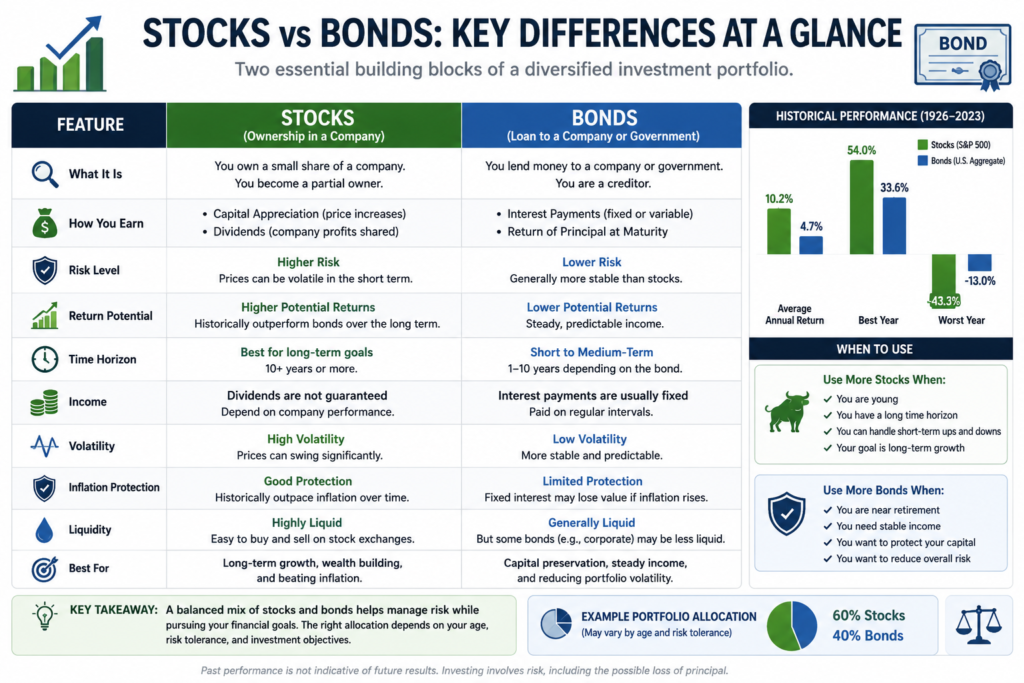
Stocks represent partial ownership in a company.
When you purchase shares, you become a shareholder and may benefit from:
- Share price appreciation
- Dividend income
Advantages
- High long-term growth potential
- Helps outpace inflation
- Suitable for younger investors with longer investment horizons
Risks
- Prices fluctuate significantly in the short term
- Individual companies can perform poorly or fail
Practical Example
Sophia invests $10,000 in a diversified portfolio of large, profitable companies. Although markets experience periodic downturns, her investments grow over the next 25 years as businesses expand and earnings increase.
Before buying individual shares, read our beginner-friendly Stock Market Basics guide.
2. Bonds
Bonds are loans made to governments or corporations.
In exchange, investors receive regular interest payments and repayment of the principal at maturity, provided the issuer meets its obligations.
Advantages
- Lower volatility than stocks
- Predictable income
- Can help stabilize a diversified portfolio
Risks
- Lower long-term returns than equities
- Bond prices can decline when interest rates rise
3. Mutual Funds
A mutual fund pools money from many investors and is managed by professional fund managers.
Mutual funds may invest in:
- Stocks
- Bonds
- Money market securities
- Mixed portfolios
Advantages
- Professional management
- Diversification
- Convenient for beginners
Disadvantages
- Management fees
- Performance depends on the fund’s strategy and manager
Learn how professionally managed funds work in our complete Mutual Funds Guide.
4. Index Funds
Index funds are designed to track the performance of a market index rather than trying to outperform it.
Examples include funds tracking broad stock market indexes.
Why Many Retirement Investors Prefer Index Funds
- Low management costs
- Broad diversification
- Passive investment approach
- Historically competitive long-term returns
Practical Example
David contributes $300 every month to a broad-market index fund for 35 years. By staying invested through market ups and downs and continuing regular contributions, he benefits from compounding and long-term market growth without needing to select individual stocks.
Index funds remain one of the most popular retirement investments. Read our Index Funds Guide or compare them with ETFs.
5. Real Estate
Real estate can play a valuable role in a retirement portfolio by providing both income and diversification.
Investments may include:
- Residential rental properties
- Commercial properties
- Real Estate Investment Trusts (REITs)
Advantages
- Rental income
- Potential property appreciation
- Diversification outside traditional stock and bond markets
Risks
- Higher maintenance costs
- Lower liquidity compared with publicly traded investments
- Property values can fluctuate
Comparison of Retirement Investment Types
| Investment | Growth Potential | Risk Level | Income Potential | Best For |
|---|---|---|---|---|
| Stocks | High | High | Moderate | Long-term growth |
| Bonds | Moderate | Low to Moderate | High | Stability and income |
| Mutual Funds | Moderate to High | Moderate | Moderate | Diversified investing |
| Index Funds | High | Moderate | Moderate | Long-term passive investing |
| Real Estate | Moderate to High | Moderate | High | Income and diversification |
Retirement Investing Strategies
A retirement investing strategy is a long-term plan that determines how you save, invest, and manage your portfolio throughout your working life. Instead of trying to predict short-term market movements, successful investors focus on consistency, diversification, and patience.
Below are some of the most widely used retirement investing strategies.
1. Buy and Hold Strategy
The Buy and Hold Strategy involves purchasing quality investments and keeping them for many years, regardless of short-term market fluctuations.
Rather than reacting to daily market news, investors stay focused on their long-term financial goals.
Why It Works
Historically, global stock markets have experienced periods of growth despite temporary declines, recessions, and market volatility. Investors who remain invested through these cycles often benefit from long-term compounding.
Practical Example
Emma, age 30, invests $500 every month into a diversified global index fund. During a market downturn, her portfolio temporarily declines by 20%. Instead of selling, she continues investing. Several years later, as markets recover, her portfolio reaches new highs because she stayed invested.
Key Lesson: Long-term discipline often produces better results than attempting to predict short-term market movements.
2. Dollar-Cost Averaging (DCA)
Dollar-Cost Averaging (DCA) means investing a fixed amount of money at regular intervals, regardless of market conditions.
For example, you might invest:
- $200 every week
- $500 every month
- $2,000 every quarter
When prices are lower, your fixed investment buys more shares. When prices are higher, it buys fewer shares. Over time, this helps average your purchase cost and reduces the emotional pressure of trying to “time the market.”
Example
James invests $400 every month into an index fund.
- January: Fund price = $40 → 10 shares purchased
- February: Fund price = $20 → 20 shares purchased
- March: Fund price = $50 → 8 shares purchased
Over time, James accumulates shares at different prices without worrying about short-term market fluctuations.
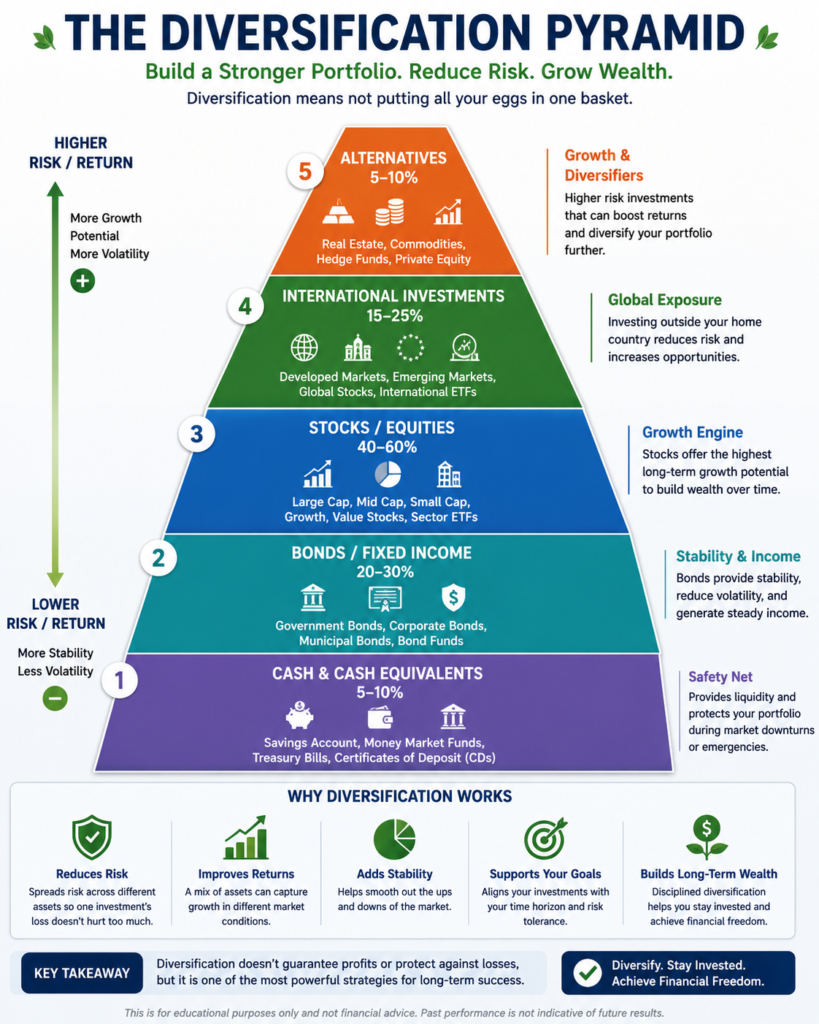
3. Diversification Strategy
Diversification means spreading your investments across different asset classes, industries, and geographic regions to reduce overall portfolio risk.
Instead of investing all your money in one company or one sector, you own a variety of investments.
A diversified retirement portfolio may include:
- Domestic stocks
- International stocks
- Government bonds
- Corporate bonds
- Real Estate Investment Trusts (REITs)
- Cash or cash equivalents
Example
David invests only in technology stocks.
Sarah invests in a diversified portfolio containing stocks, bonds, REITs, and international funds.
If technology stocks decline significantly, Sarah’s diversified portfolio is generally better positioned to absorb market volatility.
Comparison of Retirement Investing Strategies
| Strategy | Risk Level | Best For | Main Advantage |
|---|---|---|---|
| Buy and Hold | Moderate | Long-term investors | Maximizes long-term compound growth |
| Dollar-Cost Averaging | Low to Moderate | Beginners | Reduces market timing risk |
| Diversification | Moderate | All investors | Reduces portfolio risk |
| Index Fund Investing | Moderate | Passive investors | Low cost and broad market exposure |
| Portfolio Rebalancing | Moderate | Experienced investors | Maintains target asset allocation |
How Much Should You Save for Retirement?
One of the most common questions beginners ask is:
“How much money do I need for retirement?”
The answer depends on your:
- Current income
- Lifestyle
- Retirement age
- Expected expenses
- Investment returns
- Life expectancy
While every situation is different, financial planners often use general guidelines.
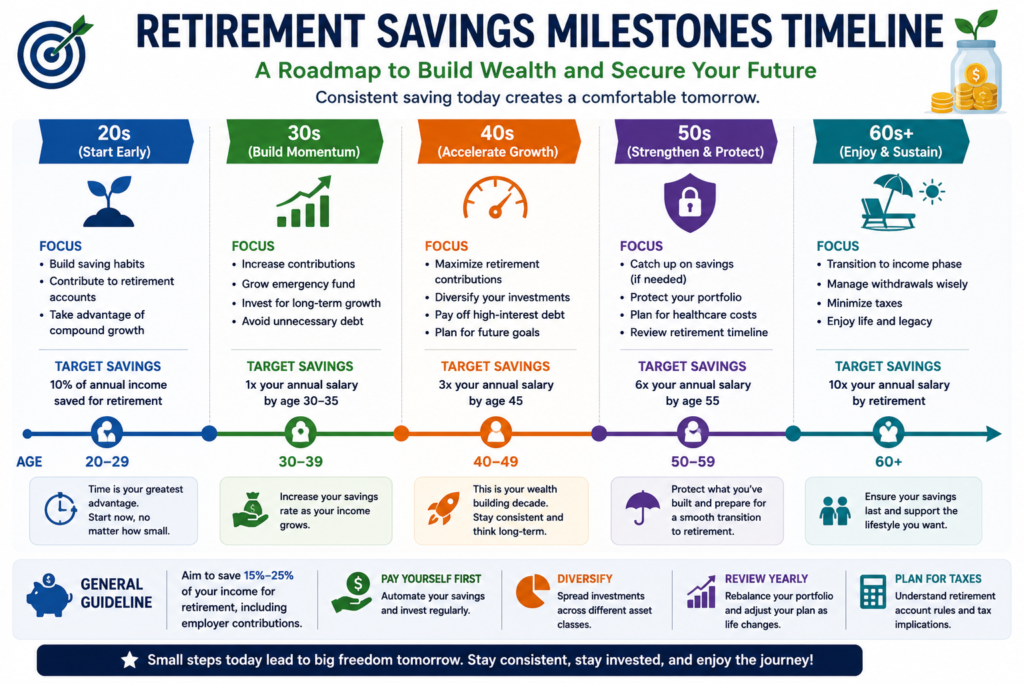
Rule of Thumb: Save 15%–25% of Your Income
Many financial experts recommend saving 15% to 25% of your annual income for retirement throughout your working years.
Example
Annual salary: $80,000
15% annual savings: $12,000
Monthly contribution: Approximately $1,000
Increasing your contribution whenever you receive a salary raise can significantly improve your retirement outcome without dramatically affecting your lifestyle.
The 25× Retirement Rule
A common guideline suggests accumulating approximately 25 times your expected annual retirement expenses.
Example
Expected annual retirement expenses: $60,000
Estimated retirement portfolio: $60,000 × 25 = $1.5 million
This guideline is closely associated with the widely discussed 4% withdrawal rule, which suggests that withdrawing around 4% of a diversified portfolio annually may support long-term retirement income in many historical market scenarios. However, it is a planning guideline—not a guarantee—and future market conditions may differ.
Your retirement target depends on your lifestyle goals. If your goal is early retirement, read our Financial Independence and FIRE Guide.
Savings Targets by Age Table
| Age | Suggested Retirement Savings Goal* |
|---|---|
| 30 | Approximately 1× annual salary |
| 40 | Approximately 3× annual salary |
| 50 | Approximately 6× annual salary |
| 60 | Approximately 8–10× annual salary |
| Retirement | Approximately 10–12× annual salary (varies by goals and spending) |
*These are general planning benchmarks and may vary depending on income, retirement age, investment returns, and personal circumstances.
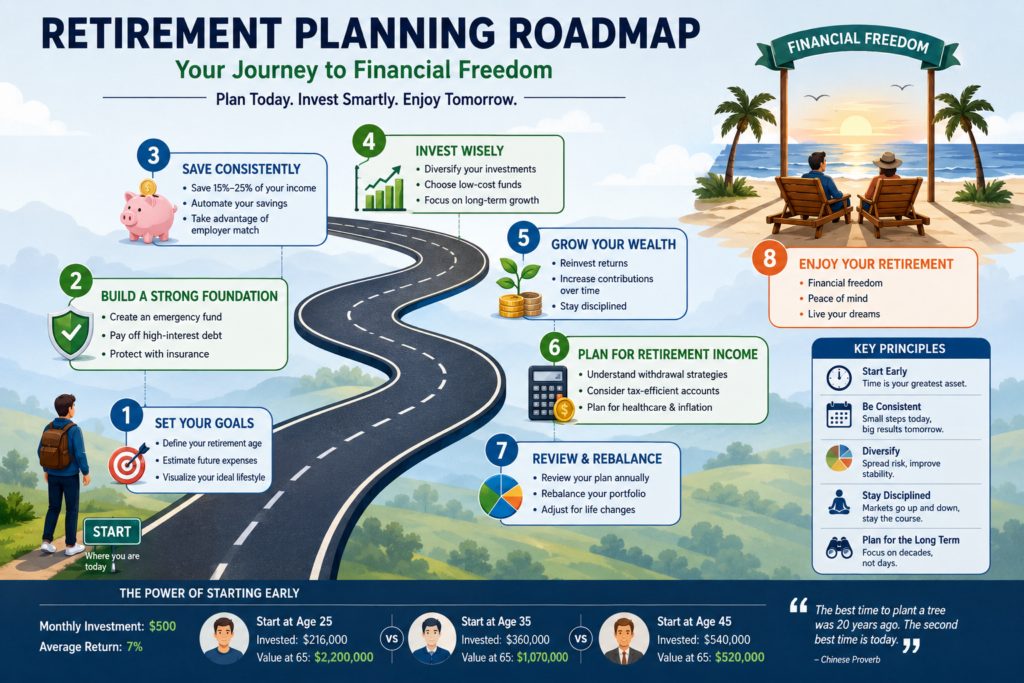
Step-by-Step Retirement Plan
Building wealth doesn’t require complicated investment strategies. Following a simple, disciplined process can help many investors achieve their long-term goals.
Step 1: Set Clear Retirement Goals
Begin by asking yourself:
- At what age do I want to retire?
- How much annual income will I need?
- What lifestyle do I want in retirement?
Having specific goals makes it easier to estimate how much you need to save and invest.
Step 2: Build an Emergency Fund
Before investing aggressively, create an emergency fund covering approximately three to six months of essential living expenses.
This reduces the likelihood of withdrawing retirement investments during unexpected financial emergencies.
Step 3: Maximize Tax-Advantaged Accounts
Whenever possible, prioritize retirement accounts that provide tax advantages, such as employer-sponsored plans or other tax-efficient retirement accounts available in your country.
These accounts can improve long-term investment growth by reducing taxes.
Step 4: Invest Consistently
Commit to investing regularly—even during market downturns.
Automating monthly contributions helps remove emotion from investing and encourages long-term discipline.
Step 5: Review and Rebalance Annually
As markets change, your portfolio allocation may drift away from your target.
Review your portfolio at least once each year and rebalance if necessary to maintain your desired level of risk.
Example Retirement Roadmap
| Age | Primary Focus |
|---|---|
| 20–30 | Build investing habits and maximize growth |
| 30–40 | Increase contributions and diversify investments |
| 40–50 | Accelerate retirement savings and monitor progress |
| 50–60 | Reduce unnecessary risk and prepare retirement income strategy |
| 60+ | Transition from wealth accumulation to sustainable retirement withdrawals |
Quick Action Checklist
□ Set a retirement target age.
□ Estimate annual retirement expenses.
□ Build an emergency fund.
□ Contribute enough to receive any available employer retirement match.
□ Automate monthly investing.
□ Diversify across asset classes.
□ Review your portfolio annually.
□ Increase contributions whenever your income rises.
Real-World Example
Consider Jennifer, a 27-year-old marketing professional earning $65,000 annually.
She decides to:
- Save 15% of her salary.
- Contribute enough to receive her employer’s full retirement match.
- Invest in low-cost index funds.
- Increase contributions whenever she receives a promotion.
- Rebalance her portfolio once a year.
- Stay invested during both bull and bear markets.
By maintaining this disciplined approach for several decades, Jennifer gives herself a strong opportunity to build a retirement portfolio capable of supporting her long-term financial goals.
The following case studies are hypothetical examples created for educational purposes. They illustrate common retirement investing scenarios and should not be interpreted as investment recommendations or expected outcomes.
Retirement Investing Case Studies
By now, you’ve learned the foundations of retirement investing basics, including retirement accounts, investment types, portfolio diversification, and long-term investing strategies. However, understanding concepts is only the first step. The next challenge is applying them in real-life situations.
This section explores practical retirement investing scenarios, highlights common mistakes to avoid, explains retirement income strategies, discusses tax-efficient investing, and shows how to protect your retirement savings from inflation. These lessons can help investors make more informed decisions regardless of whether they are just starting or approaching retirement.
1. Case Study: The Early Starter
Investor Profile
- Name: Emma
- Age: 25
- Occupation: Software Engineer
- Annual Income: $75,000
- Monthly Retirement Investment: $600
- Investment Strategy: Global index funds with automatic monthly investing
Investment Approach
Emma begins investing as soon as she starts her career. She contributes enough to receive her employer’s full retirement plan match and invests in a diversified portfolio of low-cost index funds. She also increases her contribution by 2% each time she receives a salary increase.
Results
Over the next 35 years:
- She invests consistently regardless of market conditions.
- She reinvests dividends.
- She avoids frequent trading.
Although she experiences several market downturns, including recessions, her portfolio continues growing over the long term through compound growth.
Lesson Learned
Starting early allows time to become your greatest financial advantage. Even moderate monthly contributions can grow significantly when invested consistently for several decades.
2. Case Study: The Late Starter
Investor Profile
- Name: Michael
- Age: 42
- Occupation: Project Manager
- Annual Income: $110,000
- Monthly Investment: $1,800
Situation
Michael focused on paying off debt and purchasing a home during his early career. He delayed retirement investing until his forties.
Investment Strategy
To compensate for lost time, he:
- Maximizes contributions to tax-advantaged retirement accounts.
- Invests in diversified stock and bond funds.
- Reduces unnecessary spending.
- Invests annual bonuses instead of increasing his lifestyle expenses.
Results
Although Michael started later than Emma, disciplined saving and larger contributions significantly improved his retirement outlook.
Lesson Learned
While starting early is ideal, beginning later is still better than postponing retirement investing indefinitely.
3. Case Study: The Market Timer
Investor Profile
- Name: Daniel
- Age: 36
- Occupation: Sales Executive
Situation
Daniel constantly follows financial news and attempts to predict market movements.
Whenever markets decline:
- He sells investments.
Whenever markets rise:
- He buys again.
Outcome
Over time, Daniel repeatedly sells during periods of fear and repurchases after prices recover.
As a result:
- He misses many of the market’s strongest recovery days.
- His long-term returns are lower than those of investors who simply remained invested.
Lesson Learned
Trying to predict short-term market movements often increases risk and reduces long-term investment performance.
4. Case Study: The Diversified Investor
Investor Profile
- Name: Sophia
- Age: 38
- Occupation: Financial Analyst
Portfolio
- 65% Global Stocks
- 20% Bonds
- 10% Real Estate Investment Trusts (REITs)
- 5% Cash
Investment Philosophy
Sophia believes no one can consistently predict which asset class will outperform each year.
Instead of concentrating her investments in one sector, she builds a diversified portfolio.
Results
During periods when stock markets experience significant volatility, bonds and REITs help reduce overall portfolio fluctuations.
Lesson Learned
Diversification does not eliminate risk, but it can reduce the impact of poor performance in any single investment or sector.
5. Case Study: The Disciplined Retiree
Investor Profile
- Name: Robert
- Age: 66
- Retired: Yes
Retirement Portfolio
- Diversified investment portfolio
- Emergency cash reserve
- Dividend-producing investments
- Government and corporate bonds
Retirement Income Plan
Robert withdraws only the amount needed for annual living expenses while leaving the remaining investments to continue growing.
He reviews his portfolio annually and adjusts withdrawals based on market conditions and spending needs.
Results
By avoiding excessive withdrawals and maintaining a diversified portfolio, Robert improves the likelihood that his retirement savings will support him throughout retirement.
Lesson Learned
Retirement investing does not stop when you retire. Managing withdrawals carefully is just as important as building wealth during your working years.
Common Retirement Investing Mistakes
Many retirement investors make avoidable mistakes that can significantly reduce long-term wealth. Recognizing these common pitfalls can help you stay on track.
1. Starting Too Late
Time is one of the most powerful factors in retirement investing because it allows compound growth to work over decades.
Even modest contributions started early may outperform much larger contributions begun later.
2. Saving Too Little
Many people underestimate how much they’ll need in retirement.
Regularly reviewing your retirement goals and increasing contributions as your income grows can help address this challenge.
3. Trying to Time the Market
Attempting to buy only when prices are low and sell before markets decline is extremely difficult, even for experienced professionals.
Long-term investing and consistent contributions generally provide a more reliable approach.
4. Ignoring Investment Fees
Investment expenses may appear small, but higher annual fees can reduce portfolio growth over long periods.
Comparing costs and understanding investment fees is an important part of retirement planning.
5. Lack of Diversification
Concentrating all investments in one company, industry, or asset class exposes investors to unnecessary risk.
Diversification helps spread risk across multiple investments.
6. Ignoring Inflation
Keeping too much money in cash over several decades may reduce purchasing power.
Growth-oriented investments have historically helped many investors combat inflation over the long term, although future performance is never guaranteed.
Retirement Income Strategies
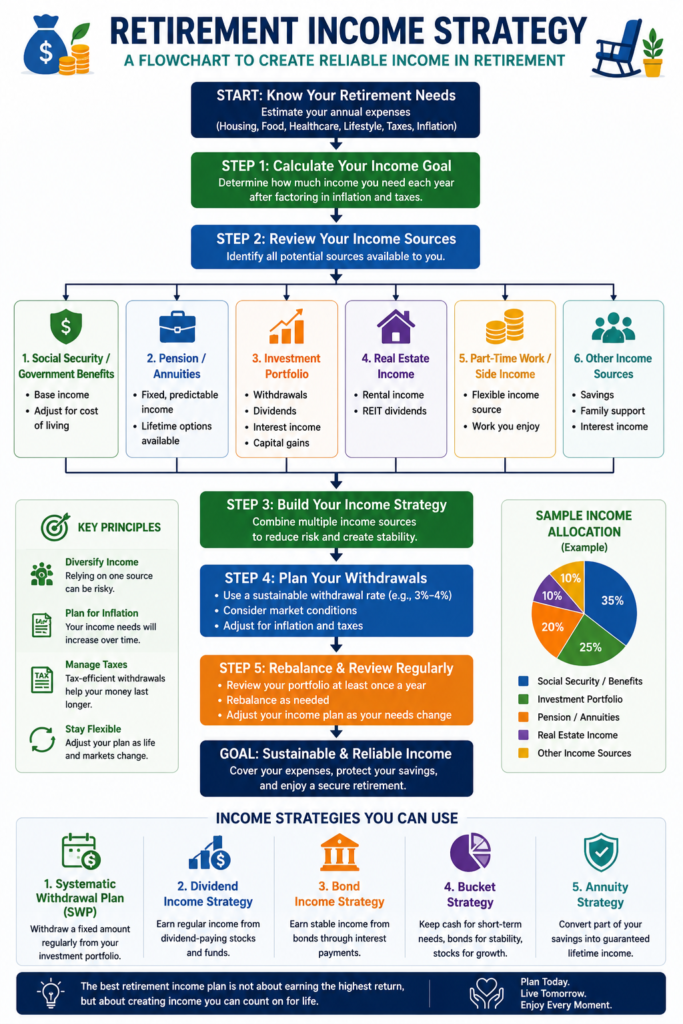
Building a retirement portfolio is only one part of the journey. After retirement, your investments need to provide a reliable source of income while helping your savings last.
1. Systematic Withdrawal Strategy
A Systematic Withdrawal Plan (SWP) involves withdrawing a planned amount from your investment portfolio at regular intervals, such as monthly or annually.
Advantages
- Predictable cash flow.
- Flexible withdrawal amounts.
- Allows remaining investments to continue growing.
2. Dividend Income Strategy
Some companies distribute a portion of their profits to shareholders through dividends.
Investors can use these dividend payments to help support retirement expenses while retaining ownership of the underlying investments.
Advantages
- Regular income.
- Potential for dividend growth over time.
- May reduce the need to sell investments during market downturns.
3. Bond Income Strategy
Government and high-quality corporate bonds typically pay periodic interest.
Including bonds in a retirement portfolio can provide more stable income and help reduce overall portfolio volatility.
4. Balanced Withdrawal Approach
Many retirees combine multiple income sources, including:
- Investment withdrawals
- Dividend income
- Bond interest
- Pension benefits
- Government retirement benefits (where applicable)
Using multiple income sources may reduce dependence on any single investment.
Tax Planning for Retirement
Tax planning is an important component of retirement investing because taxes can affect how much income you ultimately keep.
Common tax-planning principles include:
- Contributing to tax-advantaged retirement accounts when available.
- Understanding the tax treatment of withdrawals.
- Planning withdrawals strategically to help manage taxable income.
- Reviewing local tax rules before retirement.
Tax laws vary significantly by country and individual circumstances, so professional advice may be appropriate for complex situations.
Professional Advice Reminder
Tax rules differ by country and frequently change. Before making retirement contribution or withdrawal decisions, consider consulting a qualified tax professional or financial adviser who understands your personal circumstances. Official guidance from your country’s tax authority or retirement regulator can also help you understand the latest contribution limits, withdrawal rules, and reporting requirements.
Inflation Protection
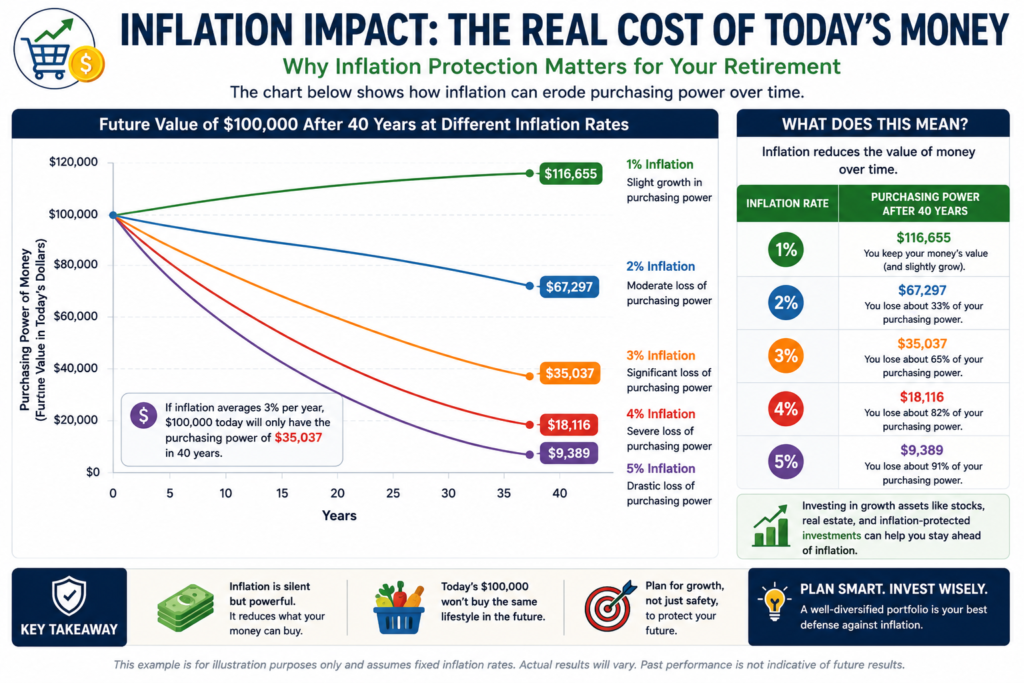
Inflation gradually reduces the purchasing power of money over time.
For example:
If inflation averages 3% annually, an item costing $100 today could cost substantially more in the future.
Because retirement may last 20 to 30 years or longer, inflation should be considered when designing a retirement portfolio.
Common Ways Investors Seek to Address Inflation
- Investing in diversified stock portfolios with long-term growth potential.
- Including international investments for broader diversification.
- Holding real estate or REITs as part of a diversified portfolio.
- Periodically reviewing and adjusting investment allocations.
- Increasing retirement contributions as income rises.
No investment guarantees protection against inflation, but maintaining a diversified, growth-oriented portfolio has historically helped many long-term investors preserve purchasing power.
Portfolio Allocation by Age
Your investment portfolio should evolve as you get older. Younger investors generally have a longer time horizon, allowing them to take more investment risk. As retirement approaches, preserving capital and generating reliable income become increasingly important.
Below are sample allocations for educational purposes. The right allocation depends on your goals, income, risk tolerance, and financial situation.
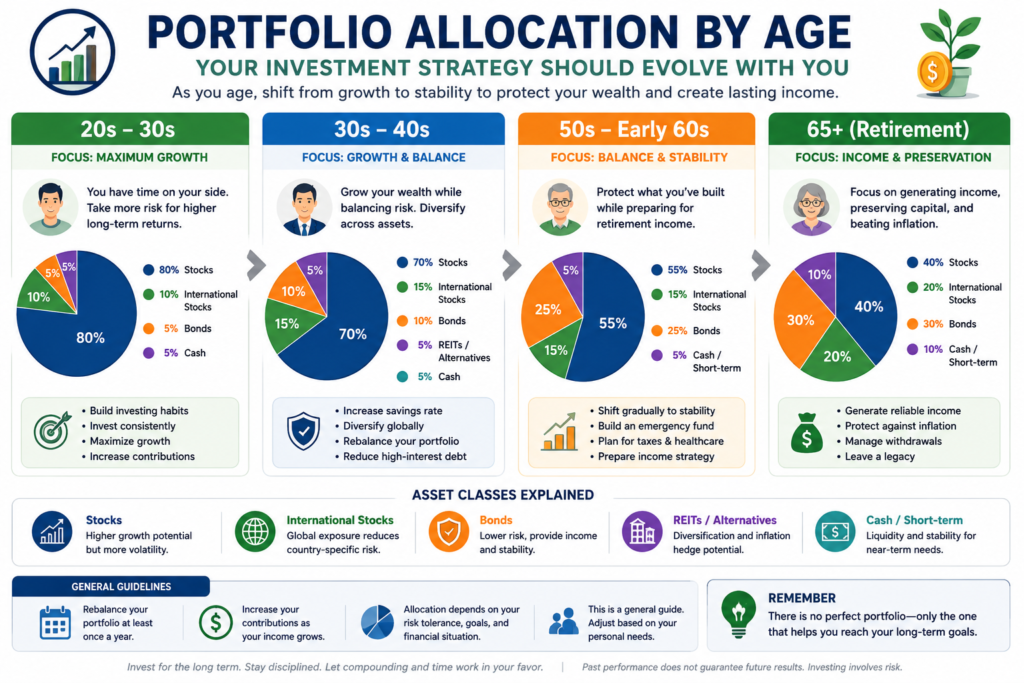
Age 20–30: Focus on Maximum Growth
Investors in their twenties typically have 30–40 years before retirement. This long investment horizon allows them to recover from short-term market declines and benefit from long-term growth.
Sample Portfolio
| Asset Class | Allocation |
|---|---|
| Global Stocks | 80% |
| International Stocks | 10% |
| Bonds | 5% |
| Cash | 5% |
Primary Goals
- Build investing habits
- Maximize compound growth
- Contribute consistently
- Increase investments with salary raises
Example
Olivia begins investing at age 24. She automatically contributes to a diversified portfolio every month and increases her contribution by 5% each time she receives a promotion. Although markets experience several downturns during her career, she remains focused on her long-term objectives.
Age 30–50: Balance Growth and Stability
During mid-career, many investors begin balancing growth with greater portfolio stability.
Sample Portfolio
| Asset Class | Allocation |
|---|---|
| Stocks | 70% |
| Bonds | 20% |
| REITs | 5% |
| Cash | 5% |
Priorities
- Increase retirement contributions
- Diversify globally
- Review retirement goals regularly
- Reduce unnecessary debt
Example
David, age 42, has increased his retirement contributions every year. Instead of changing his investments based on market news, he reviews his portfolio annually and rebalances when necessary.
Age 50–65: Prepare for Retirement
As retirement approaches, preserving accumulated wealth becomes increasingly important.
Sample Portfolio
| Asset Class | Allocation |
|---|---|
| Stocks | 55% |
| Bonds | 35% |
| Cash | 10% |
Priorities
- Reduce excessive portfolio risk
- Build a retirement income plan
- Estimate healthcare and lifestyle expenses
- Review tax-efficient withdrawal strategies
Example
Sarah plans to retire in seven years. She gradually increases her bond allocation and builds a cash reserve to reduce the likelihood of selling investments during a market downturn immediately before retirement.
Retirement (65+): Focus on Income and Preservation
Retirement portfolios generally prioritize sustainable income while maintaining enough growth to help offset inflation.
Sample Portfolio
| Asset Class | Allocation |
|---|---|
| Stocks | 40–50% |
| Bonds | 40–50% |
| Cash | 10–20% |
Goals
- Generate reliable retirement income
- Manage withdrawal rates
- Preserve purchasing power
- Maintain portfolio flexibility
These allocations are examples only and should be adjusted based on individual circumstances.
Psychological Discipline: The Hidden Key to Retirement Success
Investment knowledge alone is not enough. Successful retirement investors also develop emotional discipline.
Market volatility is normal. Economic recessions, geopolitical events, and financial crises can cause temporary declines in investment values. Investors who remain calm and continue following their long-term plan are often better positioned than those who react emotionally.
1. Stay Patient
Wealth rarely develops overnight.
Long-term investing is measured in decades, not weeks.
2. Ignore Short-Term Market Noise
Financial news often focuses on daily market movements.
Successful retirement investors focus on long-term trends rather than reacting to every headline.
3. Invest Consistently
Automatic monthly investing removes much of the emotion from investing.
Consistency can be more valuable than trying to identify the perfect investment opportunity.
4. Avoid Emotional Decisions
Fear and greed are two of the biggest enemies of investors.
Common emotional mistakes include:
- Selling during market declines
- Buying after large market rallies
- Chasing popular investments
- Frequently changing investment strategies
Following a written investment plan can help reduce emotional decision-making.
5. Think Long Term
Markets have historically experienced cycles of growth and decline.
Viewing your retirement portfolio as a long-term project rather than a daily scorecard can help maintain perspective during periods of volatility.
Final Retirement Blueprint
Use this practical roadmap as a foundation for building long-term financial security.
Step 1
Define your retirement goals.
Know when you want to retire and estimate your expected annual expenses.
Step 2
Create an emergency fund covering three to six months of essential expenses before investing aggressively.
Step 3
Take advantage of tax-advantaged retirement accounts whenever possible.
If your employer offers matching contributions, consider contributing enough to receive the full match if it fits your financial situation.
Step 4
Invest regularly using a diversified portfolio of quality investments.
Step 5
Review your portfolio annually.
Rebalance only when your asset allocation has meaningfully changed from your target.
Step 6
Increase contributions as your income grows.
Saving more after salary increases may accelerate progress toward retirement goals.
Step 7
Continue learning.
Financial markets evolve, and ongoing education can help you make more informed decisions.
Educational Disclaimer
This guide provides general educational information about retirement investing. It does not constitute personalized financial, investment, tax, or legal advice. Every investor’s goals, risk tolerance, income, and tax situation are different. Consider consulting a qualified financial or tax professional before making investment decisions.
Conclusion
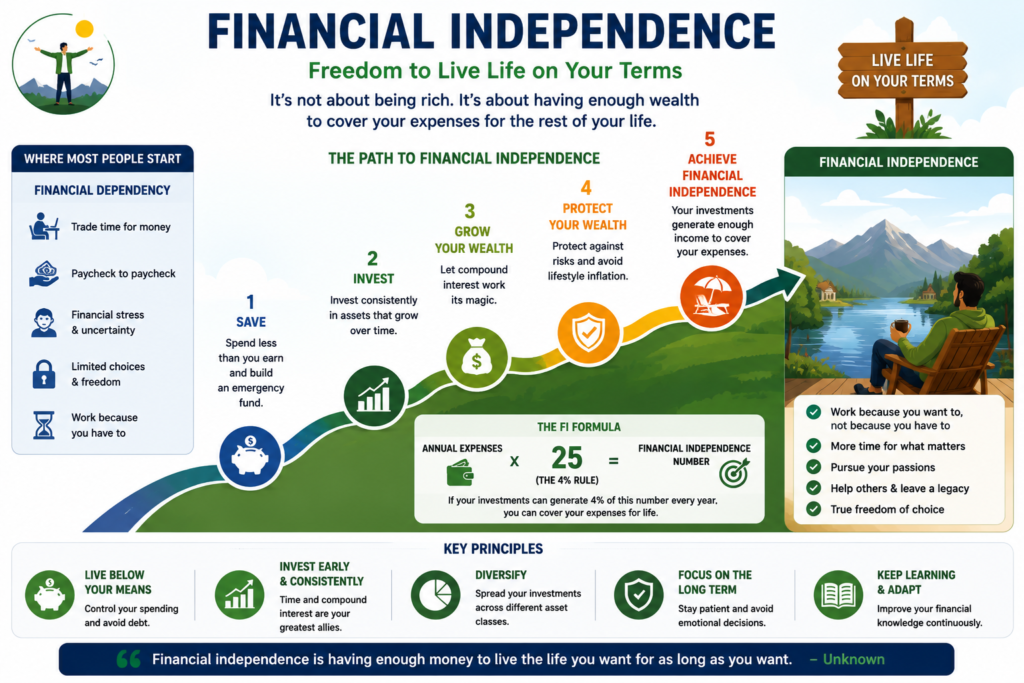
Retirement investing is one of the most valuable financial skills you can develop.
The goal is not to predict the stock market, outperform every investor, or become wealthy overnight. Instead, the objective is to create a disciplined system that steadily builds financial independence over many years.
Throughout this guide, you’ve learned that successful retirement investing is built on several timeless principles:
- Start investing as early as possible.
- Save consistently.
- Diversify your portfolio.
- Take advantage of tax-efficient retirement accounts.
- Stay invested during market volatility.
- Review your plan regularly.
- Avoid emotional decision-making.
No investment strategy can eliminate risk, and future returns cannot be guaranteed. However, disciplined investing, diversification, and long-term planning have historically helped many investors build wealth over time.
Whether you are investing your first paycheck or preparing for retirement within the next decade, the most important step is taking action and remaining consistent.
Investment Risk Disclosure
Investing involves risk, including the possible loss of principal. Investment values fluctuate, and returns are not guaranteed. Diversification and asset allocation can help manage risk but cannot eliminate it. Past performance is not a reliable indicator of future results.
Latest Retirement Investing Statistics (2025–2026)
The following statistics illustrate broad retirement and investing trends. They may change over time as new data becomes available.
- Many financial planners continue to recommend saving 15%–25% of annual income for retirement, depending on individual circumstances.
- Average life expectancy has increased in many developed countries, meaning retirement savings may need to support 20–30 years or more of retirement.
- Employer-sponsored retirement plans remain one of the primary retirement savings vehicles in the United States.
- Low-cost index funds continue to be widely used by long-term investors because of their diversification and relatively low fees.
- Automatic payroll contributions have been associated with higher retirement participation rates in employer-sponsored plans.
Sources Used
• SEC
• Investor.gov
• IRS
• Department of Labor
• SSA
• FCA
• MoneyHelper
• ATO
• OECD
• World Bank
Expert Insights
“The stock market is a device for transferring money from the impatient to the patient.” — Warren Buffett
This quote highlights the importance of long-term thinking and avoiding emotional investing.
“Do not save what is left after spending, but spend what is left after saving.” — Warren Buffett
Prioritizing savings before discretionary spending can help build disciplined financial habits.
“Know what you own, and know why you own it.” — Peter Lynch
Understanding your investments can improve confidence during periods of market volatility.
FAQs
1. What are retirement investing basics?
Retirement investing basics involve regularly investing money into assets such as stocks, bonds, index funds, mutual funds, and retirement accounts to build long-term wealth and generate income after retirement.
2. When should I start investing for retirement?
The earlier you start, the more time your investments have to benefit from compound growth. Starting early generally allows smaller contributions to grow over a longer period.
3. How much should I save for retirement?
A common guideline is saving 15%–25% of your annual income, but the ideal amount depends on your retirement goals, expected expenses, and income.
4. What is the best retirement account?
The best account depends on your country and circumstances. Examples include employer-sponsored retirement plans, individual retirement accounts, Stocks and Shares ISAs in the UK, and Superannuation in Australia.
5. Are index funds good for retirement?
Many long-term investors use diversified, low-cost index funds because they provide broad market exposure and relatively low expenses.
6. What is compound interest?
Compound growth occurs when investment earnings generate additional earnings over time, allowing wealth to grow faster over long periods.
7. Should I invest during a market crash?
Many long-term investors continue investing through market downturns as part of a disciplined investment strategy. Individual decisions should reflect personal goals and risk tolerance.
8. What is asset allocation?
Asset allocation is the process of dividing investments among different asset classes, such as stocks, bonds, cash, and real estate, to balance risk and return.
9. How often should I rebalance my portfolio?
Many investors review and rebalance their portfolios once or twice a year or after significant changes in asset allocation.
10. What is diversification?
Diversification means spreading investments across multiple companies, industries, asset classes, and geographic regions to reduce concentration risk.
11. How much money do I need to retire?
Some financial planning approaches use the 25× annual expenses guideline as a starting point, but actual retirement needs vary by lifestyle, longevity, healthcare costs, and investment performance.
12. Can I retire early?
Early retirement is possible for some people if they accumulate sufficient investments and carefully plan their income, expenses, taxes, and healthcare needs.
13. Should retirees own stocks?
Many retirees continue holding stocks to help their portfolios grow and offset inflation, though the appropriate allocation depends on individual risk tolerance and income needs.
14. What are retirement investment risks?
Common risks include market volatility, inflation, longevity risk, rising healthcare costs, and poor diversification.
15. Is real estate good for retirement?
Real estate can provide rental income and diversification, but it also involves maintenance costs, liquidity considerations, and market risk.
16. What is the 4% withdrawal rule?
The 4% rule is a historical planning guideline suggesting that withdrawing around 4% of a diversified retirement portfolio annually may support long-term retirement income in many historical scenarios. It is not a guarantee.
17. What happens if I start investing late?
Starting later generally requires higher savings rates and disciplined investing to work toward retirement goals, but meaningful progress is still possible.
18. Should I pay off debt before investing?
Many people prioritize paying off high-interest debt while also contributing enough to receive valuable employer retirement matches if available. The right balance depends on individual circumstances.
19. Can inflation affect retirement savings?
Yes. Inflation reduces purchasing power over time, which is why many retirement portfolios include investments with long-term growth potential.
20. What is the biggest retirement investing mistake?
Common mistakes include delaying investing, saving too little, chasing market trends, ignoring fees, failing to diversify, and making emotional investment decisions.
Final Thoughts
Retirement investing is not complicated—but it requires discipline and time.
👉 Key takeaway:
- Time > Timing
- Consistency > Intelligence
- Patience = Wealth
If you follow the principles in this guide, you can build a retirement portfolio that:
- Replaces your income
- Beats inflation
- Gives financial freedom
Further Reading & Official Resources
Include links to:
- U.S. Securities and Exchange Commission (SEC)
- Investor.gov
- Internal Revenue Service (IRS)
- U.S. Department of Labor
- Social Security Administration
- Financial Conduct Authority (UK)
- MoneyHelper (UK)
- Australian Taxation Office (ATO)
- OECD
- World Bank