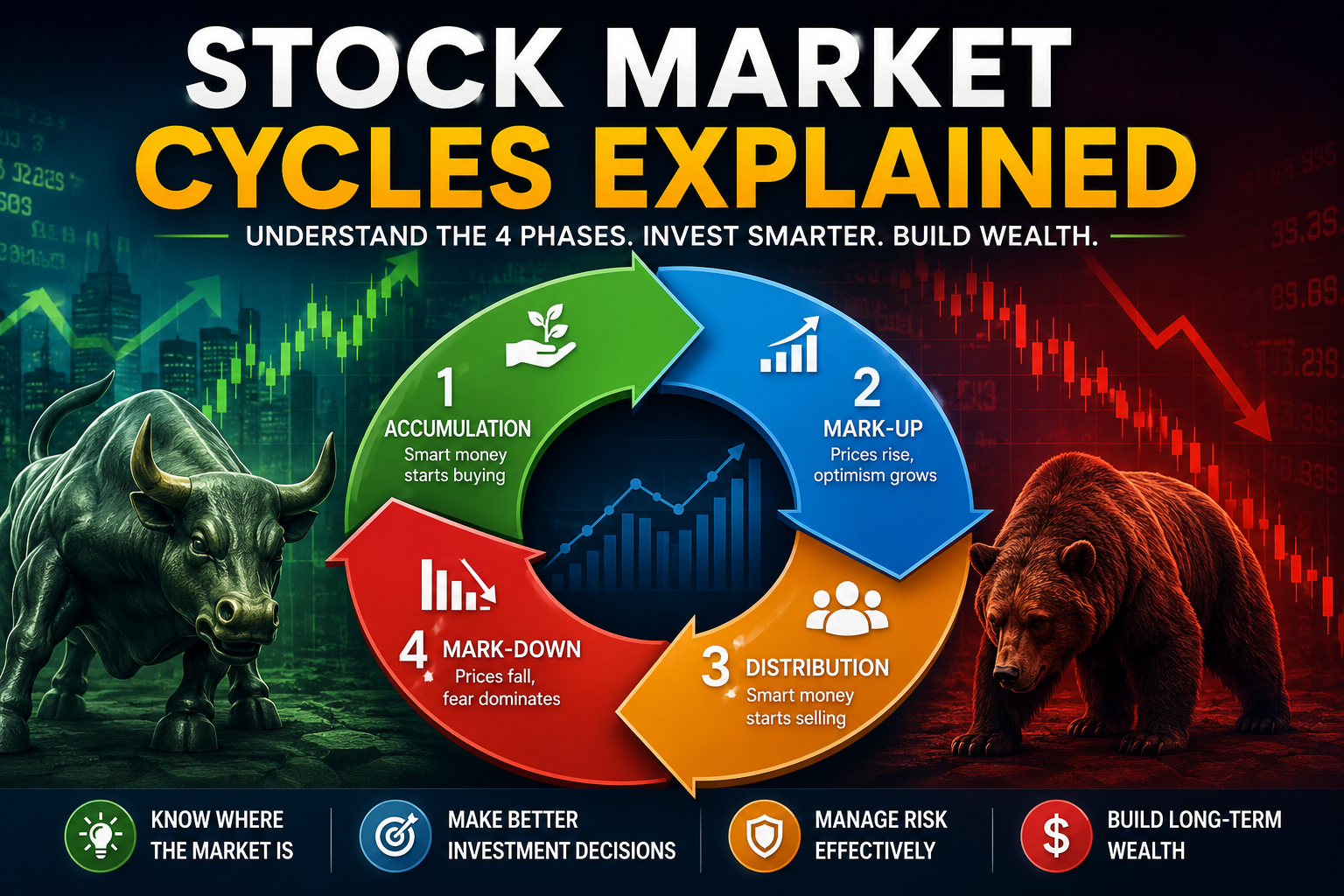
Stock Market Cycles Explained
The stock market does not move in a straight line forever. Instead, it moves through repeating patterns called market cycles. These cycles are driven by economics, interest rates, business growth, investor psychology, government policy, global events, and human emotions like fear and greed.
Understanding stock market cycles is one of the most important skills for long-term investors in countries like the United States, Canada, United Kingdom, and Australia because cycles influence:
- Stock prices
- Retirement portfolios
- Pension funds
- Real estate markets
- Interest rates
- Employment
- Consumer spending
- Wealth creation
Many beginner investors believe markets only go up or only crash. In reality, markets move through predictable stages over time. Investors who understand these stages can make smarter decisions, reduce emotional investing, and build long-term wealth more effectively.
What Is a Stock Market Cycle?
A stock market cycle is the natural rise and fall of stock prices over time.
Markets alternate between periods of:
- Growth and optimism
- Peak valuation and excitement
- Decline and fear
- Recovery and rebuilding
These phases repeat throughout history.
A market cycle can last:
- A few months
- Several years
- Sometimes more than a decade
No cycle lasts forever.
Simple Definition
A stock market cycle is:
The repeating pattern of expansion, peak, contraction, and recovery in financial markets.
Why Do Market Cycles Happen?
Market cycles occur because economies and human emotions constantly change.
Key drivers include:
| Factor | Impact on Markets |
|---|---|
| Interest rates | Affect borrowing and business growth |
| Inflation | Influences consumer spending |
| Corporate earnings | Determine company profitability |
| Government policy | Can stimulate or slow economies |
| Global events | Wars, pandemics, crises create volatility |
| Investor psychology | Fear and greed move prices dramatically |
The Four Main Phases of a Stock Market Cycle
Most analysts divide market cycles into four major stages:
- Accumulation Phase
- Mark-Up Phase
- Distribution Phase
- Mark-Down Phase
Let us understand each deeply.
1. Accumulation Phase
The accumulation phase begins after a major market decline or crash.
At this stage:
- Investor fear is extremely high
- Media headlines are negative
- Many investors have already sold
- Stock prices become undervalued
- Smart investors quietly start buying
This phase is usually dominated by:
- Institutional investors
- Value investors
- Long-term investors
Characteristics of the Accumulation Phase
| Feature | Explanation |
|---|---|
| Low valuations | Stocks trade cheaply |
| Negative sentiment | Investors remain fearful |
| Low trading volume | Many people stay away |
| Economic weakness | Recession may still exist |
| Smart money buying | Professionals accumulate assets |
Example: 2009 After the Global Financial Crisis
Following the 2008 financial crisis:
- Banks collapsed
- Housing markets crashed
- Unemployment rose sharply
- Investors panicked
The S&P 500 lost more than 50% from its peak.
But during early 2009:
- Institutional investors started buying quality companies
- Valuations became attractive
- Fear was extremely high
This became the beginning of one of the longest bull markets in history.
Psychology During Accumulation
The dominant emotion is:
Fear
Typical investor thoughts:
- “The market will never recover.”
- “Stocks are too risky.”
- “Cash is safer.”
Experienced investors often buy during this stage because prices are heavily discounted.
Warren Buffett’s Famous Principle
Warren Buffett famously said:
“Be fearful when others are greedy and greedy when others are fearful.”
This quote perfectly describes accumulation investing.
2. Mark-Up Phase
The mark-up phase is the strong upward movement of the market.
This is usually the longest and most profitable stage.
Economic conditions improve:
- Businesses grow
- Employment rises
- Consumer confidence improves
- Earnings increase
- Investors become optimistic
Stock prices steadily climb.
Characteristics of the Mark-Up Phase
| Feature | Explanation |
|---|---|
| Rising stock prices | Bull market begins |
| Increasing earnings | Companies perform better |
| Positive sentiment | Investors gain confidence |
| Higher trading volume | More participation |
| Media optimism | Positive financial news |
What Is a Bull Market?
A bull market is a prolonged period where stock prices rise significantly.
A bull market is commonly defined as:
A rise of 20% or more from recent lows.
Example: 2009–2021 Bull Market
After the 2008 crisis:
- Technology companies expanded rapidly
- Low interest rates boosted growth
- Consumer spending recovered
Companies like:
- Apple
- Microsoft
- Amazon
- NVIDIA
experienced enormous growth.
The NASDAQ Composite surged dramatically during this period.
Investor Psychology During Mark-Up
The main emotion becomes:
Optimism
Investors start believing:
- “The economy is improving.”
- “Stocks are good investments.”
- “This company has huge potential.”
More retail investors enter the market.
Compounding During Bull Markets
Bull markets allow investors to benefit from:
- Capital appreciation
- Dividend growth
- Compound returns
Example:
If a portfolio grows 10% annually:
genui{“math_block_widget_always_prefetch_v2”:{“content”:”A=P(1+r)^t”}}
Where:
- (A) = final amount
- (P) = initial investment
- (r) = annual return
- (t) = years invested
A $10,000 investment growing at 10% annually for 20 years becomes approximately $67,275.
This demonstrates the power of long-term bull markets.
3. Distribution Phase
The distribution phase occurs near the top of the market cycle.
At this point:
- Stock prices are very high
- Valuations become stretched
- Speculation increases
- Experienced investors begin selling
However, public enthusiasm remains strong.
Characteristics of Distribution
| Feature | Explanation |
|---|---|
| High valuations | Stocks become expensive |
| Excessive optimism | Investors feel invincible |
| Heavy speculation | Risk-taking increases |
| Volatility rises | Market becomes unstable |
| Smart money sells | Institutions reduce exposure |
Signs of a Market Peak
Common warning signs include:
- Meme stock mania
- Excessive IPO activity
- Retail speculation
- High margin debt
- Unrealistic valuations
Example: Dot-Com Bubble (2000)
During the late 1990s:
- Internet stocks exploded higher
- Many companies had no profits
- Investors bought stocks based on hype
The Dot-com bubble became one of the most famous speculative periods in history.
Eventually:
- Valuations collapsed
- Tech stocks crashed
- Many companies disappeared
The NASDAQ Composite fell nearly 78% from peak to bottom.
Psychology During Distribution
Dominant emotion:
Greed
Common thoughts:
- “Stocks only go up.”
- “Everyone is making money.”
- “I cannot miss out.”
This creates:
- FOMO (Fear of Missing Out)
- Speculation
- Asset bubbles
What Is a Bubble?
A bubble occurs when asset prices rise far above their true fundamental value.
Bubbles are usually driven by:
- Speculation
- Excessive optimism
- Cheap money
- Investor mania
Famous Market Bubbles
| Bubble | Period |
|---|---|
| Tulip Mania | 1630s |
| Dot-Com Bubble | 1995–2000 |
| US Housing Bubble | 2002–2008 |
| Crypto Speculation Boom | 2020–2021 |
4. Mark-Down Phase
The mark-down phase is the decline stage of the market cycle.
This phase is often fast and emotional.
Prices begin falling because:
- Earnings weaken
- Interest rates rise
- Economic growth slows
- Investors panic
Characteristics of Mark-Down
| Feature | Explanation |
|---|---|
| Falling prices | Bear market develops |
| Panic selling | Fear dominates |
| Negative headlines | Media pessimism rises |
| Economic slowdown | Recession risk increases |
| Liquidity problems | Investors seek safety |
What Is a Bear Market?
A bear market is typically defined as:
A decline of 20% or more from market highs.
Bear markets can last:
- Months
- Years
- Occasionally longer
Example: COVID-19 Crash (2020)
During the COVID-19 pandemic:
- Businesses shut down
- Travel stopped
- Economies contracted rapidly
The Dow Jones Industrial Average experienced one of the fastest crashes in history.
However:
- Governments introduced stimulus
- Central banks cut interest rates
- Markets recovered quickly
This showed how cycles can reverse rapidly.
Psychology During Market Crashes
Dominant emotion:
Panic
Investors often think:
- “Everything is collapsing.”
- “I should sell before it gets worse.”
- “The economy may never recover.”
Unfortunately, many investors sell near market bottoms.
Relationship Between Economic Cycles and Market Cycles
Stock markets are strongly connected to the economy.
Economic cycles usually include:
- Expansion
- Peak
- Contraction
- Trough
Markets often move BEFORE the economy changes.
Why Markets Move Ahead of the Economy
Stock markets are forward-looking.
Investors price in expectations about:
- Future earnings
- Interest rates
- Inflation
- Economic growth
This means:
- Markets may recover before recessions end
- Markets may fall before economic data weakens
Role of Interest Rates
Interest rates significantly affect stock market cycles.
Central banks like:
- Federal Reserve
- Bank of England
- Bank of Canada
- Reserve Bank of Australia
adjust rates to manage inflation and economic growth.
Low Interest Rates
Low rates generally help stocks because:
- Borrowing becomes cheaper
- Businesses expand
- Consumers spend more
- Investors seek higher returns in equities
High Interest Rates
High rates can hurt markets because:
- Loans become expensive
- Corporate profits slow
- Consumers reduce spending
- Bonds become more attractive
Inflation and Market Cycles
Inflation is another major driver.
Moderate Inflation
Healthy inflation can support growth.
High Inflation
Excessive inflation can damage markets because:
- Costs rise
- Profit margins shrink
- Central banks raise rates aggressively
Example: Inflation Shock of 2022
In 2022:
- Inflation surged globally
- Interest rates rose rapidly
- Technology stocks declined sharply
Growth companies suffered because future earnings became less valuable when rates increased.
Sector Rotation During Market Cycles
Different sectors perform differently during each cycle stage.
Early Recovery Phase
Strong sectors:
- Technology
- Consumer discretionary
- Small-cap stocks
Mid-Cycle Expansion
Strong sectors:
- Industrials
- Financials
- Energy
Late-Cycle Phase
Strong sectors:
- Healthcare
- Utilities
- Consumer staples
Recession Phase
Defensive assets usually outperform:
- Bonds
- Gold
- Utilities
- Cash equivalents
What Is Sector Rotation?
Sector rotation means investors shift money between industries depending on economic conditions.
Professional investors constantly rotate portfolios during cycles.
Case Study: 2008 Financial Crisis
The Global Financial Crisis provides one of the best examples of a full market cycle.
Before the Crisis
During 2003–2007:
- Housing prices surged
- Banks increased risky lending
- Consumer borrowing exploded
- Investors became overconfident
Bubble Formation
Financial institutions created risky mortgage products.
Major firms included:
- Lehman Brothers
- Bear Stearns
Eventually, the housing bubble burst.
Crash Phase
Consequences included:
- Bank failures
- Credit freezes
- Massive unemployment
- Market collapse
The S&P 500 lost over half its value.
Recovery Phase
Governments responded with:
- Bailouts
- Stimulus spending
- Low interest rates
Over time:
- Confidence returned
- Businesses stabilized
- Markets recovered
This demonstrated the complete cycle:
- Expansion
- Bubble
- Crash
- Recovery
Case Study: AI Boom and Technology Stocks
The rise of artificial intelligence created another important market cycle example.
Companies such as:
- NVIDIA
- Microsoft
- Alphabet
benefited enormously from AI optimism.
Investors poured capital into technology stocks expecting future growth.
This demonstrates how innovation can create powerful market expansions.
How Institutional Investors Use Market Cycles
Professional investors analyze cycles to:
- Adjust risk exposure
- Rebalance portfolios
- Rotate sectors
- Manage cash reserves
- Protect against downturns
Asset Allocation Across Cycles
A diversified investor may allocate assets differently depending on the cycle.
Example:
| Cycle Stage | Stocks | Bonds | Cash |
|---|---|---|---|
| Recovery | High | Moderate | Low |
| Expansion | Very High | Moderate | Low |
| Peak | Moderate | Higher | Moderate |
| Recession | Lower | High | High |
Importance of Diversification
Diversification reduces risk across cycles.
Investors diversify through:
- Domestic stocks
- International stocks
- Bonds
- Real estate
- Commodities
- ETFs
What Is an ETF?
An ETF (Exchange-Traded Fund) is a basket of investments traded on stock exchanges.
Popular ETFs include funds tracking:
- S&P 500
- International markets
- Bonds
- Technology sectors
ETFs help investors diversify efficiently.
Emotional Investing vs Rational Investing
One of the biggest dangers during cycles is emotional decision-making.
Emotional Investor Behavior
| Market Condition | Common Emotion |
|---|---|
| Crash | Fear |
| Recovery | Doubt |
| Bull market | Optimism |
| Bubble | Greed |
Rational Investor Behavior
Disciplined investors usually:
- Follow long-term plans
- Diversify assets
- Rebalance portfolios
- Avoid panic selling
- Continue investing consistently
Dollar-Cost Averaging
A common strategy for handling cycles is:
Dollar-Cost Averaging (DCA)
This means investing a fixed amount regularly regardless of market conditions.
Example:
- $500 monthly investment
- Buy more shares when prices fall
- Buy fewer shares when prices rise
Over time, this reduces timing risk.
Why Timing the Market Is Difficult
Even professionals struggle to predict:
- Market tops
- Market bottoms
- Economic turning points
Missing a few strong market days can significantly reduce long-term returns.
Long-Term Investing and Cycles
Historically, major markets have trended upward over long periods despite crashes.
Examples include:
- S&P 500
- FTSE 100
- S&P/TSX Composite Index
- ASX 200
Long-term investors benefit from:
- Economic growth
- Corporate innovation
- Productivity gains
- Population expansion
Retirement Investing and Market Cycles
Retirement accounts are deeply affected by cycles.
Examples include:
- 401(k)s in the US
- RRSPs in Canada
- ISAs in the UK
- Superannuation funds in Australia
Young investors can usually tolerate more volatility because they have longer time horizons.
Older investors often reduce risk near retirement.
Common Mistakes Investors Make During Cycles
1. Panic Selling
Selling during crashes locks in losses.
2. Buying During Mania
Investors often buy overpriced assets during bubbles.
3. Ignoring Diversification
Concentrated portfolios increase risk.
4. Following Headlines
Media coverage is often emotional and reactive.
5. Trying to Predict Every Move
Constant market timing rarely works consistently.
How to Invest Through Market Cycles
Step 1: Build a Long-Term Plan
Define:
- Goals
- Risk tolerance
- Time horizon
Step 2: Diversify
Spread investments across:
- Sectors
- Countries
- Asset classes
Step 3: Stay Consistent
Continue investing regularly during both bull and bear markets.
Step 4: Rebalance Periodically
Adjust allocations back to target percentages.
Step 5: Avoid Emotional Decisions
Focus on data and long-term objectives.
Example of Long-Term Cycle Investing
Suppose an investor in the United States invested monthly into an S&P 500 index fund from:
- 2000
- through the Dot-Com crash
- the 2008 crisis
- the COVID crash
Despite multiple downturns, long-term compounding could still produce significant wealth over decades.
Key Financial Terms Explained
| Term | Meaning |
|---|---|
| Bull Market | Extended rise in stock prices |
| Bear Market | Extended decline in prices |
| Volatility | Speed and size of price movement |
| Recession | Economic slowdown |
| Expansion | Economic growth period |
| Inflation | Rising prices in the economy |
| Interest Rate | Cost of borrowing money |
| Liquidity | Ease of buying/selling assets |
| Diversification | Spreading investment risk |
| Valuation | Estimating company worth |
Final Thoughts
Stock market cycles are natural, unavoidable parts of investing.
Every cycle includes:
- Optimism
- Excess
- Fear
- Recovery
Successful investors understand that volatility is normal and temporary.
History shows that markets:
- Crash
- Recover
- Innovate
- Grow again
Investors who remain disciplined, diversified, and patient are generally better positioned to build long-term wealth.
Rather than fearing market cycles, experienced investors learn to understand and work with them.