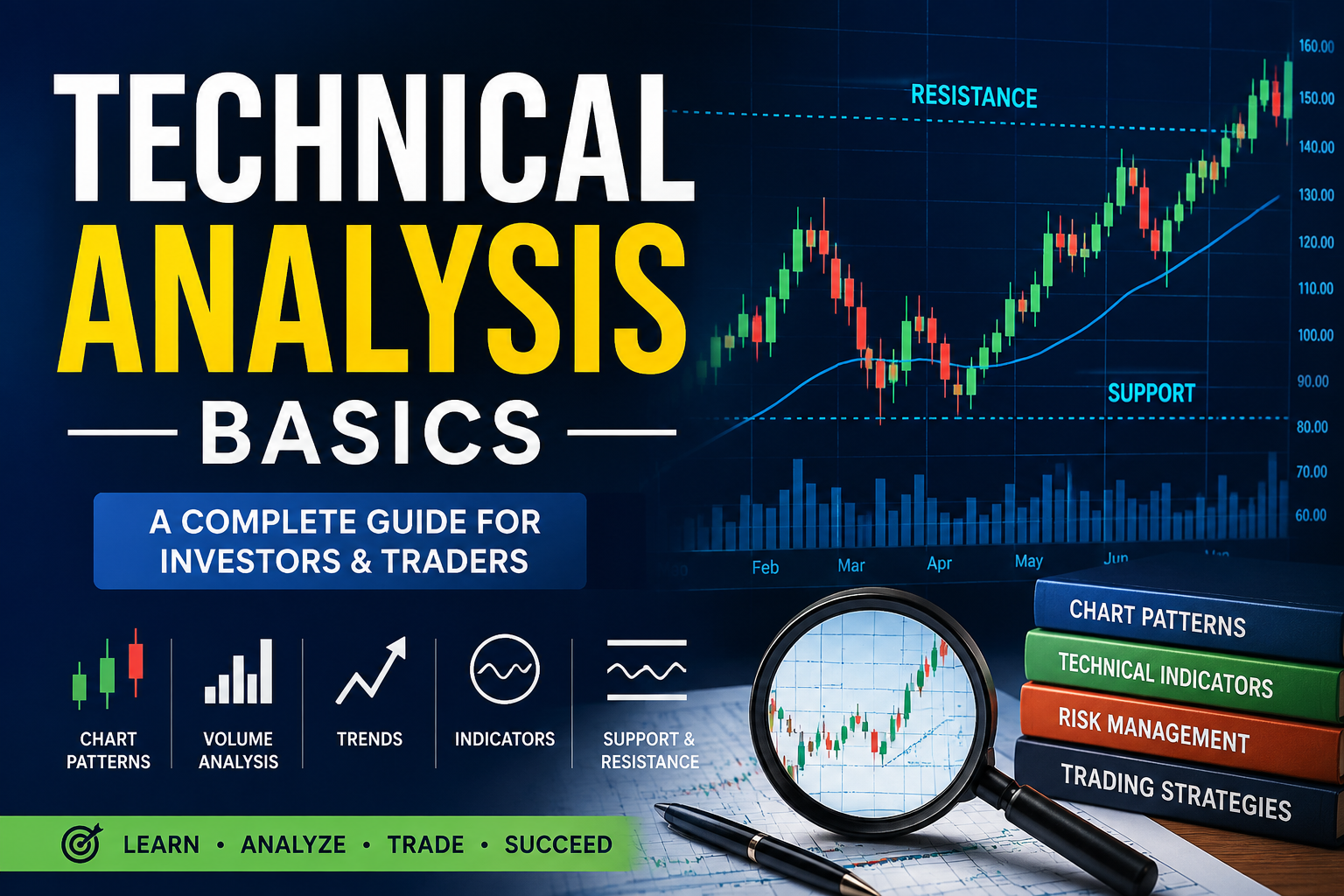
Technical Analysis Basics
Introduction to Technical Analysis
Technical analysis is the study of market price movements, trading volume, and chart patterns to predict future price behavior in financial markets. It is widely used in stock markets, forex markets, cryptocurrency trading, commodities, exchange-traded funds (ETFs), and futures markets across Tier-1 countries such as the United States, United Kingdom, Canada, and Australia.
Unlike fundamental analysis, which focuses on company financials, earnings, management quality, and economic conditions, technical analysis concentrates mainly on market action itself. Technical analysts believe that all available information is already reflected in the price.
For example:
- If investors believe a company will grow rapidly, the stock price usually rises before the earnings report becomes public.
- If traders fear economic recession, prices often fall before official data confirms it.
Technical analysis attempts to identify these price movements early.
What Is a Market Trend?
A trend is the general direction in which a financial asset moves over time.
There are three major types of trends:
1. Uptrend
An uptrend occurs when prices form:
- Higher highs
- Higher lows
This means buyers are stronger than sellers.
Example:
A stock rises from:
- $100 → $110 → $105 → $120 → $115 → $130
Even though prices temporarily fall, the overall direction remains upward.
Characteristics
- Investor confidence is strong
- Economy may be expanding
- Earnings expectations are positive
Real-World Example
Apple Inc. experienced long-term uptrends during the iPhone expansion years because investors anticipated increasing revenues and ecosystem growth.
2. Downtrend
A downtrend occurs when prices form:
- Lower highs
- Lower lows
This indicates sellers dominate the market.
Example:
- $150 → $140 → $145 → $130 → $135 → $120
Characteristics
- Fear dominates markets
- Investors sell risky assets
- Economic conditions may weaken
Case Study
During the 2008 Global Financial Crisis, many banking stocks entered major downtrends as investors feared bankruptcy and recession.
3. Sideways Trend
A sideways or range-bound market occurs when prices move within a horizontal range.
Example:
- Between $50 and $55 repeatedly
This indicates market indecision.
Common Causes
- Investors waiting for earnings
- Central bank decisions
- Economic uncertainty
Core Assumptions of Technical Analysis
Technical analysis is built on three major assumptions.
1. The Market Discounts Everything
Technical analysts believe all information is already reflected in the price.
This includes:
- Earnings reports
- Economic data
- Political events
- Investor psychology
- News expectations
Therefore, chart analysis becomes highly important.
2. Prices Move in Trends
Markets tend to move in trends rather than random motion.
Trends may continue for:
- Days
- Weeks
- Months
- Years
Technical traders attempt to identify trends early and follow them.
3. History Repeats Itself
Human emotions repeat across generations.
These emotions include:
- Fear
- Greed
- Optimism
- Panic
Because human psychology repeats, chart patterns often repeat too.
Example:
- Panic selling during crashes
- Euphoria during bubbles
Understanding Price Charts
Charts are the foundation of technical analysis.
They visually represent market activity over time.
Types of Charts
1. Line Chart
A line chart connects closing prices using a continuous line.
Advantages
- Simple
- Easy for beginners
- Good for long-term trend analysis
Disadvantages
- Limited detail
- Does not show volatility
2. Bar Chart
A bar chart shows:
- Open price
- High price
- Low price
- Close price
This is called OHLC data.
Benefits
- More detailed than line charts
- Useful for professional traders
3. Candlestick Chart
Candlestick charts originated in Japan centuries ago.
Today they are the most popular chart type globally.
Each candlestick shows:
- Open
- High
- Low
- Close
Bullish Candle
If the close is above the open:
- Buyers controlled the session
Bearish Candle
If the close is below the open:
- Sellers dominated
Candlestick Anatomy
A candlestick contains:
Body
Represents difference between open and close.
Wick (Shadow)
Represents highest and lowest prices.
Upper wick:
- Highest traded price
Lower wick:
- Lowest traded price
Important Candlestick Patterns
1. Doji
A Doji forms when open and close prices are nearly identical.
Meaning
- Market indecision
- Potential reversal
Example
After a strong rally, a Doji may signal weakening buying pressure.
2. Hammer
A Hammer has:
- Small body
- Long lower shadow
Meaning
Buyers regained control after heavy selling.
Usually bullish.
3. Shooting Star
A Shooting Star has:
- Small body
- Long upper wick
Meaning
Sellers entered aggressively after buyers pushed prices higher.
Usually bearish.
Support and Resistance
Support and resistance are among the most important concepts in technical analysis.
Support
Support is a price level where buying interest is strong enough to stop prices from falling further.
Example:
A stock repeatedly bounces near $100.
This level becomes support.
Why Support Forms
- Investors believe asset is undervalued
- Institutions buy aggressively
- Previous buyers defend positions
Resistance
Resistance is a level where selling pressure prevents prices from rising further.
Example:
A stock repeatedly fails near $150.
This becomes resistance.
Why Resistance Forms
- Investors take profits
- Traders expect reversal
- Fear of overvaluation
Breakouts
A breakout occurs when price moves strongly beyond support or resistance.
Bullish Breakout
Price breaks above resistance.
Indicates strong buying momentum.
Bearish Breakdown
Price falls below support.
Indicates strong selling pressure.
Volume in Technical Analysis
Volume measures how many shares or contracts trade during a period.
Volume is extremely important because it confirms price movements.
Why Volume Matters
High Volume
Indicates strong conviction.
Example:
If a stock rises sharply with huge volume, buyers strongly support the move.
Low Volume
Indicates weak conviction.
Price movements may be unreliable.
Volume Case Study
Suppose:
- Stock rises 10%
- Volume triples
This suggests institutional investors may be buying.
But if price rises 10% with low volume:
- Rally may fail quickly
Moving Averages
Moving averages smooth price fluctuations.
They help traders identify trends.
Simple Moving Average (SMA)
SMA calculates average price over a period.
Example:
SMA = \frac{P_1 + P_2 + P_3 + … + P_n}{n}
Where:
- (P) = price
- (n) = number of periods
Common SMA Periods
- 20-day SMA
- 50-day SMA
- 100-day SMA
- 200-day SMA
200-Day SMA
Widely used by institutional investors.
If price remains above the 200-day SMA:
- Long-term trend is bullish.
Exponential Moving Average (EMA)
EMA gives greater weight to recent prices.
This makes EMA more responsive.
Common Uses
- Short-term trading
- Swing trading
- Momentum strategies
Golden Cross and Death Cross
Golden Cross
Occurs when short-term moving average crosses above long-term moving average.
Example:
- 50-day SMA crosses above 200-day SMA
Bullish signal.
Death Cross
Occurs when short-term average crosses below long-term average.
Bearish signal.
Relative Strength Index (RSI)
RSI measures momentum.
It ranges from 0 to 100.
RSI = 100 – \frac{100}{1 + RS}
Where:
- RS = Average Gain ÷ Average Loss
RSI Interpretation
Overbought
RSI above 70.
Asset may decline soon.
Oversold
RSI below 30.
Asset may rebound soon.
RSI Example
Suppose:
- A technology stock rises rapidly
- RSI reaches 85
This suggests extreme buying enthusiasm.
A correction may occur.
MACD Indicator
MACD stands for:
Moving Average Convergence Divergence.
It measures trend strength and momentum.
MACD Components
MACD Line
Difference between two EMAs.
Signal Line
Moving average of MACD line.
Histogram
Shows distance between MACD and signal line.
MACD Signals
Bullish Signal
MACD crosses above signal line.
Bearish Signal
MACD crosses below signal line.
Bollinger Bands
Bollinger Bands measure volatility.
They contain:
- Middle moving average
- Upper band
- Lower band
Interpretation
Narrow Bands
Low volatility.
Potential large future move.
Wide Bands
High volatility.
Market already moving strongly.
Trendlines
Trendlines connect price highs or lows.
They help identify direction.
Uptrend Line
Connects rising lows.
Acts as support.
Downtrend Line
Connects falling highs.
Acts as resistance.
Chart Patterns
Chart patterns are recurring formations created by price movements.
Head and Shoulders Pattern
One of the most famous reversal patterns.
Consists of:
- Left shoulder
- Head
- Right shoulder
Usually signals bearish reversal.
Double Top
Price tests resistance twice and fails.
Bearish pattern.
Double Bottom
Price tests support twice and rebounds.
Bullish pattern.
Triangle Patterns
Ascending Triangle
Bullish pattern.
Flat resistance with rising support.
Descending Triangle
Bearish pattern.
Falling resistance with flat support.
Symmetrical Triangle
Neutral until breakout direction confirmed.
Fibonacci Retracement
Fibonacci retracement identifies potential support and resistance levels.
Common levels:
- 23.6%
- 38.2%
- 50%
- 61.8%
Traders use these levels after strong price moves.
Dow Theory
Dow Theory is one of the oldest technical analysis frameworks.
Developed from ideas of Charles Dow.
Core Principles
Market Discounts Everything
All information reflected in prices.
Trends Exist
Markets move in trends.
Volume Confirms Trend
Strong trends require volume confirmation.
Time Frames in Technical Analysis
Different traders use different time frames.
Scalping
Trades last seconds or minutes.
Requires rapid decisions.
Day Trading
Positions closed same day.
Avoids overnight risk.
Swing Trading
Trades held days or weeks.
Popular among retail traders.
Position Trading
Trades held months or years.
Closer to investing.
Risk Management
Risk management is critical.
Even strong strategies fail without proper discipline.
Stop-Loss Orders
Automatically exits losing trades.
Example:
- Buy stock at $100
- Stop-loss at $95
Limits losses.
Position Sizing
Never risk too much on one trade.
Professional traders often risk:
- 1% to 2% of capital per trade
Risk-Reward Ratio
Measures potential reward relative to risk.
Example:
- Risk = $100
- Potential profit = $300
Risk-reward ratio:
- 1:3
Psychology in Technical Analysis
Psychology drives markets.
Major emotions:
- Fear
- Greed
- Hope
- Panic
Successful traders control emotions through discipline and planning.
Behavioral Finance Connection
Behavioral finance explains irrational investor behavior.
Examples include:
- Herd mentality
- Overconfidence
- Loss aversion
Technical analysis often reflects these behaviors visually in charts.
Technical Analysis vs Fundamental Analysis
| Technical Analysis | Fundamental Analysis |
|---|---|
| Focuses on charts | Focuses on company value |
| Uses price patterns | Uses financial statements |
| Short-to-medium term | Long-term investing |
| Studies momentum | Studies intrinsic value |
Many professional investors combine both approaches.
Case Study: Technical Analysis During the COVID-19 Crash
In early 2020:
- Global markets crashed rapidly
- Fear caused massive selling
Technical indicators showed:
- RSI deeply oversold
- Volume extremely high
- Volatility surged
Soon after:
- Markets formed bottoms
- Major indices recovered strongly
Traders who identified reversal signals early benefited significantly.
Case Study: Cryptocurrency Volatility
Bitcoin frequently experiences large technical swings.
Example:
- Breakouts above resistance often attract momentum traders
- Fear-driven crashes create oversold conditions
Technical analysis is especially popular in crypto markets because traditional valuation methods are limited.
Advantages of Technical Analysis
1. Applicable Across Markets
Works in:
- Stocks
- Forex
- Crypto
- Commodities
- Futures
2. Helps Timing Decisions
Can improve entry and exit timing.
3. Focuses on Market Psychology
Captures crowd behavior.
4. Useful for Risk Management
Provides clear stop-loss levels.
Limitations of Technical Analysis
1. No Guarantee of Accuracy
Patterns can fail.
False breakouts occur frequently.
2. Subjective Interpretation
Different traders interpret charts differently.
3. News Can Override Charts
Unexpected events can invalidate technical setups instantly.
Example:
- Central bank announcements
- Wars
- Economic shocks
Common Beginner Mistakes
Overtrading
Too many trades increase costs and emotional stress.
Ignoring Risk Management
Many beginners focus only on profits.
Professionals prioritize risk first.
Using Too Many Indicators
Too many indicators create confusion.
Emotional Trading
Fear and greed lead to poor decisions.
Building a Simple Technical Trading Strategy
A beginner strategy might include:
Step 1: Identify Trend
Use 200-day moving average.
Step 2: Confirm Momentum
Use RSI and MACD.
Step 3: Wait for Breakout
Look for strong volume confirmation.
Step 4: Set Stop-Loss
Control downside risk.
Step 5: Define Profit Target
Maintain strong risk-reward ratio.
Example Trading Scenario
Suppose a U.S. technology stock:
- Breaks above resistance at $150
- Volume doubles
- RSI rises from 50 to 65
- MACD turns bullish
Trader enters at:
- $152
Stop-loss:
- $145
Target:
- $175
Potential reward exceeds risk.
Technical Analysis in Modern Markets
Modern trading increasingly uses:
- Artificial intelligence
- Algorithmic trading
- Quantitative models
- High-frequency trading
However, traditional technical concepts still remain widely influential because human psychology continues to affect markets.
Institutional traders, hedge funds, and retail investors all monitor technical levels.
Conclusion
Technical analysis is a powerful framework for understanding market behavior through price action, volume, momentum, and investor psychology. It helps traders and investors identify trends, manage risk, and make structured decisions across stocks, forex, cryptocurrencies, commodities, and global financial markets.
While technical analysis does not guarantee success, it provides valuable tools for:
- Trend identification
- Market timing
- Risk management
- Emotional discipline
- Pattern recognition
The most successful market participants usually combine:
- Technical analysis
- Fundamental analysis
- Risk management
- Psychological discipline
In Tier-1 financial markets such as the United States, United Kingdom, Canada, and Australia, technical analysis remains an essential skill for traders, portfolio managers, hedge funds, and individual investors seeking to navigate increasingly complex global markets.