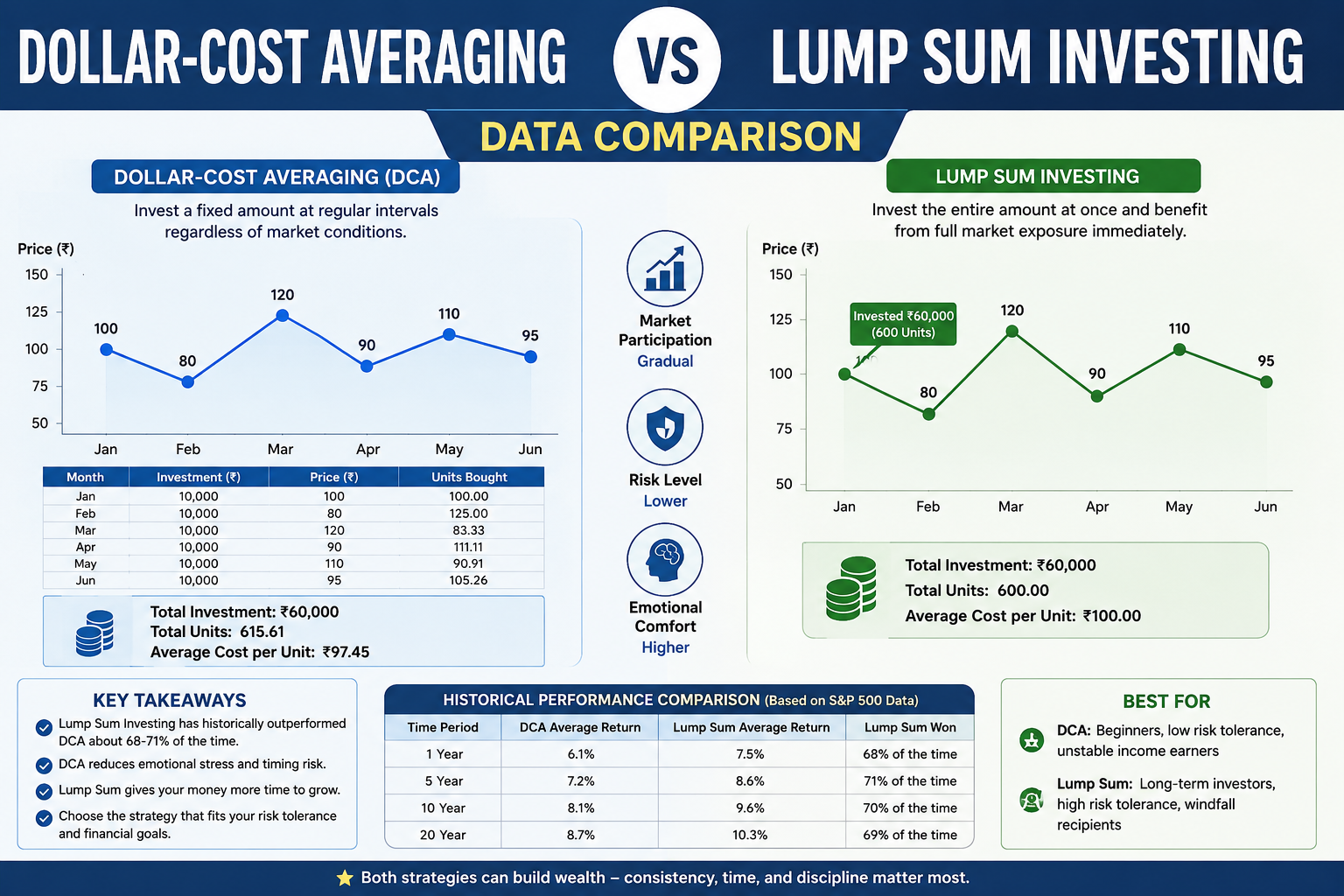
Dollar-Cost Averaging vs Lump Sum Investing (Complete Data Comparison Guide)
Dollar-Cost Averaging vs Lump Sum Investing is one of the most debated topics in personal finance and investing. Many investors wonder whether they should invest all their money at once or spread investments over time. Understanding the differences between Dollar-Cost Averaging vs Lump Sum Investing can significantly impact long-term returns, risk management, and emotional decision-making.
Investing is one of the most powerful ways to build wealth over time. But one question repeatedly creates confusion among beginners and even experienced investors:
Should you invest all your money at once, or should you spread it out over time?
This debate is known as:
- Dollar-Cost Averaging (DCA) vs Lump Sum Investing (LSI)
Both strategies are widely used by investors around the world. Both have advantages and disadvantages. Both can help build wealth. However, historical data shows important differences between them.
According to research frequently cited from Vanguard, lump sum investing historically outperformed dollar-cost averaging around two-thirds of the time across U.S., U.K., and Australian markets. (Vanguard)
But that does not automatically mean lump sum investing is best for everyone.
This guide explains:
- What DCA means
- What lump sum investing means
- Real historical data comparisons
- Psychological impact
- Risk analysis
- Market crash scenarios
- Case studies
- Examples with numbers
- Which strategy may fit different investors
Understanding the Basics
What Is Investing?
Investing means putting money into assets with the expectation that they will grow in value over time.
Examples include:
- Stocks
- Bonds
- ETFs
- Mutual funds
- Real estate
- Index funds
The main goal is to generate:
- Capital appreciation (growth)
- Income (dividends/interest)
- Long-term wealth
What Is Dollar-Cost Averaging (DCA)?
Definition
Dollar-cost averaging means investing a fixed amount of money at regular intervals regardless of market conditions.
For example:
- ₹10,000 every month
- $500 every month
- £200 every week
Whether markets rise or fall, the investor continues investing consistently.
Simple Example of DCA
Suppose you invest ₹10,000 every month into an ETF.
| Month | ETF Price | Amount Invested | Units Bought |
|---|---|---|---|
| January | ₹100 | ₹10,000 | 100 |
| February | ₹80 | ₹10,000 | 125 |
| March | ₹125 | ₹10,000 | 80 |
| April | ₹90 | ₹10,000 | 111 |
Total invested = ₹40,000
Total units = 416
Average purchase cost becomes lower than simply buying at one high price.
This is the core benefit of DCA.
What Is Lump Sum Investing?
Definition
Lump sum investing means investing all available money immediately into the market.
Example:
- Investing ₹5 lakh today
- Investing $100,000 immediately
- Putting an inheritance into index funds all at once
Instead of spreading investments across months or years, everything enters the market immediately.
Simple Lump Sum Example
Suppose you receive ₹5 lakh from:
- Bonus
- Inheritance
- Property sale
- Retirement payout
You invest the entire ₹5 lakh into an index fund today.
If markets rise afterward, your full capital benefits immediately.
Core Difference Between DCA and Lump Sum
| Feature | Dollar-Cost Averaging | Lump Sum Investing |
|---|---|---|
| Investment timing | Gradual | Immediate |
| Risk exposure | Lower short-term risk | Higher short-term risk |
| Emotional comfort | Higher | Lower |
| Market participation | Delayed | Immediate |
| Historical average returns | Usually lower | Usually higher |
| Best for | Nervous investors | Long-term disciplined investors |
Why This Debate Exists
The debate exists because markets are unpredictable in the short term.
Imagine investing ₹10 lakh today.
What if:
- The market crashes tomorrow?
- Recession starts next month?
- Stocks fall 30%?
That fear makes investors consider DCA.
However:
Markets historically rise over long periods.
That supports lump sum investing.
So the debate becomes:
Is reducing emotional risk worth sacrificing potential returns?
Historical Market Reality
Historically, stock markets trend upward over long periods.
Examples:
- S&P 500 has historically returned roughly 10% annually over long periods.
- NASDAQ Composite grew enormously over decades despite crashes.
- Global stock markets recovered after:
- 2008 Financial Crisis
- COVID-19 crash
- Dot-com crash
Because markets generally rise, investing earlier usually gives money more time to compound.
This is the biggest argument for lump sum investing.
The Mathematics Behind Lump Sum Advantage
The primary advantage of lump sum investing is:
More Time in the Market
There is a famous investing principle:
“Time in the market beats timing the market.”
When money enters the market earlier:
- Compounding starts earlier
- Dividends start earlier
- Recovery periods begin earlier
- Growth potential increases
Understanding Compounding
Compounding means earning returns on previous returns.
Example:
₹1,00,000 invested at 12% annual return:
| Year | Value |
|---|---|
| 1 | ₹1,12,000 |
| 5 | ₹1,76,234 |
| 10 | ₹3,10,585 |
| 20 | ₹9,64,629 |
The earlier money is invested, the longer compounding works.
What Historical Data Shows
Research from Vanguard found:
- Lump sum investing outperformed DCA about 68% of the time
- Across:
- U.S.
- U.K.
- Australia
- Using decades of historical market data from 1976 onward (Equicurious)
Key Historical Findings
| Strategy | Historical Success Rate |
|---|---|
| Lump Sum | ~68% |
| DCA | ~32% |
This means:
If investors had randomly selected historical periods:
- Lump sum usually produced higher returns
- DCA occasionally performed better during falling markets
Why Lump Sum Usually Wins
Because markets spend more time rising than falling.
Statistically:
- Bull markets last longer
- Economic growth continues
- Businesses innovate
- Productivity improves
Therefore:
Earlier investment exposure generally increases expected returns.
When DCA Wins
DCA performs better during:
- Market crashes
- Bear markets
- Recessions
- High volatility periods
Example:
If someone invested ₹10 lakh right before a 30% crash:
- Lump sum suffers immediate large losses
- DCA buys shares gradually at lower prices
This lowers average purchase cost.
Example: Market Crash Scenario
Lump Sum Investor
Invests ₹12 lakh in January.
Market crashes 30%.
Portfolio becomes:
₹8.4 lakh
Immediate emotional pain = very high.
DCA Investor
Invests ₹1 lakh monthly for 12 months.
As prices fall:
- Later purchases become cheaper
- More shares are accumulated
Average cost reduces.
Emotional Psychology in Investing
This is extremely important.
Investing is not only mathematics.
It is also behavior.
Many investors panic during crashes.
Fear and Regret
Imagine investing all savings today.
Tomorrow:
- Market crashes 20%
- News channels predict recession
- Social media spreads panic
Most beginners become emotionally stressed.
DCA helps reduce this emotional burden.
Psychological Benefit of DCA
DCA provides:
- Emotional comfort
- Reduced regret
- Lower anxiety
- Better investing discipline
This is one reason financial advisors still recommend DCA despite lower expected returns.
(Barron’s)
DCA Reduces Timing Risk
Timing risk means:
Investing at the wrong moment.
DCA reduces this risk because purchases happen across multiple prices.
Instead of buying everything at one price, investors buy at:
- High prices
- Medium prices
- Low prices
Average cost becomes smoother.
Real-World Case Study 1: Lump Sum Success
Scenario
Investor receives:
₹20 lakh inheritance
Chooses lump sum investing into:
S&P 500 ETF equivalent.
Outcome
Market rises 15% over next year.
Portfolio becomes:
₹23 lakh
Full capital benefited from the rally immediately.
Real-World Case Study 2: DCA Success
Scenario
Investor receives ₹20 lakh in January 2008 before financial crisis.
Uses DCA over 12 months.
What Happens?
Markets collapse during 2008.
Because money entered gradually:
- Later investments bought cheaper shares
- Average purchase price reduced significantly
DCA investor outperformed lump sum investor in short term.
The 2008 Financial Crisis Example
During the 2008 crisis:
- Global markets fell dramatically
- Investors panicked
- Banks failed
- Recession spread worldwide
A lump sum investor entering at peak suffered heavy temporary losses.
A DCA investor continued buying during falling prices.
This demonstrates why DCA can psychologically feel safer.
Opportunity Cost of DCA
The hidden cost of DCA is:
Idle Cash
While waiting to invest:
- Some money sits unused
- Cash earns lower returns
- Market gains may be missed
This is called opportunity cost.
Example:
₹10 lakh available today.
If only ₹1 lakh/month is invested:
- Remaining ₹9 lakh waits in cash
- If markets rise rapidly, gains are missed
This is why lump sum often wins historically.
Data Comparison Example
Suppose markets rise steadily:
| Strategy | Final Value |
|---|---|
| Lump Sum | ₹15 lakh |
| DCA | ₹13.8 lakh |
Reason:
Lump sum money compounded longer.
DCA Is Not “Safer”
This surprises many investors.
DCA reduces short-term volatility anxiety.
But mathematically:
Holding cash can also create risk.
Because inflation reduces cash purchasing power.
Inflation Impact
Suppose inflation = 6%.
₹10 lakh sitting partially in cash loses real value over time.
Meanwhile:
Stocks may continue rising.
This makes delayed investing expensive in some markets.
Long-Term Investors Usually Benefit More From Lump Sum
If your time horizon is:
- 10 years
- 20 years
- 30 years
Then short-term market crashes matter less.
Historically:
Long-term investors usually recovered from crashes.
Example of Long-Term Investing
Suppose:
- Investor A lump sums ₹10 lakh
- Investor B DCA invests over 2 years
After 25 years:
Difference may become massive due to compounding.
Even small early advantages multiply significantly.
The Importance of Risk Tolerance
What Is Risk Tolerance?
Risk tolerance means:
Your ability to emotionally and financially handle losses.
Some people panic at 10% declines.
Others remain calm during 40% crashes.
High Risk Tolerance Investors
Usually prefer:
- Lump sum investing
- Aggressive growth
- Long-term equity exposure
Because they can tolerate volatility.
Low Risk Tolerance Investors
Usually prefer:
- DCA
- Gradual entry
- Reduced stress
Because emotional stability matters more.
Hybrid Strategy (Best of Both Worlds)
Many investors now use:
Hybrid Investing
Example:
- Invest 50% immediately
- DCA remaining 50% over 6 months
Benefits:
- Partial market exposure
- Reduced regret risk
- Better emotional balance
Some studies suggest hybrid approaches capture most lump sum benefits while reducing psychological stress. (FinanceWonk)
DCA in Retirement Accounts
Many people already use DCA without realizing it.
Example:
- Monthly SIPs in India
- 401(k) contributions in the U.S.
- Pension contributions
- Salary deductions
Every paycheck investment is effectively DCA.
SIP Investing in India
In India:
Systematic Investment Plans (SIPs) are extremely popular.
SIPs are essentially DCA into mutual funds.
Benefits include:
- Discipline
- Automation
- Affordability
- Emotional control
Why Beginners Prefer DCA
Beginners often:
- Fear losses
- Lack market experience
- Overreact emotionally
DCA simplifies investing.
Instead of predicting markets, they invest consistently.
Why Professionals Often Prefer Lump Sum
Institutional investors and research firms often prefer lump sum because:
- Markets trend upward
- Earlier exposure historically wins
- Long-term expected return improves
But professionals also understand emotional risks.
Volatility Explained
What Is Volatility?
Volatility means how much prices fluctuate.
High volatility:
- Big daily movements
- Higher uncertainty
- More emotional stress
DCA helps smooth volatility effects.
Bear Market Example
What Is a Bear Market?
A bear market occurs when markets fall 20% or more.
During bear markets:
- DCA can outperform temporarily
- Investors accumulate cheaper shares
- Lump sum investors face bigger early declines
Bull Market Example
What Is a Bull Market?
A bull market means prices generally rise.
During bull markets:
- Lump sum strongly outperforms
- Earlier capital exposure matters most
Since markets historically spend more time rising, lump sum often wins overall.
Common Mistakes Investors Make
1. Waiting Forever
Some investors delay investing for years.
This becomes harmful because:
- Inflation grows
- Compounding is delayed
- Opportunities are lost
2. Panic Selling
Investors often:
- Buy during excitement
- Sell during fear
This destroys returns.
3. Trying to Time Markets
Perfect market timing is extremely difficult.
Even professionals struggle.
Academic Research Findings
Research papers analyzing historical stock data generally conclude:
- Lump sum has higher expected returns
- DCA lowers short-term emotional volatility
- Long-term discipline matters most
(arXiv)
Reddit Community Discussions
Investing communities on Reddit frequently discuss this topic.
A common theme appears repeatedly:
Lump sum usually wins mathematically, but DCA helps people stay invested emotionally.
(Reddit)
Example Portfolio Comparison
Scenario
Investment amount = ₹12 lakh
Time horizon = 10 years
Annual market return = 12%
Lump Sum Result
Entire ₹12 lakh invested immediately.
Approximate value after 10 years:
₹37.2 lakh
DCA Result
₹1 lakh invested monthly over 12 months.
Approximate value after 10 years:
₹34–35 lakh
Difference exists because lump sum started compounding earlier.
Is Lump Sum More Dangerous?
Short term: yes.
Long term: not necessarily.
Historically:
- Markets recovered over time
- Patience rewarded investors
However:
Emotional discipline is critical.
Which Strategy Is Better During Recession?
During uncertain markets:
- DCA may feel safer
- Reduces regret risk
- Helps nervous investors stay invested
But if recession fears are exaggerated and markets rebound quickly:
- Lump sum can outperform dramatically
Age and Strategy Choice
Younger Investors
Usually benefit from:
- Lump sum
- Higher equity exposure
- Long time horizon
Because recovery time is long.
Older Investors
May prefer:
- DCA
- Lower volatility
- Gradual entry
Especially near retirement.
Wealth Building Perspective
Wealth creation depends more on:
- Consistency
- Time horizon
- Asset allocation
- Staying invested
Than choosing perfect entry timing.
Key Insight Most Investors Miss
The biggest investing mistake is often:
Not Investing At All
People spend years waiting for:
- Market crashes
- Perfect entry points
- Economic certainty
Meanwhile:
Markets continue compounding.
The “Peace of Mind Tax”
Some experts call DCA’s lower expected returns:
The peace of mind tax.
Meaning:
You may accept slightly lower returns in exchange for emotional comfort.
For many investors, this tradeoff is worthwhile.
Best Strategy for Different Investor Types
| Investor Type | Better Strategy |
|---|---|
| Nervous beginner | DCA |
| Long-term disciplined investor | Lump Sum |
| Windfall recipient | Lump Sum or Hybrid |
| Retiree | DCA |
| Young aggressive investor | Lump Sum |
| Emotional investor | DCA |
| Experienced investor | Lump Sum |
Important Truth About Both Strategies
Both strategies can build substantial wealth if:
- Investments are diversified
- Costs are low
- Time horizon is long
- Investor stays disciplined
ETFs and Index Funds
Both strategies work especially well with:
- Index funds
- Broad-market ETFs
- Low-cost diversified portfolios
Examples include:
- S&P 500 index funds
- Total market ETFs
- Global equity funds
Final Comparison Summary
| Factor | DCA | Lump Sum |
|---|---|---|
| Emotional comfort | Excellent | Lower |
| Historical return potential | Lower | Higher |
| Market timing risk | Lower | Higher |
| Long-term compounding | Slower | Faster |
| Volatility management | Better | Worse |
| Simplicity | Easy | Easy |
| Best during crashes | Often | Sometimes painful |
| Best during bull markets | Usually weaker | Usually stronger |
FAQs
1. What is Dollar-Cost Averaging (DCA)?
Dollar-Cost Averaging is an investment strategy where you invest a fixed amount at regular intervals regardless of market conditions.
2. What is Lump Sum Investing?
Lump Sum Investing means investing your entire available amount in the market at one time.
3. Which is better: Dollar-Cost Averaging or Lump Sum Investing?
Lump Sum Investing has historically outperformed DCA, but the best choice depends on your risk tolerance and goals.
4. Is Dollar-Cost Averaging good during a market crash?
Yes, DCA allows you to buy more shares at lower prices during market declines.
5. Why does Lump Sum Investing often generate higher returns?
Lump Sum Investing gives your money more time to compound in the market.
6. Is Dollar-Cost Averaging suitable for beginners?
Yes, DCA is ideal for beginners because it reduces emotional investing and market timing risk.
7. Is SIP the same as Dollar-Cost Averaging?
Yes, a Systematic Investment Plan (SIP) is a form of Dollar-Cost Averaging.
8. Can I combine Dollar-Cost Averaging and Lump Sum Investing?
Yes, a hybrid strategy combines immediate investing with regular investments over time.
9. Does Dollar-Cost Averaging eliminate investment risk?
No, DCA reduces timing risk but cannot eliminate market risk.
10. When should I choose Lump Sum Investing?
Lump Sum Investing is generally suitable when you have a long-term investment horizon and can tolerate market volatility.
11. Which strategy is better for long-term wealth creation?
Lump Sum Investing has historically produced higher long-term returns in rising markets.
12. What is the biggest advantage of Dollar-Cost Averaging?
The biggest advantage of DCA is reducing emotional stress while maintaining consistent investing discipline.
Final Conclusion
Dollar-cost averaging and lump sum investing are both valid investing strategies.
However, historical evidence strongly suggests that:
Lump sum investing usually produces higher long-term returns because markets generally rise over time. (Vanguard)
But investing is not only about mathematics.
It is also about:
- Psychology
- Discipline
- Emotional control
- Risk tolerance
For investors who panic easily or fear market crashes, DCA can provide emotional stability and help them remain invested consistently.
For disciplined long-term investors comfortable with volatility, lump sum investing may maximize expected returns.
In reality, the “best” strategy is often the one that helps you:
- Stay invested
- Avoid panic selling
- Continue compounding for decades
Because ultimately:
Long-term investing success depends less on perfect timing and more on consistency, patience, and time in the market.
How to Analyze a Stock Before Buying: 10 Powerful & Proven Steps (2026 Guide)