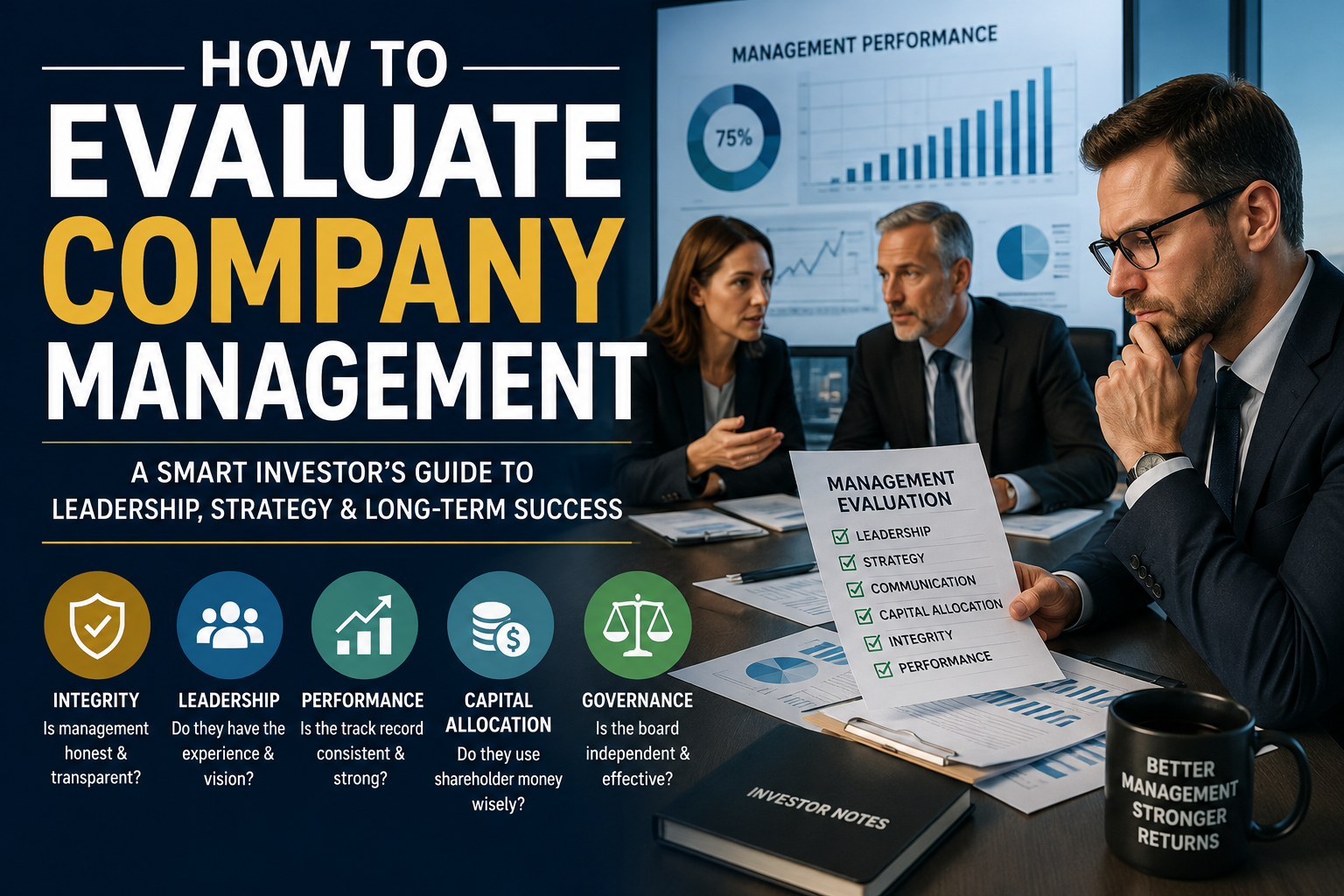
Introduction: How to Evaluate Company Management
Learning how to evaluate company management is an essential skill for investors who want to identify businesses capable of creating sustainable long-term shareholder value. Revenue growth, earnings, valuation ratios, and competitive advantages are important, but they cannot tell the whole story. Understanding how to evaluate company management helps investors look beyond financial statements and assess the leadership decisions that influence a company’s long-term performance. Investors must also understand the people making decisions about the company’s money, employees, strategy, and future.
Two businesses may operate in the same industry and generate similar revenue, yet produce very different long-term results. One management team may reinvest profits intelligently, maintain financial discipline, and build customer loyalty. Another may overpay for acquisitions, borrow excessively, ignore operational problems, or reward executives despite disappointing results.
Investors should also understand the wider context of stock market investing fundamentals before assessing individual companies.
For investors in the United States, United Kingdom, Canada, and Australia, public company filings provide valuable evidence about leadership decisions. Annual reports, proxy statements, corporate governance disclosures, and financial statements can help investors separate management promises from measurable performance.
This guide explains how to evaluate company management through practical methods, financial metrics, governance checks, and documented real-world case studies. It is an educational framework, not a recommendation to buy or sell any particular stock.
Readers who are new to investing can review these investing basics for beginners before applying the management evaluation framework.
What Is Company Management?
Company management refers to the executives and leadership structures responsible for operating a business and implementing its strategy.
The Chief Executive Officer (CEO) oversees the company’s overall direction. The Chief Financial Officer (CFO) manages financial reporting, budgeting, liquidity, and financial planning. The Chief Operating Officer (COO), where the position exists, generally oversees day-to-day operations.
The board of directors is different from the executive management team. The board supervises management, appoints or evaluates the CEO, oversees important risks, and represents shareholder interests under the applicable legal framework.
Corporate stewardship means managing resources responsibly on behalf of the people and institutions that have invested in the business. Investors should examine whether executives act as responsible stewards of shareholder capital.
Why Management Evaluation Matters
Management decisions influence profitability, innovation, financial risk, employee retention, and the company’s competitive position. A systematic approach to how to evaluate company management helps investors distinguish sustainable business performance from temporary growth or favorable market conditions.
Strong leaders can improve operations, respond to technological changes, protect liquidity during recessions, and allocate capital to attractive opportunities. Weak leadership can undermine an otherwise promising business through poor decisions or ineffective controls.
However, good management does not automatically make a stock a good investment. A well-run company can still be overpriced, face declining industry demand, or experience unexpected risks. Management quality must be assessed alongside business quality, financial strength, and valuation.
Key Qualities of Great Management
The first step in how to evaluate company management is to examine integrity, competence, accountability, and the ability to make sound long-term decisions.
1. Integrity
Integrity means honesty, ethical conduct, and accurate communication with shareholders, employees, customers, and regulators.
Investors should check whether management acknowledges mistakes, explains material risks, and reports financial results consistently. Repeated accounting restatements, misleading disclosures, or unexplained related-party transactions deserve further investigation.
A famous cautionary example is Enron. The company’s accounting scandal demonstrated how misleading financial reporting and weak oversight can destroy confidence in a business.
Read the U.S. Department of Justice’s historical account of the Enron prosecution for background on corporate fraud and accountability.
Key question: Does management communicate honestly when business performance deteriorates, or does it consistently present setbacks as temporary problems beyond its control?
2. Competence
Competence is management’s ability to make sound decisions and execute a business strategy.
Investors can assess competence by reviewing revenue growth, operating margins, customer retention, productivity, product development, and performance against previously announced goals.
A company growing revenue by 20% annually may appear successful, but the growth is less impressive if operating losses expand, debt increases rapidly, or customer acquisition costs become unsustainable.
Compare several years of performance rather than relying on a single quarter. Also consider industry conditions: growth during a strong economic expansion may not demonstrate the same ability as disciplined execution during a downturn.
3. Long-Term Thinking
Long-term thinking means prioritizing sustainable business value over temporary improvements in reported results.
Management may need to invest in research, employee training, cybersecurity, production capacity, or distribution systems before the financial benefits become visible.
Amazon provides a useful historical example of long-term investment in logistics, technology, and cloud infrastructure. Its development illustrates why investors should evaluate reinvestment decisions over several years rather than judge every decision by immediate accounting profit.
Long-term thinking does not justify unlimited spending. Investors must still ask whether investments have realistic objectives, measurable milestones, and credible expected returns.
Investors evaluating management decisions should also understand strategies for building long-term wealth and the importance of disciplined investing over time.
4. Capital Allocation Skills
Capital allocation is the process of deciding how a company should use its available money. When researching how to evaluate company management, examine whether executives direct capital toward productive investments or use it in ways that unnecessarily increase financial risk.
Management can reinvest earnings, acquire another business, repay debt, pay dividends, or repurchase shares. Each choice has a different effect on financial risk and shareholder value.
A good management team compares opportunities based on expected returns, risk, timing, and the company’s financial position. It does not automatically reinvest every dollar or distribute all available cash.
Investors can also learn about building a diversified investment portfolio when assessing how management allocates capital across business opportunities and financial risks.
Understanding Capital Allocation
Reinvestment
Reinvestment means putting money back into the business to support future growth. Examples include building new facilities, improving software, opening stores, and developing products.
Investors should evaluate whether new investment produces attractive incremental returns. Expansion that increases revenue but consistently earns less than the cost of capital may destroy value.
Acquisitions
An acquisition occurs when a company purchases another business or its assets. Acquisitions can add technology, customers, distribution, or new capabilities, but they can also create integration problems and excessive debt.
The AOL–Time Warner merger is a well-known historical cautionary example. The companies announced the combination during the technology boom, but the merged business struggled with strategic integration and changing market conditions. The lesson is not that all acquisitions fail; it is that management must justify the purchase price and demonstrate that the expected benefits are achievable.
Share Buybacks
A share buyback occurs when a company repurchases its own shares, reducing the number of shares outstanding.
Buybacks can benefit continuing shareholders when shares are purchased below their reasonable intrinsic value and the company can afford the expenditure. They can destroy value when management overpays, borrows excessively, or prioritizes short-term earnings-per-share targets over business resilience.
Dividends
Dividends distribute part of a company’s profits or accumulated resources to shareholders. A sustainable dividend should be supported by the company’s cash generation and financial obligations.
Investors should not assume that a high dividend yield indicates excellent management. A yield may rise because the stock price has fallen in anticipation of financial difficulties.
Evaluating CEO Performance
The CEO is responsible for the company’s strategic direction and overall execution. Evaluating the CEO requires comparing stated objectives with actual results while accounting for market conditions and decisions inherited from previous leadership.
An important part of how to evaluate company management is comparing the CEO’s stated objectives with actual financial results, operational progress, and decisions made over several years.
Important CEO Evaluation Metrics
Revenue Growth
Revenue is the money a company earns from its ordinary business activities before expenses are deducted.
Consistent growth can indicate increasing demand, successful product launches, or expansion into new markets. However, investors should distinguish organic growth from growth caused by acquisitions, price increases, or currency movements.
Profitability
Profitability measures how effectively a company converts revenue into earnings.
Operating margin is operating income divided by revenue. Net profit margin is net income divided by revenue. Comparing these figures across several years can reveal whether management is controlling costs and maintaining pricing power.
A company can grow quickly while profitability deteriorates. Investigate the reasons rather than assuming that growth alone demonstrates leadership quality.
Return on Invested Capital (ROIC)
ROIC measures how efficiently a business generates after-tax operating profit from the capital invested in its operations.
A common analytical formula is:
ROIC = NOPAT ÷ Average Invested Capital
NOPAT means net operating profit after taxes. Invested capital generally represents the capital used to operate the business, calculated using a consistent methodology.
Compare ROIC with the company’s weighted average cost of capital (WACC), which estimates the blended cost of its debt and equity financing. Sustained returns above that cost can indicate value creation, although accounting adjustments and industry characteristics matter.
Employee Retention
Employee retention measures how effectively an organization keeps its workforce. High turnover can increase recruitment and training costs and may indicate workplace problems.
However, turnover varies by industry and role. Use employee disclosures, workforce trends, and credible independent reporting rather than relying exclusively on anonymous online reviews.
The Importance of Corporate Culture
Corporate culture is the collection of shared values, habits, incentives, and behaviors that influence how employees make decisions.
A healthy culture encourages accountability, ethical conduct, constructive disagreement, and early reporting of problems. An unhealthy culture may discourage employees from challenging unrealistic deadlines or raising safety concerns.
Microsoft’s cultural and strategic transformation under CEO Satya Nadella is a useful example of leadership emphasizing collaboration and cloud-based services. When studying such a transformation, evaluate measurable business results alongside leadership statements instead of attributing every improvement to one executive.
Culture is especially important in regulated industries, including aviation, banking, healthcare, and energy, where poor internal communication can create serious operational and financial consequences.
How Management Communicates With Investors
Management communication reveals how executives explain their decisions, risks, and priorities. Investors studying how to evaluate company management should compare public promises with subsequent disclosures to determine whether leadership communicates consistently and accepts responsibility for setbacks.
Review annual reports, earnings-call transcripts, shareholder letters, and investor presentations. Compare the language used before a major decision with the subsequent results.
Strong communication is specific, balanced, and supported by evidence. Management should explain both successes and failures, distinguish estimates from established facts, and disclose material risks.
Be cautious when executives repeatedly use optimistic forecasts without explaining assumptions or when reported performance differs substantially from their earlier expectations.
Reading Annual Reports
An annual report provides an overview of a company’s business, risks, financial statements, and management’s explanation of its performance. For investors learning how to evaluate company management, annual reports provide essential evidence about executive decisions, business risks, financial performance, and strategic priorities.
For U.S.-listed companies, the SEC’s EDGAR company filings database provides access to public filings.
Important documents include:
- Form 10-K: The annual filing containing business information, risk factors, financial statements, and management discussion.
- Form 10-Q: The quarterly filing that updates financial and operational information.
- DEF 14A proxy statement: A document that commonly contains executive compensation, board information, and shareholder voting matters.
Canadian, UK, and Australian investors should use the corresponding national disclosure systems and the company’s official investor-relations website.
Management Discussion and Analysis (MD&A)
Management Discussion and Analysis explains management’s interpretation of financial performance, liquidity, capital resources, and important trends.
Read it alongside the audited financial statements. Look for explanations of margin changes, unusual expenses, debt maturities, capital expenditure plans, and cash-flow movements.
Compare management’s current explanation with previous reports. If executives repeatedly promise improvements but the same operational problems persist, investigate whether the strategy is ineffective or the targets were unrealistic.
Evaluating the Board of Directors
The board oversees the CEO and other senior executives. A thorough review of how to evaluate company management should also consider whether directors independently challenge executives and protect shareholders from conflicts of interest. Its effectiveness depends on independence, relevant experience, access to reliable information, and willingness to challenge management.
Review directors’ backgrounds, committee responsibilities, attendance, tenure, and potential conflicts of interest.
Independent directors can improve oversight, but independence on paper does not guarantee effective governance. Investors should look for evidence that the board addresses material risks and holds executives accountable.
Corporate Governance
Corporate governance refers to the systems, policies, and procedures through which a company is directed and supervised.
Important areas include shareholder voting rights, internal controls, audit oversight, related-party transactions, whistleblower protections, and risk management.
Weak governance can allow executives to pursue personal interests at shareholders’ expense. Dual-class shares, for example, may give founders voting control disproportionate to their economic ownership. This arrangement can support long-term decision-making but can also reduce the influence of outside shareholders.
Executive Compensation
Executive compensation may include salary, annual bonuses, restricted stock, stock options, and long-term performance awards. When assessing how to evaluate company management, check whether compensation rewards sustainable profitability and long-term value creation rather than short-term financial targets alone.
The key question is whether compensation encourages durable business performance rather than short-term manipulation.
Examine the performance measures used to determine bonuses. Revenue growth alone may encourage unprofitable expansion, while earnings-per-share targets may encourage excessive buybacks. A balanced structure may incorporate profitability, cash generation, returns on capital, safety, and long-term shareholder outcomes.
Compare executive pay with company size, performance, and relevant peers. High pay alone does not prove poor management; the relationship between pay and results matters more.
Insider Ownership
Insider ownership refers to shares held by executives, directors, and other company insiders.
Meaningful ownership can align leadership’s financial interests with those of shareholders. Nevertheless, ownership concentration can also create governance risks, especially when a founder controls voting rights or the board.
Review beneficial ownership disclosures and distinguish actual share ownership from unexercised options or other compensation awards.
Insider Buying and Selling
Insider transactions can provide context about management incentives and confidence, but they are not reliable standalone investment signals.
Executives may sell shares to diversify their wealth, meet tax obligations, or follow predetermined trading plans. Purchases may reflect confidence, but they do not guarantee that a stock is undervalued.
Check the size, timing, and pattern of transactions, as well as the applicable disclosure rules. In the United States, company filings and insider transaction disclosures are accessible through SEC EDGAR.
Management Track Record
A track record is the history of decisions and outcomes associated with management. Reviewing this history is central to how to evaluate company management because previous decisions can reveal patterns in risk-taking, capital allocation, and execution.
Review previous acquisitions, product launches, debt decisions, restructuring programs, and crisis responses. Ask whether executives achieved the objectives they announced and whether the results were sustainable.
Also consider inherited circumstances. A new CEO should not automatically receive credit for investments made by a predecessor, nor should a new leadership team automatically be blamed for every historical problem.
Crisis Management
A crisis tests whether management can identify problems, communicate honestly, protect stakeholders, and correct failures.
Examples include recessions, cybersecurity breaches, product defects, regulatory investigations, and supply-chain disruptions.
Evaluate the speed and quality of the response. Did leadership disclose material information, investigate the root cause, preserve liquidity, and implement corrective action? Or did the company repeatedly experience similar failures without meaningful improvement?
Case Study: Boeing’s Manufacturing-Quality Failures
Boeing illustrates why investors must assess operational controls and safety culture, not just revenue and order books.
Following the January 5, 2024, Alaska Airlines Flight 1282 incident involving a Boeing 737-9 MAX door plug, the U.S. National Transportation Safety Board issued findings on June 24, 2025. The NTSB identified inadequate training, guidance, and oversight as the probable cause of the incident and highlighted deficiencies in Boeing’s safety-management processes and the FAA’s oversight.
These are documented findings about a specific event, not proof that every Boeing executive or decision was deficient. Nevertheless, the case demonstrates how weaknesses in manufacturing processes, documentation, training, and oversight can become major operational and financial risks.
Read the NTSB’s June 2025 findings and Boeing’s 2025 Chief Aerospace Safety Officer Report. Compare the company’s stated corrective actions with independently verified progress.
Innovation and Adaptability
Innovation means developing or improving products, services, processes, or business models. Adaptability is the ability to respond when customer preferences, technology, or competitive conditions change.
Kodak’s decline is a historical warning about the risks of failing to adapt to digital photography. The company had developed early digital-camera technology but struggled to transition its business away from its traditional film-based model.
When evaluating a modern company, examine research and development spending, product adoption, customer retention, and the commercial results of new initiatives. Research expenditure is not automatically productive; investors must assess whether innovation creates sustainable economic value.
Vision and Strategic Direction
A strategic vision describes what management wants the company to become and how it intends to compete.
A credible strategy identifies target customers, competitive advantages, required investment, major risks, and measurable objectives. It also explains what management will not pursue.
Beware of strategies built primarily around fashionable terms or large market forecasts without clear execution plans. Compare the company’s actual capital expenditure and hiring decisions with its stated priorities.
Financial Discipline
Financial discipline means balancing growth ambitions with liquidity, debt obligations, costs, and uncertainty. Investors researching how to evaluate company management should check whether leadership maintains adequate liquidity and avoids taking unnecessary financial risks to pursue growth.
Strong management maintains enough financial flexibility to survive difficult conditions while investing in worthwhile opportunities. Weak discipline may produce excessive borrowing, unnecessary acquisitions, or commitments that become unsustainable when demand falls.
Examine debt maturities, interest expense, cash reserves, lease obligations, and contingent liabilities rather than relying on one balance-sheet ratio.
Debt Management
Debt can fund productive investment, but excessive borrowing increases financial risk.
The debt-to-equity ratio compares debt with shareholders’ equity. Its interpretation varies by industry, and negative or unusually small equity can make the ratio misleading.
For non-financial companies, also consider net debt, interest coverage, and the ability to generate cash to meet obligations. Banks and insurers require industry-specific analysis because borrowing and financial leverage are fundamental to their operations.
Free Cash Flow
Free cash flow (FCF) is commonly calculated as operating cash flow minus capital expenditure. It estimates the cash remaining after a business funds its operating activities and investments in property, plant, and equipment.
Consistent FCF can give management flexibility to repay debt, invest, pay dividends, or repurchase shares.
However, one unusually strong year may reflect temporary working-capital movements or deferred investment. Compare several years of cash flow with reported earnings and investigate large differences between accounting profit and cash generation.
Return on Equity (ROE)
Return on equity measures net income relative to shareholders’ equity.
ROE = Net Income ÷ Average Shareholders’ Equity
A high ROE can indicate efficient use of shareholder capital. However, leverage and share repurchases can reduce the equity base and inflate the ratio.
Use ROE alongside ROIC, debt measures, and cash-flow analysis. For banks, ROE should be assessed with capital adequacy, loan quality, and credit-loss indicators.
Transparency and Accounting Quality
Accounting quality determines how faithfully financial statements represent a company’s underlying performance. An essential part of how to evaluate company management is checking whether reported earnings are supported by cash flow and transparent financial disclosures.
Warning signs include repeated restatements, unexplained changes in accounting estimates, large adjustments excluded from management’s preferred earnings measures, and rising receivables that outpace revenue.
Compare net income with operating cash flow, read auditor opinions, and review material weaknesses in internal controls. An auditor’s clean opinion is useful evidence, but it does not guarantee that fraud or future problems are impossible.
Red Flags in Management Evaluation
1. Constant Excuses
Management should explain external pressures while accepting responsibility for decisions within its control. Repeatedly blaming the economy or competitors without corrective action may indicate weak accountability.
2. Frequent Strategy Changes
Frequent changes can be justified when market conditions shift. The warning sign is a pattern of poorly explained reversals that waste capital and undermine execution.
3. Excessive Debt-Funded Acquisitions
Repeated acquisitions funded by borrowing may increase financial risk. Check whether acquired businesses generate the expected cash flow and whether debt remains manageable.
4. Overpromising
Repeatedly missed targets, unsupported forecasts, and exaggerated claims deserve scrutiny. Compare previous guidance with actual results and look for consistent explanations of forecast errors.
5. Insider Selling
Insider selling should be examined in context. A broad pattern of sales combined with deteriorating results or misleading public statements warrants closer review, but selling alone does not establish misconduct.
Comparing Management Across Industries
Management quality must be assessed using industry-appropriate evidence.
Technology Companies
Evaluate product innovation, research efficiency, cybersecurity, customer retention, and competitive positioning. Companies such as NVIDIA and Alphabet operate in markets where technological change and capital allocation are important.
Banking
Examine credit quality, loan-loss provisions, liquidity, capital adequacy, compliance, and risk controls. Revenue growth is not enough if it results from imprudent lending.
Consumer Goods
Review brand strength, pricing power, distribution, inventory management, and supply-chain resilience. Companies such as Procter & Gamble illustrate why consistent execution and consumer trust matter in established markets.
Airlines and Industrial Companies
Assess safety, maintenance, operational reliability, capital expenditure, and regulatory compliance. In these industries, cutting costs at the expense of quality can create consequences far beyond short-term financial performance.
Case Study: Berkshire Hathaway
Berkshire Hathaway offers a useful example of capital allocation, decentralized operations, shareholder communication, and leadership succession.
Its 2025 annual report documents the transition to Greg Abel as CEO effective January 1, 2026, following the board’s earlier appointment decision. The report also describes Berkshire’s decentralized operating structure and the importance of the CEO’s capital-allocation responsibilities.
This transition illustrates why investors should examine succession planning rather than assume a company’s performance depends indefinitely on one leader. A strong organization needs processes, capable managers, and a culture that can endure leadership changes.
Read Berkshire Hathaway’s 2025 annual report to study management’s discussion, risk disclosures, operating structure, and succession arrangements.
Case Study: General Electric
General Electric’s historical difficulties provide another lesson in complexity, leverage, and strategic focus. The company experienced substantial financial challenges as it dealt with business restructuring, problems in its financial operations, and a changing industrial environment.
The useful lesson is not that diversification is always harmful. Rather, investors should investigate whether management understands each business, allocates capital effectively, and maintains sufficient oversight across a complex organization.
When reviewing a diversified company, analyze its individual business segments, debt, cash generation, and capital requirements. Consolidated revenue can conceal weakness in important divisions.
Quantitative vs Qualitative Evaluation
Quantitative evaluation uses measurable data, including revenue growth, margins, debt ratios, ROIC, and cash flow. Qualitative evaluation examines leadership integrity, culture, communication, judgment, and strategic clarity.
Neither approach is sufficient alone. Financial metrics reveal outcomes but may not explain why they occurred. Qualitative evidence helps explain decisions but can be influenced by reputation, charisma, and personal bias.
A strong process combines both, checks management claims against independent evidence, and compares performance over multiple years.
Questions Investors Should Ask
Before investing in a company, ask:
- Does management communicate honestly about risks and mistakes?
- Are capital-allocation decisions creating sustainable value?
- Does the company generate cash as well as accounting profits?
- Are executive incentives linked to long-term results?
- Does the board provide effective oversight?
- Has management delivered on previously announced objectives?
- Can the business withstand a recession or operational shock?
- Is there a credible succession plan?
- Are related-party transactions and potential conflicts disclosed?
- Is the current stock valuation reasonable given the company’s risks and prospects?
Tools Investors Use to Evaluate Management
SEC Filings
U.S. investors can use the SEC EDGAR database to access annual reports, quarterly reports, proxy statements, and insider filings.
Earnings Calls
Transcripts help investors assess how executives explain results, respond to difficult questions, and discuss future priorities. Compare statements across multiple quarters.
Investor Presentations
Presentations can clarify strategy and financial targets. Verify important claims against formal filings and subsequent results.
Employee Reviews
Platforms such as Glassdoor may provide clues about workplace culture, but reviews can be unrepresentative or outdated. Treat them as supplementary evidence rather than definitive proof.
Country-Specific Sources
UK investors can use Companies House, while Australian investors can consult ASIC and ASX company announcements. Canadian investors can use SEDAR+.
How Institutional Investors Evaluate Management
Institutional investors, including pension funds and asset managers, often examine management through a combination of financial analysis, governance reviews, executive meetings, and risk assessments.
They may evaluate capital-allocation decisions, succession planning, operational controls, and whether executive incentives encourage sustainable results.
Individual investors can apply the same principles using public information. Direct access to executives is not essential to conduct a disciplined management review.
ESG and Management Evaluation
Environmental, Social, and Governance (ESG) analysis examines issues that may affect business sustainability and risk.
Governance includes board oversight, shareholder rights, executive pay, and ethical controls. Social considerations may include employee safety, labor practices, and customer treatment. Environmental considerations may include resource use, pollution, and climate-related exposure.
ESG ratings can differ across providers, so investors should investigate the underlying measures rather than treating a single rating as conclusive proof of management quality.
Management During Economic Cycles
Management quality becomes particularly visible during recessions and periods of financial stress.
Strong leaders may preserve liquidity, control unnecessary spending, maintain customer relationships, and continue investing in essential capabilities. Weak leaders may overborrow during expansions and face forced asset sales when conditions deteriorate.
Compare how the company performed during previous downturns, while accounting for differences in interest rates, demand, and industry conditions.
Founder-Led Companies
Founder-led companies can benefit from strong product knowledge, long-term commitment, and a clear strategic vision.
However, founder control may also weaken board independence or create succession risks. Investors should assess the quality of oversight, voting rights, related-party transactions, and whether the company can function effectively without its founder.
Founder status alone is neither proof of superior leadership nor evidence of poor governance.
Importance of Succession Planning
Succession planning identifies and prepares future leaders before a critical vacancy occurs.
Investors should examine whether the company has experienced executives capable of taking on greater responsibility and whether the board has a credible process for selecting the next CEO.
A company that relies excessively on one individual may face disruption if that person leaves unexpectedly. Berkshire Hathaway’s leadership transition is a useful reminder that continuity requires planning, not simply a celebrated founder or CEO.
Common Mistakes Investors Make
1. Ignoring Management
A low valuation or attractive financial ratio cannot compensate automatically for dishonest leadership or poor operational controls.
2. Trusting Charisma Alone
Confident speeches and ambitious promises should be tested against financial results and independent evidence.
3. Following Media Hype
Media attention can exaggerate a CEO’s importance while overlooking the contributions of employees, market conditions, and competitors.
4. Ignoring Governance
Investors who overlook voting rights, board independence, and executive incentives may underestimate risks that are not immediately visible in earnings.
Practical Framework for Evaluating Management
Use the following checklist to apply a consistent method for how to evaluate company management. Review the evidence for each category and document both strengths and potential warning signs before making an investment decision.
| Evaluation area | Evidence to review |
|---|---|
| Integrity | Disclosures, restatements, regulatory findings |
| Competence | Multi-year operating and financial results |
| Capital allocation | Reinvestment, acquisitions, dividends, buybacks |
| Financial discipline | Debt, liquidity, cash flow |
| Communication | Annual reports and earnings calls |
| Governance | Board independence and shareholder rights |
| Incentives | Executive compensation and ownership |
| Adaptability | Product development and response to disruption |
| Culture | Employee, safety, and operational indicators |
| Succession | Leadership depth and transition planning |
Score each area consistently, for example from 1 to 5, and record the evidence supporting the score. A score is a research aid, not a scientific prediction of future stock returns.
Real-World Example: Comparing Two CEOs
Consider two hypothetical retailers with similar revenue.
CEO A invests in inventory systems, keeps borrowing under control, explains setbacks clearly, and evaluates store expansion based on expected returns. CEO B increases debt to expand rapidly, makes acquisitions without clear integration plans, and rewards executives mainly for revenue growth.
CEO A appears to demonstrate stronger financial discipline. However, investors should still examine actual profitability, customer demand, competitive threats, and valuation before drawing a final conclusion.
The purpose of the comparison is to demonstrate a method, not to represent real companies or actual historical financial results.
Frequently Asked Questions
These frequently asked questions explain how to evaluate company management using financial evidence, executive disclosures, governance practices, and practical investing methods.
1. How do you evaluate company management before buying a stock?
Read the annual report and proxy statement, review multi-year financial results, examine capital allocation, and investigate governance, executive compensation, and management’s track record. Compare stated objectives with actual outcomes.
2. What is the most important quality of good management?
Integrity is foundational because investors need reliable information to assess a business. Competence, financial discipline, and strategic judgment are also essential.
3. Which financial ratios help evaluate management?
ROIC, operating margin, free cash flow, ROE, interest coverage, and debt ratios can help. No single metric proves management quality, and ratios must be interpreted in the context of the industry.
4. How can I check whether a CEO is honest?
Examine public disclosures, compare previous forecasts with results, read auditor reports, review regulatory findings, and look for transparent explanations of mistakes. No public checklist can establish a person’s honesty with certainty.
5. Why is capital allocation important?
Capital allocation determines how management uses cash to grow the business, reduce debt, acquire other companies, pay dividends, or repurchase shares. Poor decisions can destroy value even when the underlying business is profitable.
6. Is high insider ownership always a good sign?
No. Insider ownership can align incentives, but concentrated voting power can weaken oversight. Consider the amount owned, voting rights, related-party transactions, and board independence.
7. Are insider sales a warning sign?
Sometimes, but not automatically. Executives sell shares for many reasons, including diversification and tax obligations. Look at the broader pattern and relevant disclosures rather than one transaction.
8. Where can investors find reliable information about management?
Use official annual reports, proxy statements, regulator databases, audited financial statements, earnings calls, and company announcements. For U.S. public companies, SEC EDGAR is a key resource.
9. How do I evaluate management in a company with high debt?
Review debt maturities, interest coverage, liquidity, operating cash flow, and the company’s ability to meet obligations during a downturn. Compare leverage with industry peers and distinguish productive borrowing from borrowing that supports unsustainable expansion.
10. Can excellent management make an overvalued stock a good investment?
Not necessarily. Even an excellent business can produce disappointing returns if investors pay too much. Assess management quality alongside valuation, financial risk, business fundamentals, and your investment time horizon.
Final Thoughts
Learning how to evaluate company management helps investors look beyond stock prices, headlines, and short-term earnings. It encourages a disciplined examination of leadership decisions, financial reporting, capital allocation, corporate culture, and governance.
Strong management is more likely to communicate honestly, allocate capital rationally, respond to risks, and build systems that endure beyond one executive. Weak management may reveal itself through recurring operational failures, excessive leverage, poor incentives, or a persistent gap between promises and results.
The most useful approach combines quantitative evidence with qualitative judgment. Read official disclosures, compare multiple years of performance, investigate warning signs, and avoid relying on a CEO’s reputation alone. Management quality should be assessed alongside personal objectives, including planning for retirement through investing and maintaining an appropriate investment time horizon.
Ultimately, investors are not simply purchasing a company’s current earnings. They are also placing trust in the people responsible for protecting and deploying its resources. That trust should be earned through evidence, accountability, and consistent execution.
By applying these checks consistently, investors can make a more evidence-based assessment of leadership quality, business resilience, and potential long-term shareholder value.
Financial disclaimer: This article is for educational purposes only and does not constitute personalized financial, investment, legal, or tax advice. Investments can lose value. Consider your circumstances and consult a qualified professional when appropriate.