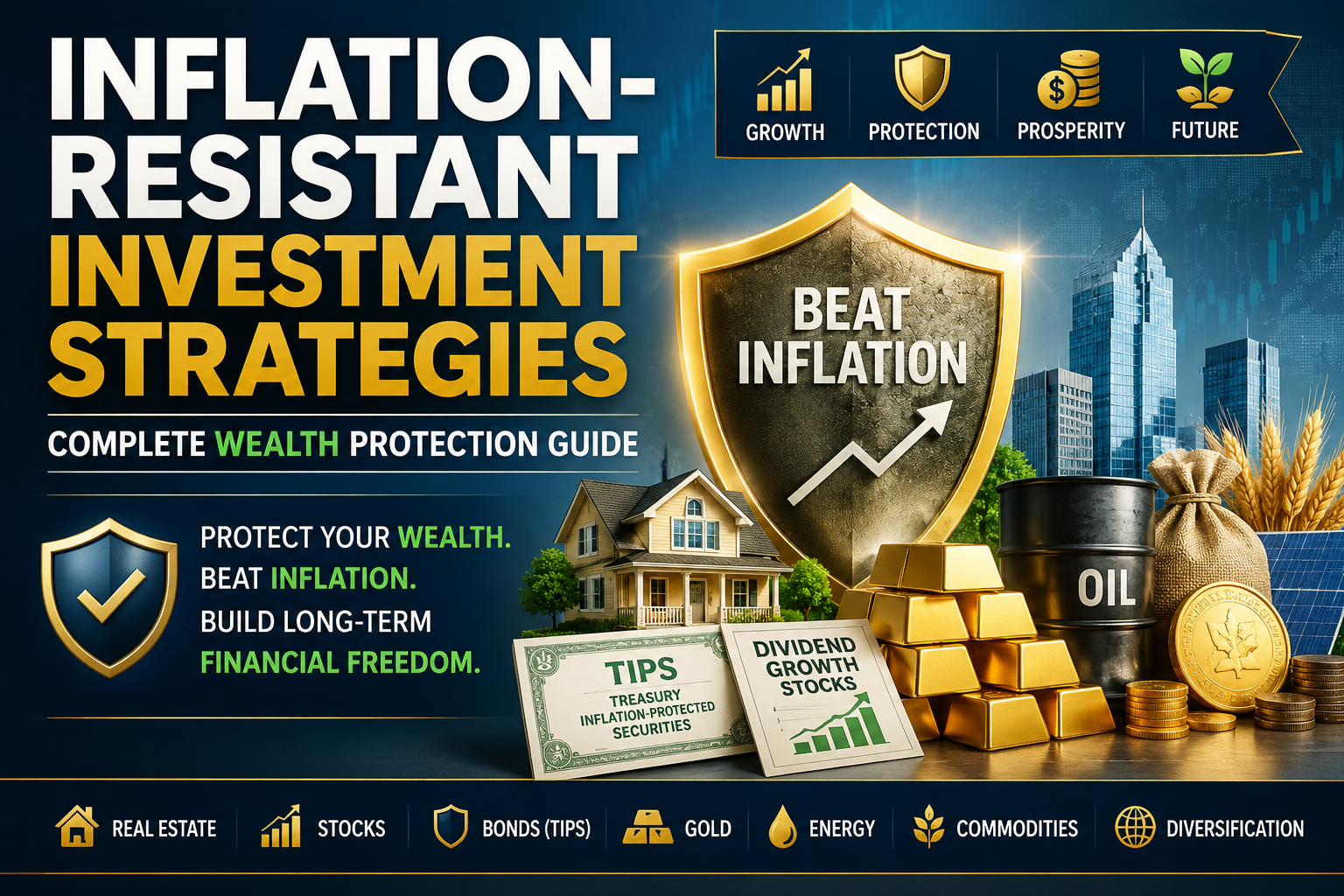
Introduction: Why Inflation-Resistant Investment Strategies Matter
Inflation-Resistant Investment Strategies help investors protect their purchasing power, manage rising living costs, and build long-term wealth when prices increase. For households and investors in the United States, United Kingdom, Canada, Australia, and other developed economies, inflation can affect everything from groceries and housing to healthcare, retirement income, and investment returns.
Imagine that you have $50,000 in a savings account. The balance may remain unchanged, but if prices rise by 4% annually, that money will buy less in the future. If your savings earn only 2% interest, your purchasing power declines even though your account earns a positive return.
This is why inflation deserves attention in long-term financial planning.
Inflation does not affect every investment equally. Some companies can increase prices without losing customers. Certain government bonds adjust their principal according to inflation. Rental properties may generate higher income over time, while broad stock-market investments can benefit from long-term business growth.
However, no investment is guaranteed to outperform inflation in every year. Real estate can decline, shares can fall, commodities can be volatile, and inflation-linked bonds can lose market value if sold before maturity.
The objective is therefore not to find one perfect inflation hedge. It is to build a diversified portfolio that can withstand different economic conditions.
This guide explains the terminology, investment options, calculations, historical case studies, and practical portfolio decisions investors can use to develop a more resilient financial strategy.
1. Understanding Inflation and Its Impact on Wealth
What Is Inflation?
Inflation is a sustained increase in the general price level of goods and services over time. As prices rise, each unit of currency purchases fewer goods and services.
For example, suppose a household spends $200 a week on groceries. If the prices of its usual groceries increase by 5%, the same basket would cost approximately $210, assuming the household buys the same quantities.
The additional $10 is not necessarily the result of buying more food. It reflects a higher cost for the same basket.
Inflation can be caused by strong consumer demand, supply shortages, higher production costs, wage pressures, or a combination of these factors.
For readers who are new to financial markets, understanding the fundamentals of investing is an important first step before choosing investments to protect their wealth. Our beginner investing guide explains how to get started, understand investment risks, and develop a long-term investing approach.
Important Inflation Terms Every Investor Should Know
Consumer Price Index (CPI): A statistical measure tracking changes in the prices consumers pay for a representative basket of goods and services. National statistical agencies use CPI to report inflation.
Core inflation: A measure that excludes selected volatile categories. In the United States, core CPI excludes food and energy. It helps analysts assess underlying price pressures, although it is not a perfect measure of future inflation.
Purchasing power: The quantity of goods and services that a particular amount of money can buy.
Nominal return: The percentage gain or loss on an investment before adjusting for inflation.
Real return: The investment return after accounting for inflation. It gives investors a better indication of how their purchasing power has changed.
Interest rate: The cost of borrowing money or the compensation received for lending or depositing money.
Inflation hedge: An investment or strategy intended to reduce the damaging effects of inflation on purchasing power.
Asset allocation: The distribution of investments among categories such as shares, bonds, cash, property, and commodities.
Diversification: Spreading investments across different assets, companies, sectors, and markets to reduce dependence on any single investment.
How to Calculate Your Real Investment Return
The following formula calculates the approximate relationship between investment returns and inflation.
Approximate real return = Nominal return − Inflation rate
For example, if an investment earns 8% and inflation is 3%, its approximate real return is 5%.
A more precise formula is:
Real return = [(1 + nominal return) ÷ (1 + inflation rate)] − 1
Suppose an investment earns 8% during a year when inflation is 3%.
Real return = (1.08 ÷ 1.03) − 1 = 4.85% approximately.
This is the return before considering taxes, investment fees, and other costs.
The distinction matters because earning money is not the same as increasing purchasing power. An investment that earns 3% while inflation is 5% has a negative real return.
2. What the Latest Inflation Data Tell Investors
Inflation-resistant investing should respond to economic evidence rather than headlines alone.
As of November 2, 2026, the latest available official releases show that inflation conditions differ across developed economies.
- United States: The Bureau of Labor Statistics reported annual CPI inflation of 3.7% for September 2026. Gasoline prices rose sharply that month and accounted for more than half of the monthly increase in the overall index. Source: U.S. Bureau of Labor Statistics.
- United Kingdom: The Office for National Statistics reported annual CPI inflation of 3.5% for September 2026, up from 3.1% in August. UK investors can verify inflation trends using the official ONS consumer price inflation statistics. CPIH, which also incorporates owner-occupiers’ housing costs, rose by 3.6%.
- Canada: The Bank of Canada’s published data showed annual CPI inflation of 3.1% for September 2026. Canadian investors can follow changes in consumer prices through the Bank of Canada’s Consumer Price Index data. Its core-inflation measures were lower than the headline figure, illustrating why investors should examine more than one indicator.
- Australia: The Australian Bureau of Statistics reported annual CPI inflation of 4.3% for September 2026, up from 4.0% in August. Australian investors can verify these figures and explore historical inflation trends through the Australian Bureau of Statistics Consumer Price Index releases. Trimmed-mean inflation, a measure intended to reduce the influence of unusually large price movements, was 3.6%.
These figures use each country’s own methodology and should not be treated as perfectly identical measurements.
What is the practical lesson? Investors should consider the inflation rate in the country where they live, the currency in which they spend money, their expected retirement expenses, and the inflation sensitivity of their investments. A strategy appropriate for a US investor may require adjustments for a British, Canadian, or Australian household.
3. Strategy One: Invest in High-Quality Stocks With Pricing Power
What Is Pricing Power?
Pricing power is a company’s ability to increase the prices of its products or services without losing too many customers or damaging its competitive position.
A company with a trusted brand, limited competition, essential products, or high customer switching costs may have stronger pricing power than a business selling an interchangeable product.
Understanding how shares are valued, traded, and influenced by economic conditions can help investors identify businesses with sustainable competitive advantages. Read our comprehensive stock market investing guide to understand market fundamentals, stock valuation, and long-term investment opportunities.
For example, a household may continue purchasing a familiar cleaning product even after its price increases slightly. A business selling an undifferentiated product in a highly competitive market may find that customers immediately switch to cheaper alternatives.
During inflation, companies face higher wages, transportation expenses, raw-material costs, rents, and energy bills. Strong businesses may offset some of these increases through price adjustments, productivity improvements, or better supply contracts.
How to Evaluate Inflation-Resistant Companies
Investors can examine:
- Gross profit margin: The proportion of revenue remaining after direct production costs.
- Operating margin: The proportion of revenue remaining after operating expenses.
- Free cash flow: Cash generated after operating expenses and capital expenditure.
- Debt levels: Borrowing that can become more expensive when interest rates rise.
- Customer loyalty: The likelihood that customers continue purchasing despite higher prices.
- Competitive advantage: Features that help a company defend its market position.
Companies associated with consumer staples, healthcare, software, and other established industries may possess pricing power, but sector membership alone does not make a stock safe.
Example: How Pricing Power Can Protect Profits
Consider a fictional household-products company with annual revenue of $100 million and operating costs of $80 million. Its operating profit is $20 million.
If costs increase by $5 million during inflation, but the company cannot increase prices, operating profit falls to $15 million.
If it raises prices and generates enough additional revenue to cover those higher costs without materially reducing demand, its profitability may remain stronger.
This illustrates why pricing power matters. It does not mean that a company’s share price will rise: investors must also consider valuation, interest rates, competition, and future earnings expectations.
4. Strategy Two: Dividend Growth Investing
What Is Dividend Growth Investing?
A dividend is a distribution that a company pays to shareholders, generally from profits or accumulated distributable resources. Dividend growth investing focuses on businesses with a record of increasing dividends and a credible ability to continue paying them.
A rising dividend can help investors meet future expenses. However, dividends are not guaranteed and can be reduced or suspended.
Two important measurements are:
Dividend yield = Annual dividend per share ÷ Current share price × 100
Dividend growth rate = (New dividend − Previous dividend) ÷ Previous dividend × 100
Suppose a company pays $2 per share annually and its share price is $50.
Its dividend yield is 4%.
If the annual dividend increases from $2 to $2.10, the growth rate is 5%.
For an investor who owns the shares, the dividend per share has increased. Nevertheless, whether that increase keeps pace with inflation depends on the inflation rate, and the investment’s total return also depends on changes in the share price.
What Should Investors Examine?
Review the company’s cash flow, payout ratio, debt, profitability, and history of dividend changes. The payout ratio measures the proportion of earnings or cash flow distributed as dividends, depending on the calculation used.
An unusually high yield may indicate that the market expects a dividend cut or that the company’s share price has fallen because of financial difficulties.
Dividend growth stocks can support an inflation-aware portfolio, but investors should not chase high yields without evaluating the underlying business.
5. Strategy Three: Inflation-Linked Government Bonds
What Are Treasury Inflation-Protected Securities?
Treasury Inflation-Protected Securities, commonly called TIPS, are US government securities designed to adjust their principal in response to changes in the Consumer Price Index. The US Treasury provides an official explanation of Treasury Inflation-Protected Securities (TIPS), including principal adjustments, interest payments, maturity, and inflation-related features.
Unlike conventional bonds with a fixed nominal principal, TIPS have an inflation-adjusted principal. Their fixed coupon rate is applied to that adjusted principal, so the dollar amount of interest payments can change as the principal changes.
For example, assume an investor purchases $10,000 of TIPS and the applicable inflation adjustment increases the principal by 3%. The adjusted principal would become approximately $10,300. A 2% annual coupon rate would then correspond to $206 in annual interest, paid according to the security’s payment schedule.
This is an illustration, not a forecast of an actual security’s return.
The US Treasury explains that TIPS principal can rise or fall with inflation or deflation, while investors who hold them to maturity receive at least the original principal under the security’s terms. Selling before maturity can result in a gain or loss because market prices fluctuate.
What About Other Countries?
The United Kingdom issues index-linked gilts, whose payments are linked to a specified inflation index under their terms. Other countries also offer inflation-linked government securities, although availability, tax treatment, indexation rules, and market liquidity vary.
These bonds can help match future inflation-sensitive liabilities. However, they are not risk-free in every practical sense: market interest rates, inflation expectations, taxes, and the timing of a sale all affect realized returns.
6. Strategy Four: Real Estate and Rental Properties
Why Property May Help During Inflation
Real estate includes residential property, commercial buildings, industrial premises, and other land or structures. It can offer two potential sources of return: rental income and changes in property value.
During some inflationary periods, replacement construction costs and rents rise. Owners of well-located properties may benefit if lease terms permit rent increases and tenants can afford them.
However, rent increases are not automatic. Local regulations, lease agreements, weak demand, high vacancy rates, maintenance costs, and borrowing costs can limit returns.
Calculate Rental Yield
Gross rental yield = Annual rental income ÷ Property purchase price × 100
Suppose a property costs $300,000 and generates $18,000 in annual rent.
Gross rental yield = ($18,000 ÷ $300,000) × 100 = 6%.
This figure excludes property taxes, insurance, repairs, vacancy periods, management fees, financing costs, and transaction expenses.
Net rental yield is more informative because it deducts relevant operating expenses. Investors using a mortgage should also calculate cash flow after debt payments.
Case Example: A Rental Property During Inflation
Imagine an investor owns a rental apartment and annual rent increases from $18,000 to $18,900, a 5% increase. If maintenance, insurance, and financing expenses rise by more than the rental income, net cash flow may actually decline.
The lesson is that property owners should evaluate income after expenses, not simply assume that higher rents mean higher profits.
7. Strategy Five: Real Estate Investment Trusts (REITs)
A Real Estate Investment Trust, or REIT, is an investment vehicle that owns, finances, or operates income-producing real estate, depending on its structure and jurisdiction.
Listed REITs allow investors to obtain exposure to property markets without purchasing an entire building. Examples of property types include apartments, warehouses, healthcare facilities, shopping centres, and data centres.
REITs can distribute income and provide diversification, but their share prices can fall when interest rates rise, borrowing becomes more expensive, or property valuations decline.
A REIT that owns buildings with inflation-linked leases may have different risks from one whose tenants have long fixed-rate leases. Investors should examine the property portfolio, debt maturities, occupancy, lease structure, and cash available for distributions.
For readers learning about portfolio construction, see the internal guide to portfolio strategy.
8. Strategy Six: Gold and Other Commodities
Gold as a Potential Inflation Hedge
Gold is a precious metal that investors sometimes use as a store of value or portfolio diversifier. It is traded internationally and is not the liability of a particular company or government.
Gold can perform well during certain periods of financial uncertainty, currency weakness, or strong investment demand. However, it does not reliably rise whenever inflation increases.
Gold generates no interest or dividends. Its price can fall for extended periods, and returns depend on the purchase price, selling price, storage costs, fund expenses, and currency movements.
What Are Commodities?
Commodities are basic materials or agricultural products used in the economy. Examples include crude oil, natural gas, copper, wheat, and corn.
Commodity prices can rise when supply is disrupted or demand grows faster than production. Since energy and raw materials are inputs into many goods and services, commodity-price increases can also contribute to broader inflation.
But commodity prices are volatile. A recession, improved supply, or falling demand can push prices down even while consumer prices remain elevated.
Investors should understand whether a commodity fund owns physical materials, futures contracts, or shares of commodity-producing businesses. These investments have different risks and return characteristics.
9. Strategy Seven: Broad-Market Index Funds and ETFs
An index fund aims to track a defined market index. An exchange-traded fund, or ETF, is an investment fund that trades on an exchange. Some ETFs track indexes; others follow specific sectors, asset classes, or investment strategies.
Broad-market funds can provide exposure to hundreds or thousands of companies, depending on the index. This reduces dependence on the results of any single business.
Investors who want to understand how these funds work can explore our detailed ETF and index funds guide, which explains index tracking, expense ratios, diversification, and the differences between individual stocks and exchange-traded funds.
Over long periods, productive businesses may grow revenue, earnings, and dividends, helping investors build wealth. However, broad equity markets can suffer substantial losses during recessions, financial crises, or valuation corrections.
A fund tracking the S&P 500, for example, offers exposure to large US companies rather than a direct guarantee against US inflation. A global equity fund adds exposure to companies in multiple countries, though it introduces foreign-currency and international-market risks.
10. Strategy Eight: Infrastructure and Essential-Service Businesses
Infrastructure investments include assets such as electricity networks, toll roads, pipelines, airports, communication towers, and certain renewable-energy facilities.
Some infrastructure businesses operate under contracts or regulatory frameworks that allow prices to adjust with inflation. Such arrangements can support revenue, but the extent of protection depends on the exact contract and regulatory environment.
For example, a toll-road operator may be allowed to adjust toll charges according to a formula. Higher charges can support revenue if traffic remains stable. However, if motorists reduce their journeys or operating and financing expenses increase faster than revenue, profitability can still weaken.
Investors can gain infrastructure exposure through listed companies or specialised funds. Private infrastructure investments may have limited liquidity, high minimum commitments, and complex fee structures.
11. Strategy Nine: International Diversification
International diversification means investing across countries and regions instead of concentrating all assets in one domestic market.
Inflation, economic growth, monetary policy, interest rates, and currency movements differ among countries. Global diversification can reduce dependence on one economy, although international markets can also decline together during global shocks.
For example, a Canadian investor might hold Canadian and international equities, government bonds, and some US assets. A British investor may hold UK investments alongside US, European, and global funds.
Currency exposure matters. If a UK investor owns a US asset and the US dollar weakens against sterling, the investment’s sterling value may decline even if its US-dollar price rises. Currency-hedged funds attempt to reduce some currency effects, but hedging has costs and may not eliminate all risk.
International diversification should complement, not replace, an appropriate allocation to assets that match an investor’s future spending needs and liabilities.
12. Strategy Ten: Value Stocks and Shorter-Duration Bonds
Value Stocks
Value stocks are shares that appear inexpensive relative to measures such as earnings, cash flow, book value, or estimated business value. The definition varies according to the valuation method used.
Some value-oriented businesses generate substantial current cash flow, which may make them less sensitive than certain expensive growth stocks to changes in discount rates. However, value stocks can be highly cyclical, heavily indebted, or exposed to industries under long-term pressure.
A low share price does not automatically mean an investment is undervalued.
Shorter-Duration Bonds
Bond duration measures how sensitive a bond’s price is to changes in interest rates. In general, bonds with shorter duration are less sensitive to interest-rate movements than otherwise comparable bonds with longer duration.
Shorter-duration bonds may therefore reduce some interest-rate risk when yields rise. They do not automatically protect purchasing power, however. If their yields are below inflation, their real returns may remain negative.
Investors should consider credit quality, maturity, yield, taxes, and the purpose of the bond allocation.
13. Strategy Eleven: Build Skills or Own a Resilient Business
Inflation protection is not limited to financial markets. Improving earning capacity can also strengthen a household’s ability to cope with rising expenses.
Skills in areas such as healthcare, technology, engineering, accounting, and specialised trades may improve employment opportunities, although no profession guarantees wage growth.
Business ownership can also provide pricing flexibility. A company may adjust prices, negotiate supplier contracts, reduce waste, or improve productivity. But small businesses often face rising rent, wages, inventory costs, and financing expenses, which can squeeze margins.
An investor considering a business should assess customer demand, cash flow, competitive advantage, debt, and the ability to pass higher costs to customers.
14. Strategy Twelve: Maintain an Emergency Fund and Manage Debt
An emergency fund is cash or an equivalent liquid reserve set aside for unexpected expenses, job loss, urgent repairs, or temporary income disruption.
Building an emergency fund, controlling household expenses, managing debt, and planning for unexpected financial obligations are essential parts of financial stability. Explore our personal finance fundamentals guide to learn more about budgeting, saving, debt management, and financial planning.
Although cash may lose purchasing power during inflation, an emergency fund can prevent investors from being forced to sell shares or property at an unfavourable time.
The appropriate amount depends on household expenses, income stability, dependants, insurance coverage, and access to credit. Many households use three to six months of essential expenses as a starting point, adjusting upward when income is irregular or financial obligations are substantial.
Debt management also matters. A fixed-rate loan has scheduled interest terms that do not automatically rise with market rates, whereas a variable-rate loan may become more expensive when interest rates increase.
Investors should compare the guaranteed benefit of repaying high-interest debt with the uncertain returns of investing. Maintaining liquidity and avoiding unsustainable borrowing can be as important as choosing an inflation hedge.
15. Real-World Case Studies: What History Teaches Investors
Case Study One: The Great Inflation of the 1970s
The United States experienced a prolonged inflationary period during the 1960s and early 1980s, with major oil shocks contributing to price pressures in the 1970s. Energy disruptions increased costs for transportation, manufacturing, and households. Monetary and economic policy also played important roles.
The Federal Reserve’s historical account discusses the oil shocks of 1973–74 and 1978–79 and the anti-inflation measures introduced under Chairman Paul Volcker in 1979. For a deeper understanding of the monetary-policy decisions and economic events during this period, read the Federal Reserve’s historical research on inflation in the United States.
Lesson for investors: An energy shock can affect many parts of the economy at once. A diversified portfolio and a realistic assessment of inflation risk are more robust than assuming that one asset will always rise during a crisis.
Case Study Two: The 2022 US Inflation Peak
The US Bureau of Labor Statistics reported that CPI inflation reached 9.1% over the 12 months to June 2022, the largest 12-month increase since the period ending November 1981. Investors can also monitor current inflation releases through the official Consumer Price Index data published by the U.S. Bureau of Labor Statistics. Gasoline, shelter, and food were among the major contributors. Source: BLS, June 2022 CPI release.
The episode demonstrated how supply disruptions, energy costs, demand, and other forces can combine to push prices higher. Central banks responded to inflation with tighter monetary policy, which also affected bond yields, borrowing costs, and equity valuations.
Lesson for investors: Inflation does not make every asset rise. Higher interest rates can pressure long-duration bonds, property valuations, and expensive growth stocks, while energy producers may benefit from higher commodity prices. Outcomes depend on valuations, company fundamentals, and the source of inflation.
Case Study Three: Inflation Differences Across Developed Economies in 2026
The latest September 2026 releases show annual inflation of 3.7% in the United States, 3.5% in the United Kingdom, 3.1% in Canada, and 4.3% in Australia, according to their respective national sources.
These differences reinforce the importance of local data. Headline inflation, core inflation, housing costs, and energy exposure can tell different stories. The best portfolio response depends on the investor’s own spending pattern, time horizon, tax situation, and risk tolerance.
Lesson for investors: Do not build an investment strategy around a single headline number. Review the underlying inflation measures and how they relate to your future expenses.
16. How to Build an Inflation-Resistant Portfolio
There is no universally correct asset allocation. A portfolio must reflect the investor’s time horizon, income needs, financial obligations, capacity for loss, and risk tolerance.
Choosing the right combination of stocks, bonds, property, cash, and other investments requires a structured approach to asset allocation and risk management. Our comprehensive portfolio strategy guide explains diversification, portfolio construction, rebalancing, and long-term investment planning.
For educational purposes, consider this illustrative allocation:
| Asset category | Illustrative allocation | Main purpose |
|---|---|---|
| Broad global equities | 40% | Long-term growth and diversification |
| High-quality bonds, including inflation-linked bonds | 20% | Income and risk management |
| Real estate or REITs | 10% | Property exposure and potential income |
| Gold or broad commodity exposure | 5% | Potential diversification |
| Infrastructure or other real assets | 5% | Exposure to essential assets |
| Cash and short-term reserves | 10% | Liquidity and near-term spending |
| Additional diversified equities or bonds | 10% | Adjust risk and regional exposure |
| Total | 100% |
This is a sample framework, not a personalised recommendation. The additional diversified allocation should be assigned according to the investor’s circumstances rather than treated as a separate mandatory asset class.
A young investor with decades until retirement may tolerate more equity-market volatility. Someone nearing retirement may need greater emphasis on liquidity and matching near-term spending needs. Tax rules, investment account types, and local inflation-linked securities differ by country.
Rebalancing and Portfolio Maintenance
Rebalancing means restoring a portfolio toward its intended asset allocation after market movements cause weights to change.
For example, if equities rise substantially, they may become a larger share of the portfolio than planned. Selling a portion or directing new contributions to underweighted assets can help maintain the desired risk level.
Rebalancing does not guarantee higher returns. It is a risk-management practice that can prevent an investor’s portfolio from drifting into an unintended concentration.
17. Inflation Chart: How Purchasing Power Changes Over Time
The following illustration shows how the purchasing power of $10,000 changes if inflation averages 3%, 5%, or 7% annually. It assumes no investment return and uses constant annual inflation rates solely to demonstrate the mathematical effect.
| Years | At 3% inflation | At 5% inflation | At 7% inflation |
|---|---|---|---|
| 0 | $10,000 | $10,000 | $10,000 |
| 5 | $8,626 | $7,835 | $7,130 |
| 10 | $7,441 | $6,139 | $5,083 |
| 20 | $5,537 | $3,769 | $2,584 |
These figures represent the equivalent purchasing power of the original $10,000, not a prediction of future prices.
The formula is:
Future purchasing power = Present amount ÷ (1 + inflation rate)^number of years
At 5% annual inflation over 10 years:
$10,000 ÷ (1.05)^10 ≈ $6,139.
In other words, if inflation averaged 5% for a decade, $10,000 held without interest would buy roughly what $6,139 buys today.
The actual inflation rate will fluctuate, and investment returns may be positive or negative. The illustration simply explains why long-term planning should consider inflation rather than focusing only on the account balance.
18. Common Inflation-Investing Mistakes to Avoid
Assuming One Asset Always Beats Inflation
Gold, property, commodities, stocks, and inflation-linked bonds behave differently. None is guaranteed to outperform every year or in every inflation environment.
Chasing Recent Winners
An asset that has already risen sharply may be expensive. Buying solely because its price recently increased can expose investors to losses if conditions change.
Ignoring Fees and Taxes
Fund expenses, brokerage costs, property maintenance, capital-gains taxes, and dividend taxes reduce the amount investors keep. Compare after-cost and, where relevant, after-tax returns.
Taking Too Much Debt
Borrowing can amplify gains, but it also magnifies losses. Variable interest rates and refinancing risks can become especially difficult when borrowing costs rise.
Confusing Income With Total Return
A high dividend or rental yield does not necessarily mean a good investment. Investors should also account for price changes, expenses, risks, and the sustainability of income.
Ignoring Personal Inflation
Official CPI measures represent average spending patterns. A household spending heavily on rent, medical care, childcare, or education may experience a different change in living costs.
19. A Practical Inflation-Protection Checklist
Investors can use this checklist to review their plans:
- Track the relevant national CPI and, where useful, core inflation.
- Calculate the real return on savings and investments.
- Keep adequate cash for emergencies and near-term expenses.
- Review debt balances and variable interest rates.
- Diversify across appropriate asset classes and regions.
- Evaluate whether companies can maintain margins when costs rise.
- Understand the terms and market risks of inflation-linked bonds.
- Check investment fees, tax treatment, and liquidity.
- Rebalance periodically according to a written plan.
- Review the plan when income, goals, or financial obligations change.
The purpose of this process is to reduce avoidable risks, not to predict inflation perfectly.
20. Frequently Asked Questions About Inflation-Resistant Investment Strategies
1. What are Inflation-Resistant Investment Strategies?
They are investment and financial-planning methods designed to help preserve purchasing power when prices rise. They may include diversified equities, inflation-linked bonds, selected real assets, prudent debt management, and maintaining adequate liquidity.
2. Which investments are best during inflation?
There is no single best investment for every inflationary period. Inflation-linked bonds can provide a direct contractual adjustment to a specified inflation index, while selected equities, property, and commodities may offer protection under certain conditions. Suitability depends on valuation, risk, time horizon, and personal circumstances.
3. Does gold always rise when inflation increases?
No. Gold prices are influenced by real interest rates, currency movements, investor demand, and other market forces. Gold may diversify a portfolio, but it does not guarantee inflation protection.
4. Are stocks a good long-term inflation hedge?
Broad stock markets have historically offered long-term growth potential because companies produce goods and services and may increase earnings over time. Nevertheless, stocks can fall sharply, and their returns may lag inflation over shorter periods.
5. Are TIPS risk-free?
TIPS are US government securities with inflation-adjusted principal, but their market prices can fluctuate. Investors who sell before maturity may receive less than they paid. Tax treatment and the timing of inflation adjustments also matter.
6. Is real estate better than stocks during inflation?
Neither asset class is consistently superior. Property can provide rental income and potential appreciation but has maintenance costs, financing risks, and limited liquidity. Stocks offer easier diversification and liquidity but can be volatile. The right choice depends on the investor’s objectives and constraints.
7. How much gold should an investor own?
There is no universally correct percentage. An allocation, if appropriate, should reflect the investor’s risk tolerance, other assets, liquidity needs, and reasons for owning gold. Gold does not generate regular income and can experience substantial price declines.
8. How can beginners protect savings from inflation?
Beginners can start by maintaining an emergency reserve, managing high-interest debt, comparing savings rates with inflation, and learning about diversified low-cost funds and government bonds. Money needed soon should generally not depend on volatile investments.
9. How does inflation affect retirement planning?
Inflation increases the future cost of living. A retirement plan should consider rising expenses, healthcare costs, the purchasing power of pension income, and the real return on investments. Inflation assumptions should be reviewed periodically.
10. Can cryptocurrency protect against inflation?
Cryptocurrencies such as Bitcoin have attracted investors who view limited supply as a potential store-of-value feature. However, prices can be extremely volatile, and their behaviour does not reliably track consumer inflation. Regulatory, custody, liquidity, and technology risks should be considered.
11. Should I invest more aggressively when inflation rises?
Not automatically. Higher inflation can increase uncertainty and borrowing costs. Changing a portfolio solely in response to inflation headlines may result in buying expensive assets or selling during downturns. Decisions should be based on goals, risk capacity, and a consistent plan.
12. How often should an inflation-resistant portfolio be reviewed?
A periodic review, such as annually or when major life circumstances change, can be a useful starting point. Investors may also review allocations when they move substantially away from their targets. Frequent changes based on short-term inflation reports are not necessary for every long-term investor.
Conclusion: Build Wealth With a Long-Term Inflation Plan
Inflation-Resistant Investment Strategies are most useful when they form part of a broader financial plan rather than a short-term reaction to rising prices. Protecting purchasing power is only one part of financial success; consistently investing, managing risk, and allowing productive assets to compound over time are also essential elements of long-term wealth-building strategies.
Understanding purchasing power, calculating real returns, choosing diversified investments, and managing debt can help investors make better decisions across different economic conditions.
Equities can offer long-term growth, dividend-growing companies may increase income, inflation-linked bonds provide a defined form of index protection, and real assets can add diversification. Cash remains important for emergencies even when inflation reduces its purchasing power.
Historical inflation episodes show that economic conditions can change quickly. The strongest response is not to assume that any single asset will always win, but to prepare for multiple outcomes through diversification, realistic expectations, careful cost management, and regular portfolio reviews.
Educational disclaimer: This article is for informational and educational purposes only and does not provide personalised financial, tax, or investment advice. Investments can lose value. Consider your goals, risk tolerance, local tax rules, and financial circumstances, and consult an appropriately qualified professional when necessary.
Read our complete Financial Disclaimer for information about the limitations of our financial and investment content.
Sources and further reading
- U.S. Bureau of Labor Statistics – Consumer Price Index
- Federal Reserve History – Inflation
- TreasuryDirect – Treasury Inflation-Protected Securities
- UK Office for National Statistics – Inflation and price indices
- Bank of Canada – Consumer Price Index
- Australian Bureau of Statistics – Consumer Price Index