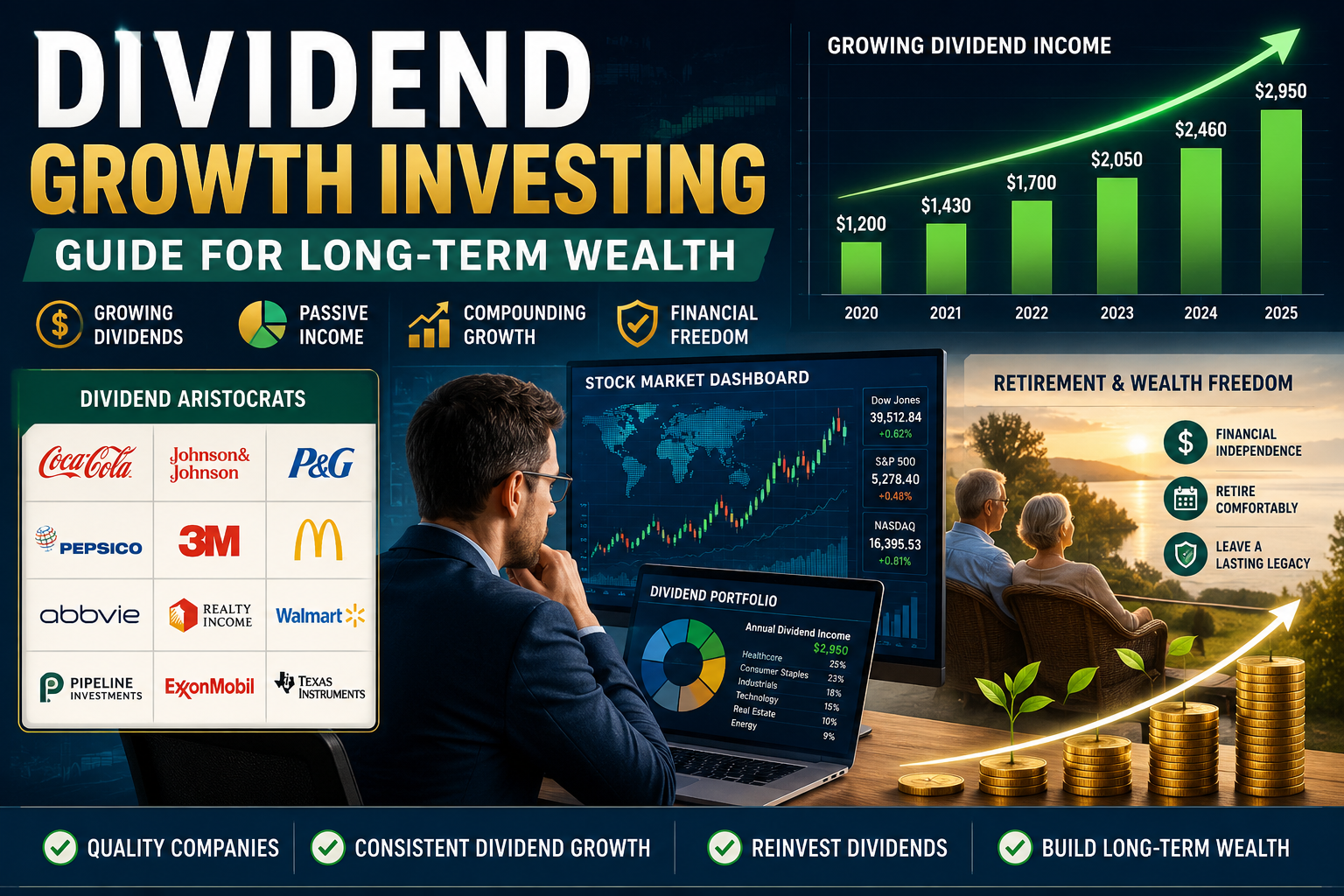
Dividend Growth Investing: The Complete Guide to Building Long-Term Wealth Through Growing Dividend Income
Introduction to Dividend Growth Investing
Dividend Growth Investing is one of the most effective long-term investment strategies for building passive income and creating generational wealth. By investing in companies that consistently increase their dividends, investors can benefit from both growing income and capital appreciation over time.
The strategy focuses on buying shares of high-quality companies that not only pay dividends but also increase those dividend payments consistently over many years or even decades.
Unlike speculative investing, which attempts to profit from short-term price movements, Dividend Growth Investing emphasizes ownership of profitable businesses that generate increasing cash flows and share those profits with shareholders.
The primary objective is not merely to receive income today. Instead, the goal is to create a growing stream of passive income that can support retirement, provide financial independence, and preserve purchasing power against inflation.
Many of the world’s most successful long-term investors have embraced dividend growth principles because they combine the benefits of capital appreciation, compounding, and increasing income.
Understanding the Meaning of Dividend Growth Investing
To fully understand this strategy, it is important to break down each word.
What Is a Dividend?
A dividend is a payment made by a company to its shareholders from the profits generated by the business.
When companies earn profits, management generally has three options:
- Reinvest profits into the business
- Reduce debt
- Return money to shareholders
Returning money to shareholders is often done through dividends.
For example, if a company earns billions of dollars annually and decides to distribute a portion of those profits, shareholders receive dividend payments based on the number of shares they own.
If an investor owns 1,000 shares and the company pays $2 per share annually, the investor receives:
1,000 × $2 = $2,000 annually
This income is generated without selling any shares.
What Does Growth Mean?
Growth refers to an increase over time.
In Dividend Growth Investing, growth means that the dividend payment increases regularly.
For example:
Year 1 = $1.00 per share
Year 2 = $1.10 per share
Year 3 = $1.22 per share
Year 4 = $1.35 per share
The shareholder receives more income every year without buying additional shares.
This is one of the most attractive features of the strategy.
What Is Investing?
Investing means allocating capital into assets with the expectation of generating future returns.
When investors purchase stocks, they become partial owners of a business.
As owners, they participate in:
- Profit growth
- Share price appreciation
- Dividend distributions
Dividend Growth Investing combines all three benefits.
Why Dividend Growth Investing Is Popular in Tier-1 Countries
The strategy is particularly successful in developed nations because of strong economic systems.
These countries typically have:
- Stable legal systems
- Transparent accounting standards
- Strong shareholder protections
- Mature corporations
- Reliable capital markets
Because businesses operate within stable environments, they are more capable of generating consistent profits and increasing dividends over long periods.
Many companies in Tier-1 countries have maintained dividend increases for decades.
This creates confidence among investors seeking predictable income.
The History of Dividend Growth Investing
Dividend investing is not a new concept.
In fact, dividends have been a major component of stock market returns for over a century.
Historically, a significant portion of total stock market returns has come from reinvested dividends.
Research has shown that reinvesting dividends dramatically increases long-term portfolio performance.
Investors who ignore dividends often underestimate their impact on wealth creation.
Over periods of 20, 30, and 40 years, dividend reinvestment can contribute a substantial percentage of total returns.
This is why pension funds, retirement funds, and institutional investors frequently focus on dividend-paying companies.
Key Terms Every Dividend Growth Investor Must Understand
Dividend Yield
Dividend yield measures annual dividend income relative to stock price.
Formula:
Dividend Yield = Annual Dividend ÷ Stock Price × 100
Example:
Stock Price = $100
Annual Dividend = $4
Dividend Yield = 4%
This means an investor earns $4 annually for every $100 invested.
Dividend Growth Rate
The Dividend Growth Rate measures how quickly dividends increase.
Example:
Dividend in 2021 = $2
Dividend in 2022 = $2.20
Dividend Growth Rate = 10%
Companies with strong dividend growth often indicate healthy business performance.
Earnings Per Share (EPS)
Earnings Per Share represents company profit allocated to each share.
Formula:
EPS = Net Income ÷ Outstanding Shares
Growing EPS often supports future dividend increases.
Payout Ratio
The payout ratio measures how much profit is distributed as dividends.
Formula:
Payout Ratio = Dividends ÷ Earnings
Example:
Profit = $100 million
Dividends = $40 million
Payout Ratio = 40%
Lower payout ratios usually indicate safer dividends.
Free Cash Flow
Free Cash Flow represents cash remaining after business expenses and investments.
Strong free cash flow is essential because dividends are paid with cash, not accounting profits.
Many experienced investors consider free cash flow more important than earnings.
The Power of Compounding
Compounding is often called the eighth wonder of the world.
Compounding occurs when investment returns generate additional returns.
Dividend Growth Investing uses compounding through reinvestment.
Suppose an investor purchases shares worth $10,000.
The investment produces dividends.
The dividends purchase additional shares.
Those shares produce additional dividends.
The cycle repeats year after year.
This creates a powerful snowball effect.
The longer the investment period, the larger the snowball becomes.
Case Study: Coca-Cola
One of the most famous Dividend Growth Investing examples is Coca-Cola.
Coca-Cola has increased dividends for more than six decades.
The company sells products in hundreds of countries and benefits from strong brand recognition.
Consumers continue purchasing beverages regardless of economic conditions.
This predictable demand supports stable cash flows.
Stable cash flows support stable dividends.
Stable dividends support consistent dividend growth.
Investors who purchased Coca-Cola decades ago now receive annual dividend income that far exceeds their original investment cost.
This demonstrates the power of long-term dividend growth.
Case Study: Johnson & Johnson
Johnson & Johnson is another excellent example.
The company operates in healthcare, pharmaceuticals, and medical devices.
Healthcare demand remains relatively stable because people require medical products regardless of economic conditions.
The company has increased dividends for decades.
This consistency attracts retirees and long-term investors.
Johnson & Johnson demonstrates how essential products can support long-term dividend growth.
Case Study: Procter & Gamble
Procter & Gamble produces household products used daily.
Examples include:
- Shampoo
- Toothpaste
- Laundry detergent
- Personal care products
Consumers continue purchasing these products during both economic expansions and recessions.
This stability creates reliable profits.
Reliable profits allow management to continue increasing dividends.
As a result, Procter & Gamble has become one of the most respected dividend growth companies in the world.
Case Study: Microsoft
Many investors incorrectly assume technology companies cannot be dividend growth stocks.
Microsoft proves otherwise.
The company generates enormous cash flows from software, cloud computing, artificial intelligence, and enterprise services.
Strong profitability allows Microsoft to:
- Invest in growth
- Acquire businesses
- Increase dividends
The company has become a favorite among modern dividend growth investors.
Characteristics of Great Dividend Growth Companies
Not all dividend-paying companies are equal.
The best dividend growth companies usually share several characteristics.
Strong Competitive Advantage
A competitive advantage helps a company maintain profitability.
Examples include:
- Brand strength
- Intellectual property
- Network effects
- Customer loyalty
These advantages make it difficult for competitors to steal market share.
Consistent Revenue Growth
Revenue growth indicates increasing customer demand.
Companies that consistently grow revenue are more likely to increase profits.
Growing profits often support growing dividends.
Strong Balance Sheet
A balance sheet shows company assets and liabilities.
Companies with low debt have greater financial flexibility.
This makes dividend payments safer during economic downturns.
Reliable Cash Flow
Cash flow represents money moving into and out of a business.
Strong cash flow supports dividend growth.
Without cash flow, dividend increases become difficult.
Benefits of Dividend Growth Investing
Passive Income
Dividend payments create passive income.
Investors receive cash without actively working.
This income can supplement salaries or support retirement.
Inflation Protection
Inflation reduces purchasing power.
If prices rise by 3% annually, income must also rise.
Dividend growth helps offset inflation.
Companies that increase dividends faster than inflation help investors maintain purchasing power.
Reduced Volatility
Dividend-paying companies are often mature businesses.
Their stock prices may fluctuate less than speculative growth stocks.
This can reduce portfolio volatility.
Financial Independence
Many investors pursue dividend growth to achieve financial independence.
The goal is simple:
Generate enough dividend income to cover living expenses.
When dividend income exceeds expenses, financial independence becomes possible.
Risks of Dividend Growth Investing
Although powerful, the strategy is not risk-free.
Dividend Cuts
Companies can reduce or eliminate dividends.
This often occurs during severe financial distress.
Investors should evaluate dividend safety before investing.
Slow Growth
Some dividend stocks grow slowly.
Investors focused exclusively on dividends may miss opportunities in faster-growing sectors.
Interest Rate Risk
Higher interest rates can reduce the attractiveness of dividend stocks.
Investors may move money into bonds if yields become competitive.
Business Risk
Even strong companies can face challenges.
Changes in technology, competition, regulations, or consumer behavior may affect future profitability.
Building a Dividend Growth Portfolio
A diversified portfolio reduces risk.
Investors should avoid concentrating all investments in one sector.
A balanced portfolio may include:
Consumer Staples
Products used daily regardless of economic conditions.
Examples include food, beverages, and household goods.
Healthcare
Healthcare demand remains relatively stable.
Examples include pharmaceuticals and medical devices.
Technology
Technology provides growth opportunities.
Examples include software and cloud computing companies.
Financial Services
Banks and insurance companies often pay dividends.
Industrials
Industrial businesses provide economic diversification.
Dividend Aristocrats and Dividend Kings
Dividend Growth Investors often focus on special groups of companies.
Dividend Aristocrats
Dividend Aristocrats have increased dividends for at least 25 consecutive years.
These companies demonstrate exceptional consistency.
Examples include:
- Coca-Cola
- PepsiCo
- Procter & Gamble
Dividend Kings
Dividend Kings have increased dividends for at least 50 consecutive years.
This achievement is extremely rare.
These businesses have survived multiple recessions, inflation periods, and market crashes.
Example of a Dividend Growth Journey
Imagine a 30-year-old investor.
They invest $500 per month into a diversified dividend growth portfolio.
The average dividend yield is 3%.
The average dividend growth rate is 8%.
Dividends are reinvested automatically.
After 10 years, the portfolio begins generating meaningful annual income.
After 20 years, dividend income becomes substantial.
After 30 years, annual dividend income may reach tens of thousands of dollars depending on market performance.
The investor has transformed regular savings into a growing income-producing asset.
Dividend Growth Investing During Market Crashes
Market crashes often create opportunities.
When stock prices fall, dividend yields rise.
Strong companies may become available at attractive valuations.
Experienced dividend investors frequently view market declines as buying opportunities.
As long as company fundamentals remain strong, lower prices can improve future returns.
Retirement and Dividend Growth Investing
Dividend Growth Investing is especially attractive for retirees.
Retirees often need regular income without selling assets.
Dividend payments can provide that income.
Growing dividends also help offset rising living expenses during retirement.
This makes the strategy popular among pension funds and retirement portfolios throughout Tier-1 countries.
The Future of Dividend Growth Investing
The future remains promising.
Global populations continue aging.
Demand for retirement income continues growing.
Strong companies continue generating profits.
Technology improves efficiency and productivity.
As businesses become more profitable, many will continue rewarding shareholders through increasing dividends.
Dividend Growth Investing therefore remains one of the most reliable long-term wealth-building strategies available.
Conclusion
Dividend Growth Investing is a proven strategy centered on purchasing high-quality businesses that consistently increase dividend payments over time.
The strategy combines passive income, compounding, capital appreciation, inflation protection, and financial discipline into a single investment approach.
Companies such as Coca-Cola, Johnson & Johnson, Procter & Gamble, and Microsoft demonstrate how powerful dividend growth can be when combined with patience and long-term thinking.
For investors in Tier-1 countries, Dividend Growth Investing offers a practical path toward retirement security, financial independence, and generational wealth.
The core principle is simple: invest in exceptional businesses, reinvest dividends, remain patient, and allow compounding to work over decades. Over time, a small portfolio can evolve into a substantial source of growing income and long-term wealth.