Market Cycles Explained (Expansion vs Recession): The Complete Guide for Investors in Tier-1 Countries
Introduction
Financial markets and economies do not move in a straight line. Just as seasons change from spring to summer, autumn, and winter, economies move through recurring periods of growth and decline known as market cycles or business cycles.
Understanding market cycles is one of the most important skills for investors, business owners, policymakers, and individuals planning their financial future. Whether you invest in the stock market of the United States, Canada, United Kingdom, Germany, Australia, or Japan, market cycles influence investment returns, employment opportunities, interest rates, business profits, and wealth creation.
Many investors lose money because they fail to recognize where the economy stands in the cycle. They become overly optimistic near market peaks and excessively fearful near market bottoms. Successful long-term investors understand that expansion and recession are normal parts of economic life.
This comprehensive guide explains every important term, concept, indicator, and example related to market cycles, with real-world case studies from major Tier-1 economies.
What Is a Market Cycle?
A market cycle refers to the recurring pattern of growth and decline in economic activity and financial markets over time.
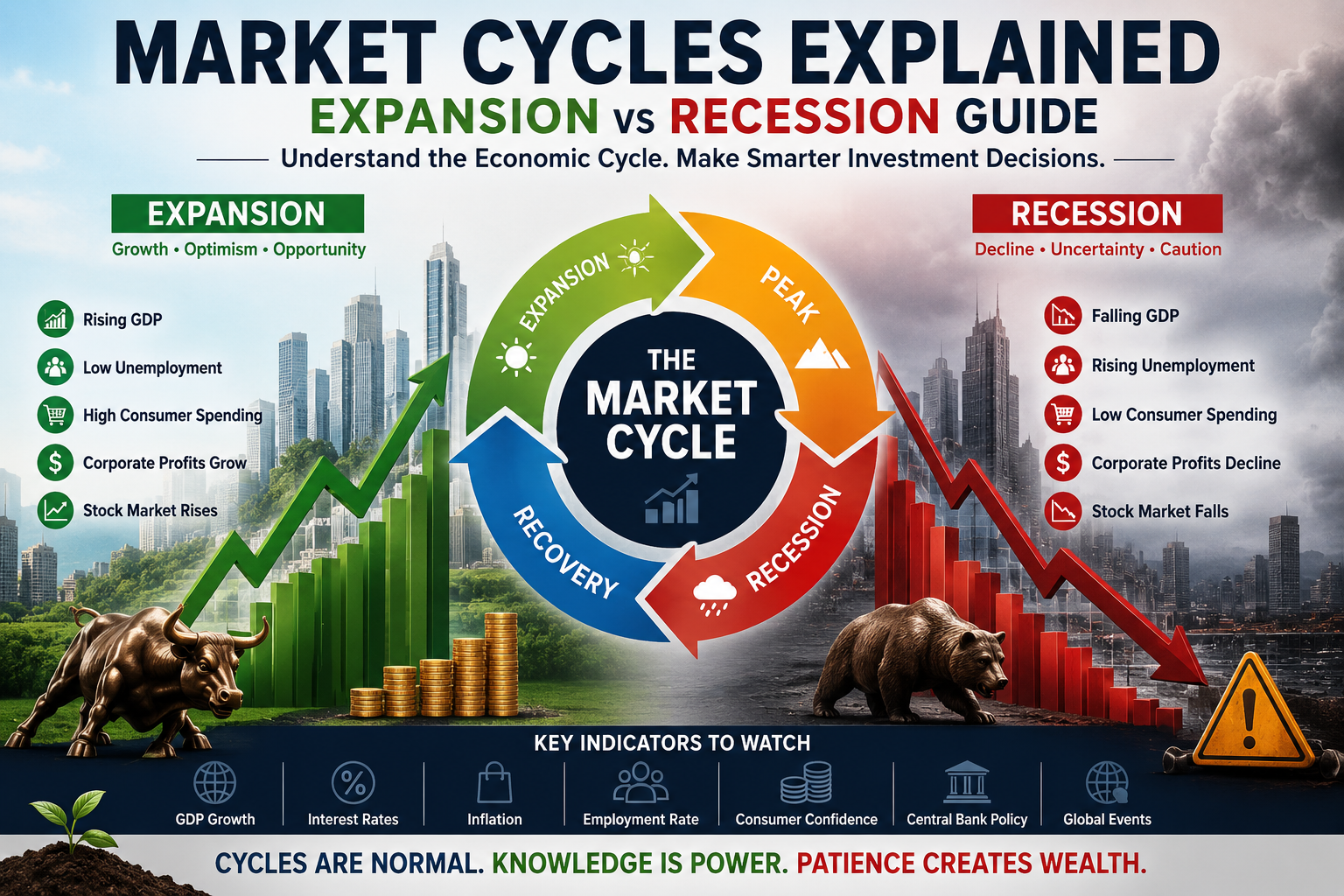
A cycle typically consists of four phases:
- Expansion
- Peak
- Recession (Contraction)
- Recovery
Although all four phases are important, the most significant phases are:
- Expansion
- Recession
These two phases drive most investment decisions and economic outcomes.
Understanding the Term “Cycle”
A cycle is something that repeats.
Examples:
- Day → Night → Day
- Summer → Winter → Summer
- Economic Growth → Economic Decline → Economic Growth
No economy grows forever.
Similarly, no recession lasts forever.
This principle is one of the most important truths in economics.
The Four Stages of a Market Cycle
Stage 1: Expansion
Economic activity increases.
Businesses grow.
Consumers spend more.
Jobs become available.
Stock markets generally rise.
Stage 2: Peak
The economy reaches maximum growth.
Corporate profits are high.
Investor optimism reaches extreme levels.
Inflation often becomes a concern.
Stage 3: Recession
Economic activity declines.
Consumer spending weakens.
Business profits fall.
Unemployment rises.
Markets decline.
Stage 4: Recovery
The economy stabilizes.
Confidence slowly returns.
Investments become attractive again.
Growth begins anew.
The cycle repeats.
What Is Expansion?
Expansion is a period when the economy is growing.
Think of expansion as the “summer” of the economic cycle.
Everything appears healthy:
- Businesses expand
- Employment rises
- Wages increase
- Consumers spend more
- Investors become optimistic
Understanding GDP During Expansion
GDP Meaning
GDP stands for Gross Domestic Product.
Gross = Total
Domestic = Within a country
Product = Goods and services produced
GDP measures the total economic output of a nation.
Example
Suppose businesses produce:
- Cars worth $500 billion
- Food worth $300 billion
- Technology worth $700 billion
The combined value contributes to GDP.
When GDP rises:
The economy is growing.
When GDP falls:
The economy is shrinking.
Why GDP Matters
GDP acts as the economy’s report card.
Strong GDP growth indicates:
- Higher production
- More jobs
- More spending
- Strong business activity
For developed economies, annual GDP growth of 2%–4% is generally considered healthy.
Employment During Expansion
Employment refers to people who have jobs.
During expansion:
Companies need more workers because demand increases.
Example:
A technology company receives more orders.
To meet demand, it hires:
- Engineers
- Designers
- Marketing professionals
- Sales staff
This creates employment opportunities.
Understanding Unemployment
Unemployment refers to people actively looking for work but unable to find jobs.
Formula
Unemployment Rate = Unemployed Workers ÷ Total Labor Force
Low unemployment generally indicates economic strength.
Example
Before COVID-19:
The United States unemployment rate fell near 3.5%, among the lowest levels in decades.
Wage Growth During Expansion
As businesses compete for workers:
- Salaries rise
- Bonuses increase
- Employee benefits improve
This process is called wage growth.
Higher wages lead to:
- More spending
- More economic activity
- More growth
Consumer Spending Explained
Consumer spending refers to purchases made by households.
Examples:
- Food
- Clothing
- Cars
- Travel
- Housing
- Entertainment
In most developed economies, consumer spending accounts for a large portion of GDP.
Why Consumer Spending Is Important
Businesses earn revenue when consumers buy products and services.
If people spend more:
- Businesses earn more
- Profits increase
- Hiring increases
This creates a positive cycle.
Consumer Confidence
Consumer confidence measures how optimistic people feel about the economy.
If people believe:
- Jobs are secure
- Wages will rise
- The economy is healthy
They spend more.
If confidence falls:
People spend less.
Business Investment During Expansion
Businesses often invest in:
- New factories
- Technology
- Equipment
- Research and development
These investments increase future productivity.
Corporate Profits
Corporate profit is the money left after a company pays all expenses.
Revenue
Money earned from sales.
Expenses
Costs such as:
- Salaries
- Rent
- Materials
- Taxes
Profit
Revenue minus expenses.
During expansion:
Profits generally increase.
This often causes stock prices to rise.
The Stock Market During Expansion
The stock market usually performs well during expansion.
Why?
Because investors expect:
- Higher profits
- Higher earnings
- Future growth
This creates a bull market.
What Is a Bull Market?
A bull market is a prolonged period during which stock prices rise.
Characteristics:
- Optimism
- Confidence
- Strong corporate earnings
- Rising valuations
The term “bull” comes from a bull attacking upward with its horns.
Interest Rates and Expansion
Interest rates are set by central banks.
Examples include:
- Federal Reserve
- European Central Bank
- Bank of England
Lower interest rates encourage:
- Borrowing
- Investment
- Home purchases
This stimulates growth.
Inflation During Expansion
Inflation means prices increase over time.
Examples:
A coffee costs:
- $3 today
- $3.20 next year
That increase represents inflation.
Moderate inflation is normal.
Excessive inflation can become problematic.
Expansion Case Study: The United States (2010–2019)
After the Global Financial Crisis:
The Federal Reserve:
- Reduced interest rates
- Increased liquidity
- Supported economic recovery
Results:
- GDP growth resumed
- Unemployment declined
- Stock markets surged
- Consumer confidence improved
The S&P 500 delivered one of the strongest bull markets in history.
This became one of the longest economic expansions ever recorded.
What Is a Recession?
A recession is a period of economic decline.
Think of recession as the “winter” of the economy.
Characteristics include:
- Falling GDP
- Rising unemployment
- Reduced spending
- Lower profits
- Weak markets
Formal Definition of Recession
Traditionally:
A recession occurs when GDP declines for two consecutive quarters.
However, economists also consider:
- Employment
- Industrial production
- Income levels
- Consumer spending
Understanding Economic Contraction
Contraction means shrinking economic activity.
Businesses:
- Produce less
- Hire fewer workers
- Invest less
Consumers:
- Spend less
- Save more
Why Recessions Happen
Several factors can trigger recessions.
1. High Interest Rates
When inflation becomes excessive, central banks raise rates.
Higher rates make borrowing expensive.
Examples:
- Mortgage payments rise
- Car loans become costly
- Business financing becomes expensive
Demand weakens.
Growth slows.
2. Financial Crises
Banking failures can trigger recessions.
If banks stop lending:
Businesses struggle.
Consumers reduce spending.
Economic activity declines.
3. Asset Bubbles
A bubble occurs when asset prices become disconnected from reality.
Examples:
- Housing bubble
- Technology bubble
- Cryptocurrency bubble
When bubbles burst:
Markets crash.
Confidence collapses.
4. External Shocks
Examples include:
- Pandemics
- Wars
- Oil crises
- Natural disasters
These events can suddenly reduce economic activity.
Unemployment During Recession
Businesses facing lower demand often reduce costs.
This may involve:
- Hiring freezes
- Layoffs
- Budget cuts
As a result:
Unemployment rises.
Consumer Behavior During Recession
Consumers become cautious.
They often:
- Delay vacations
- Postpone home purchases
- Reduce luxury spending
- Increase savings
This further slows economic activity.
Corporate Profits During Recession
Lower spending leads to:
- Reduced sales
- Lower earnings
- Smaller profit margins
Some companies may report losses.
Stock Market During Recession
Markets often decline sharply.
Investors fear:
- Falling profits
- Economic weakness
- Business failures
This creates a bear market.
What Is a Bear Market?
A bear market is a prolonged period of declining stock prices.
Characteristics:
- Fear
- Uncertainty
- Negative sentiment
- Falling valuations
The term “bear” comes from a bear swiping downward with its claws.
Case Study: The Dot-Com Crash (2000)
During the late 1990s:
Internet companies attracted enormous investment.
Many firms had:
- Little revenue
- No profits
- Extremely high valuations
Investors believed every internet company would succeed.
Eventually:
Reality failed to match expectations.
Technology stocks collapsed.
The NASDAQ lost a significant portion of its value.
This became one of history’s most famous market crashes.
Case Study: Global Financial Crisis (2008)
The 2008 crisis began with a housing bubble in the United States.
Banks issued risky mortgages.
Many borrowers could not repay loans.
When home prices fell:
Defaults increased.
Financial institutions suffered massive losses.
One major trigger was the collapse of Lehman Brothers.
Consequences:
- Global recession
- Millions of job losses
- Housing market collapse
- Severe stock market decline
Governments responded with:
- Bank rescues
- Stimulus programs
- Interest-rate cuts
The crisis reshaped global finance.
Case Study: COVID-19 Recession (2020)
The COVID-19 pandemic created one of the fastest recessions in modern history.
Lockdowns caused:
- Business closures
- Travel restrictions
- Supply chain disruptions
Markets fell rapidly.
Governments introduced:
- Stimulus checks
- Business support programs
- Emergency monetary policies
The recession was severe but relatively short.
Technology companies benefited from:
- Remote work
- Cloud computing
- E-commerce
Markets recovered quickly.
Investor Psychology Throughout Market Cycles
Economics is not only about numbers.
Human emotions play a major role.
Expansion Psychology
People experience:
- Hope
- Optimism
- Excitement
- Confidence
Late-stage expansion often creates:
- Speculation
- Greed
- Overconfidence
Recession Psychology
People experience:
- Fear
- Anxiety
- Uncertainty
- Panic
Many investors sell near market bottoms because emotions dominate rational thinking.
Expansion vs Recession Comparison
| Economic Factor | Expansion | Recession |
|---|---|---|
| GDP | Rising | Falling |
| Employment | Rising | Falling |
| Unemployment | Low | High |
| Spending | Strong | Weak |
| Profits | Growing | Declining |
| Investor Sentiment | Optimistic | Fearful |
| Stock Market | Bull Market | Bear Market |
| Lending | Easy | Difficult |
| Business Investment | High | Low |
Impact on Different Asset Classes
Stocks
Expansion:
- Growth stocks perform well
- Corporate earnings rise
Recession:
- Stocks often decline
- Defensive sectors outperform
Bonds
Government bonds often become attractive during recessions because investors seek safety.
Real Estate
Expansion:
- Home prices rise
- Construction increases
Recession:
- Housing demand weakens
- Prices may decline
Gold
Gold is often considered a safe-haven asset.
During uncertain periods, investors frequently move toward gold.
How Professional Investors Use Market Cycles
Professional investors analyze:
- GDP growth
- Interest rates
- Inflation
- Employment data
- Corporate earnings
They attempt to determine where the economy sits within the cycle.
Common Mistakes Investors Make
Buying at Peaks
Investors become excited after years of gains.
They buy when valuations are highest.
Selling at Bottoms
Fear causes investors to sell after major declines.
Often, the recovery begins shortly afterward.
Ignoring Diversification
Concentrating investments in one sector increases risk.
Lessons from 100 Years of Market History
Market history teaches several important lessons:
Lesson 1
Every expansion eventually ends.
Lesson 2
Every recession eventually ends.
Lesson 3
Markets recover before economic news improves.
Lesson 4
Patience is rewarded.
Lesson 5
Long-term investing usually outperforms emotional trading.
How Long Do Market Cycles Last?
There is no fixed duration.
Examples:
- Some expansions last only a few years.
- Others can last a decade.
Some recessions last months.
Others last several years.
The length depends on:
- Economic conditions
- Government policies
- Global events
- Financial stability
Final Conclusion
Market cycles are the foundation of economic and investment analysis. Every developed economy—including the United States, Canada, United Kingdom, Germany, Australia, and Japan—moves through periods of expansion and recession.
During expansion, GDP grows, employment rises, businesses prosper, consumer confidence strengthens, and stock markets generally perform well. During recession, economic activity slows, unemployment rises, spending weakens, profits decline, and markets often fall.
History—from the Dot-Com Crash of 2000 to the Global Financial Crisis of 2008 and the COVID-19 recession of 2020—shows that cycles are unavoidable. However, these same events also demonstrate that economies recover, businesses adapt, and markets eventually move higher over the long term.
For investors, the goal is not to perfectly predict every cycle. The goal is to understand how cycles work, stay disciplined, avoid emotional decisions, and use both expansions and recessions as opportunities to build long-term wealth. A deep understanding of market cycles allows investors to navigate uncertainty with confidence and make better financial decisions throughout every phase of the economic journey.