Introduction
How Central Banks Control Stock Markets is one of the most important topics every investor should understand. Central banks influence interest rates, liquidity, inflation, borrowing costs, and investor sentiment, making them one of the most powerful forces behind stock market movements.
In modern financial markets, central banks are among the most powerful institutions influencing asset prices. While they do not directly buy and sell most stocks, their policies affect the cost of money, the availability of credit, investor psychology, corporate profits, and economic growth. These factors collectively drive stock market performance.
In Tier-1 economies such as the United States, United Kingdom, Canada, Australia, Japan, and the Eurozone, central bank decisions often determine whether markets enter a bull market, bear market, recession, or recovery.
Many professional investors even follow a simple rule:
“Don’t fight the central bank.”
This phrase exists because history repeatedly shows that stock markets tend to move in the direction encouraged by monetary policy.
This guide explains exactly how central banks influence stock markets, the tools they use, the economic mechanisms behind their actions, and real-world case studies that demonstrate their impact.
For beginners, understanding how monetary policy affects markets is an important part of learning how to start investing.
Disclaimer: This article is for educational and informational purposes only and should not be considered personalized financial, investment, tax, or legal advice. Investment decisions involve risk, and readers should consider their individual circumstances and consult a qualified professional when appropriate.
Chapter 1: What Is a Central Bank?
A central bank is the primary monetary authority of a country or economic region.
Its responsibilities include:
- Managing inflation
- Regulating money supply
- Setting interest rates
- Supervising financial stability
- Supporting banking systems during crises
- Maintaining confidence in the currency
Major central banks include:
- Federal Reserve System (United States)
- European Central Bank
- Bank of England
- Bank of Japan
- Bank of Canada
- Reserve Bank of Australia
Unlike commercial banks, central banks do not primarily serve consumers.
Instead, they influence the entire financial system.
Major Central Banks That Influence Global Stock Markets
Central banks play a major role in the global financial system because their monetary-policy decisions influence interest rates, inflation, liquidity, borrowing costs, currencies, bond markets, and economic activity. These factors can eventually affect corporate earnings, stock valuations, and investor sentiment.
For investors in major markets such as the United States, United Kingdom, Canada, Australia, Japan, and the Eurozone, following central-bank policy can provide valuable information about the broader investment environment.
Federal Reserve (Fed) — United States
The Federal Reserve, commonly called the Fed, is the central bank of the United States. It conducts U.S. monetary policy and uses tools such as interest-rate policy and its balance sheet to influence financial conditions.
Investors closely monitor the Fed because the United States has one of the world’s largest stock markets and the U.S. dollar plays an important role in global finance.
Investors watch:
- Federal funds rate decisions
- Inflation
- Employment
- Economic growth
- Federal Reserve guidance
- Quantitative easing (QE)
- Quantitative tightening (QT)
When the Fed raises rates, borrowing costs and financial conditions generally become tighter. This can place pressure on economic activity and some stock valuations. The Federal Reserve (Fed) is the central bank of the United States and is responsible for conducting U.S. monetary policy.
When the Fed lowers rates, financial conditions can become more supportive, potentially benefiting economic activity and risk assets.
European Central Bank (ECB) — Eurozone
The European Central Bank (ECB) is responsible for monetary policy in the euro area.
ECB decisions influence borrowing costs, bond yields, bank lending, consumer spending, business investment, and the value of the euro.
Investors monitor:
- ECB interest-rate decisions
- Inflation expectations
- Economic forecasts
- Monetary-policy guidance
- Asset-purchase policies
- Euro-area economic conditions
For European stock investors, ECB policy can have a significant impact on corporate financing conditions and economic growth. The European Central Bank (ECB) is responsible for monetary policy in the euro area.
Bank of England (BoE) — United Kingdom
The Bank of England (BoE) is the central bank of the United Kingdom. It is responsible for monetary policy and plays an important role in monetary and financial stability.
Investors monitor the BoE because its decisions can affect:
- UK interest rates
- Mortgage costs
- Business borrowing
- Government bond yields
- The British pound
- Consumer spending
- Corporate investment
Higher interest rates can increase borrowing costs and potentially reduce economic demand, while lower rates can provide greater support to borrowing and economic activity.
The Bank of England (BoE) is the central bank of the United Kingdom and is responsible for monetary policy.
Bank of Japan (BoJ) — Japan
The Bank of Japan (BoJ) is Japan’s central bank and has been particularly important in the development of unconventional monetary policy.
Japan has experienced long periods of very low interest rates and low inflation, leading the BoJ to use policies such as large-scale asset purchases and other measures to influence financial conditions.
Investors monitor:
- Interest-rate decisions
- Inflation
- Government bond yields
- Asset purchases
- Currency movements
- Monetary-policy guidance
BoJ decisions can influence not only Japanese stocks but also global markets through currency movements, international capital flows, and global bond markets. The Bank of Japan (BoJ) is Japan’s central bank and plays an important role in the country’s monetary policy and financial conditions.
Bank of Canada (BoC) — Canada
The Bank of Canada (BoC) is Canada’s central bank and conducts the country’s monetary policy.
Investors monitor its decisions because interest rates can affect:
- Consumer borrowing
- Housing activity
- Business investment
- Economic growth
- The Canadian dollar
- Corporate earnings
Canada’s significant exposure to commodities and natural resources also means investors often consider monetary policy alongside energy and commodity-market conditions. The Bank of Canada (BoC) is Canada’s central bank and is responsible for conducting monetary policy.
Reserve Bank of Australia (RBA) — Australia
The Reserve Bank of Australia (RBA) is Australia’s central bank and conducts monetary policy for the Australian economy.
Investors monitor:
- Interest rates
- Inflation
- Employment
- Economic growth
- Housing conditions
- Australian dollar movements
- Monetary-policy guidance
Interest-rate changes can have an important effect on Australian households and businesses because borrowing costs influence mortgages, consumption, investment, and economic activity. The Reserve Bank of Australia (RBA) is Australia’s central bank and conducts monetary policy for the Australian economy.
Why Investors Monitor Major Central Banks
The basic transmission process can be summarized as:
Central Bank Decision → Interest Rates → Bond Yields → Borrowing Costs → Economic Activity → Corporate Earnings → Stock Valuations → Stock Prices
However, this relationship is not automatic. Stock markets also respond to earnings, economic growth, inflation expectations, fiscal policy, geopolitical events, commodity prices, and investor expectations.
Therefore, investors should focus not only on what a central bank does, but also on why it does it and what markets expected beforehand.
Chapter 2: Why Stock Markets Care About Central Banks
Stock prices depend on two major factors:
1. Corporate Earnings
This refers to how much profit a company generates.
Examples:
- Revenue growth
- Profit margins
- Cash flow
- Future earnings potential
2. Valuation
Valuation refers to how much investors are willing to pay for those earnings.
This is where central banks become extremely important.
The valuation of stocks is heavily influenced by:
- Interest rates
- Inflation
- Bond yields
- Liquidity
- Credit conditions
- Investor sentiment
A company may earn exactly the same profits, yet its stock price can rise or fall dramatically depending on central bank policy.
Understanding these relationships is an important part of learning stock market investing, because interest rates can influence both corporate earnings and investor valuations.
Chapter 3: Understanding Money Supply
To understand stock markets, you must understand money.
Money supply refers to the total amount of money circulating within an economy.
When central banks increase money supply:
- Lending increases
- Investment increases
- Consumption increases
- Asset prices often rise
When money supply contracts:
- Spending slows
- Borrowing decreases
- Economic activity weakens
- Markets often struggle
Think of liquidity as fuel.
The stock market is the engine.
Without fuel, the engine slows down.
Chapter 4: Interest Rates Explained
Interest rates represent the cost of borrowing money.
If you borrow $100,000 and repay $105,000:
The extra $5,000 is interest.
Central banks control short-term interest rates.
These rates influence:
- Mortgages
- Credit cards
- Business loans
- Government borrowing
- Bond yields
Why Stocks React
When rates are low:
- Borrowing becomes cheaper
- Companies expand more easily
- Consumers spend more
- Profits increase
This often boosts stock prices.
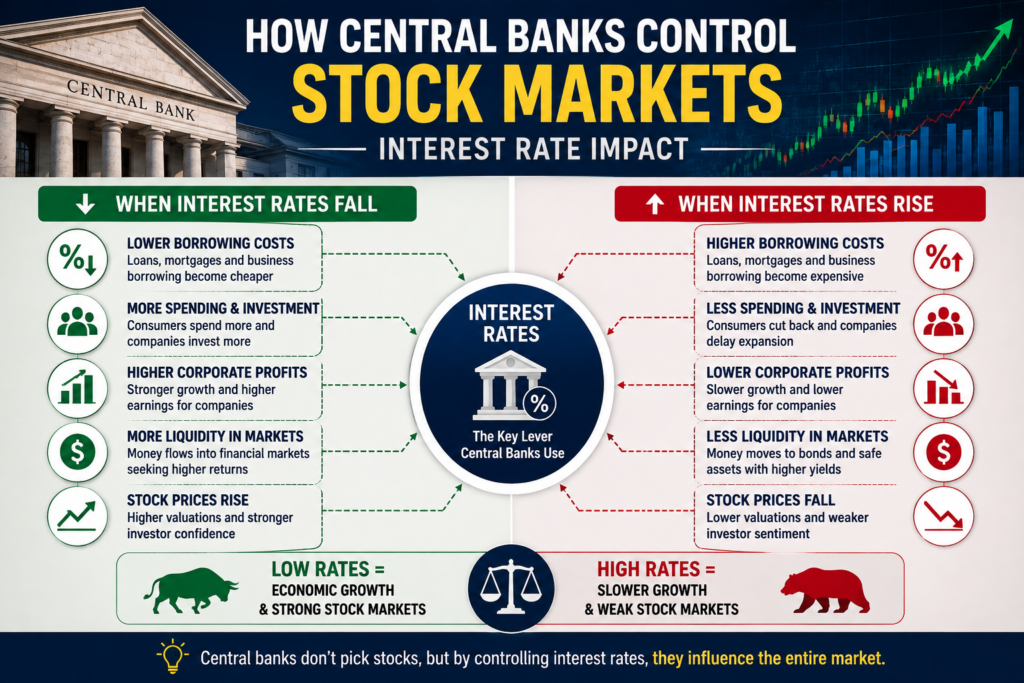
When rates rise:
- Borrowing becomes expensive
- Spending slows
- Corporate growth slows
- Valuations decline
Stocks often fall.
The Federal Funds Rate and Why It Matters
The federal funds rate is a key short-term interest rate in the U.S. financial system. It is the rate at which eligible financial institutions lend reserve balances to one another, typically overnight.
The Federal Reserve influences this rate through its monetary-policy framework.
Although consumers and most businesses do not directly borrow at the federal funds rate, changes in it can spread throughout the financial system.
The transmission process can look like:
Federal Funds Rate → Money-Market Rates → Bank Lending Rates → Borrowing Costs → Economic Activity
How Does It Affect Commercial Banks?
Changes in monetary policy influence short-term funding conditions and other market interest rates.
When rates rise, banks can face higher funding costs and may charge higher rates on some loans. When rates fall, financial conditions can become more supportive of lending.
These changes can eventually affect:
- Mortgages
- Business loans
- Consumer credit
- Credit cards
- Commercial real estate
- Corporate financing
How Does It Influence Borrowing Costs?
Higher interest rates can make borrowing more expensive for businesses and consumers.
A company refinancing debt at a higher interest rate may have greater interest expenses. It may respond by reducing expansion, delaying investment, or changing its financing plans.
Lower rates can have the opposite effect by making certain forms of financing less expensive.
How Does It Affect Treasury Yields?
The federal funds rate is a short-term rate, while U.S. Treasury securities have different maturities.
However, Federal Reserve policy strongly influences market expectations for future interest rates, which can affect Treasury yields across the yield curve.
Investors therefore watch the Fed alongside:
- Inflation
- Economic growth
- Employment
- Treasury supply and demand
- Expected future interest rates
How Does It Eventually Affect Stocks?
The relationship can be summarized as:
Interest rates → Borrowing costs → Economic activity → Corporate earnings → Valuations → Stock prices
When rates rise:
Fed funds rate ↑ → borrowing costs ↑ → financial conditions tighten → valuations may decline
When rates fall:
Fed funds rate ↓ → borrowing costs ↓ → financial conditions ease → stocks may receive support
These are general relationships rather than guaranteed outcomes.
For example, a rate cut caused by a severe recession may not immediately produce a stock-market rally because investors could remain concerned about falling corporate earnings.
Because interest rates also affect borrowing and household finances, understanding monetary policy can be useful when managing broader personal finance decisions.
Chapter 5: The Discount Rate Explained
One of the most important concepts in investing is the discount rate.
Investors buy stocks because of future profits.
However:
A dollar earned ten years from now is worth less than a dollar today.
The discount rate helps determine the present value of future earnings.
Example
Imagine a company expected to generate:
- $1 billion profit in ten years
If interest rates are low:
Investors may value that profit highly.
If interest rates rise:
Future profits become less valuable.
As a result:
Stock valuations decline.
This explains why growth stocks are highly sensitive to interest rates.
How Bond Yields Affect Stock Valuations
Bond yields are extremely important to stock-market investors because they provide a reference point for comparing the potential return from bonds with the potential return from equities.
When Treasury yields rise, investors may demand greater returns from stocks to compensate for taking additional equity risk.
Treasury Yields and Stock Valuations
U.S. Treasury securities are generally viewed as relatively low-risk investments compared with equities. Their yields therefore influence the required returns investors may expect from other assets.
If Treasury yields increase substantially, stocks may become relatively less attractive at unchanged valuations.
If Treasury yields decline, equities may become relatively more attractive, particularly when investors expect corporate earnings to remain strong.
Discount Rates and Future Earnings
Stock valuation often involves estimating the present value of future cash flows or earnings.
Future money is worth less in today’s terms, and the discount rate used in valuation models reflects the required return associated with those future cash flows.
When interest rates and discount rates rise, the present value of future earnings can decline.
This is particularly relevant to growth companies.
Why Growth Stocks Can Be Sensitive
Growth companies often have a larger portion of their expected value tied to profits that may occur several years into the future.
For example, imagine two companies:
Company A: Generates substantial cash flow today.
Company B: Expects most of its significant profits many years in the future.
If discount rates rise, Company B’s future earnings can be affected more significantly in valuation models.
This is one reason technology and other high-growth stocks can sometimes react strongly to changes in interest-rate expectations.
P/E Ratios and Interest Rates
The price-to-earnings (P/E) ratio compares a company’s share price with its earnings per share.
Higher interest rates can place downward pressure on the valuation multiples investors are willing to pay, particularly when bond yields become more attractive.
However, P/E ratios are also influenced by:
- Earnings growth
- Profit margins
- Economic conditions
- Risk
- Investor expectations
- Industry characteristics
Therefore:
Higher rates ≠ automatically lower stock prices
Instead, interest rates are one of several factors that influence valuation.
Chapter 6: How Rate Cuts Boost Stock Markets
Rate cuts can be supportive for equities, but the market reaction depends on why rates are being cut and what investors have already priced in.
Investors who prefer diversified exposure can also use ETFs and index funds to participate in broad sections of the stock market rather than selecting individual companies.
When central banks cut rates:
Step 1
Borrowing becomes cheaper.
Step 2
Consumers spend more.
Step 3
Businesses invest more.
Step 4
Corporate profits improve.
Step 5
Investors buy stocks.
The result is often a strong market rally.
Chapter 7: How Rate Hikes Hurt Stocks
Rate hikes produce the opposite effect.
Higher rates:
- Reduce borrowing
- Slow economic growth
- Increase financing costs
- Reduce corporate profits
Additionally:
Bonds become more attractive.
If investors can earn 6% from government bonds with little risk, many will move money away from stocks.
This reduces stock demand.
Chapter 8: Quantitative Easing (QE)
Quantitative Easing is one of the most powerful tools used by modern central banks.
Definition
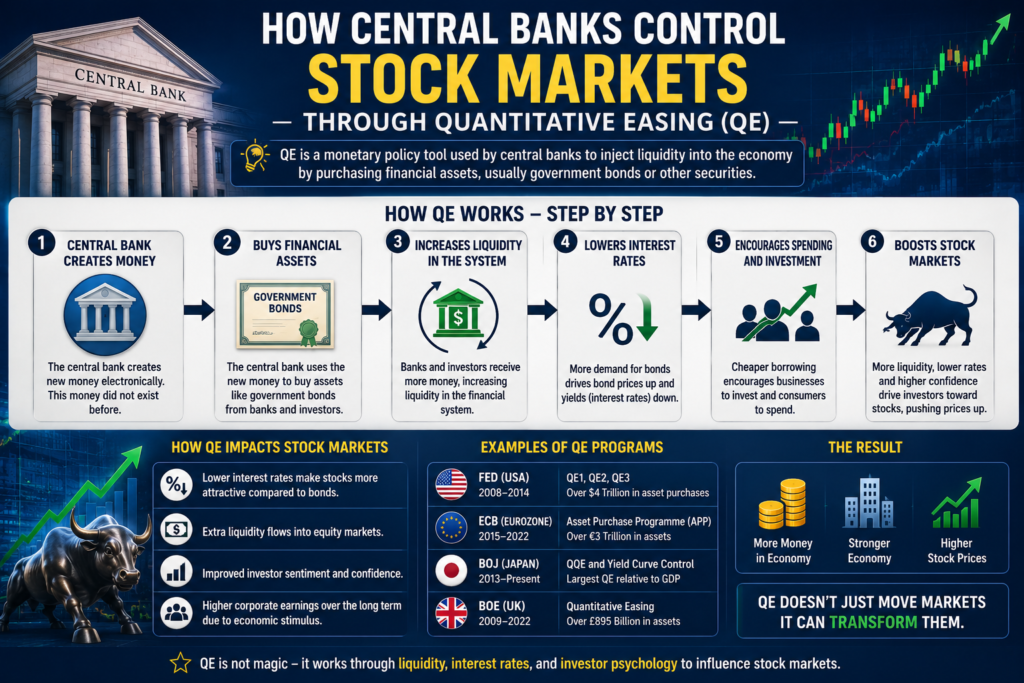
QE occurs when a central bank creates new money electronically and uses it to purchase financial assets.
Typically:
- Government bonds
- Mortgage-backed securities
- Corporate bonds
Purpose:
- Increase liquidity
- Lower interest rates
- Support economic growth
The Federal Reserve has used large-scale asset purchases as an unconventional monetary-policy tool during periods of severe economic and financial stress.
Chapter 9: Why QE Boosts Stock Markets
QE affects stocks through several channels.
Lower Bond Yields
Bond prices rise.
Yields fall.
Investors searching for returns move into stocks.
Increased Liquidity
Financial institutions receive cash.
Much of this money eventually reaches asset markets.
Improved Confidence
Investors believe central banks are supporting the economy.
This encourages risk-taking.
Case Study: The 2008 Financial Crisis
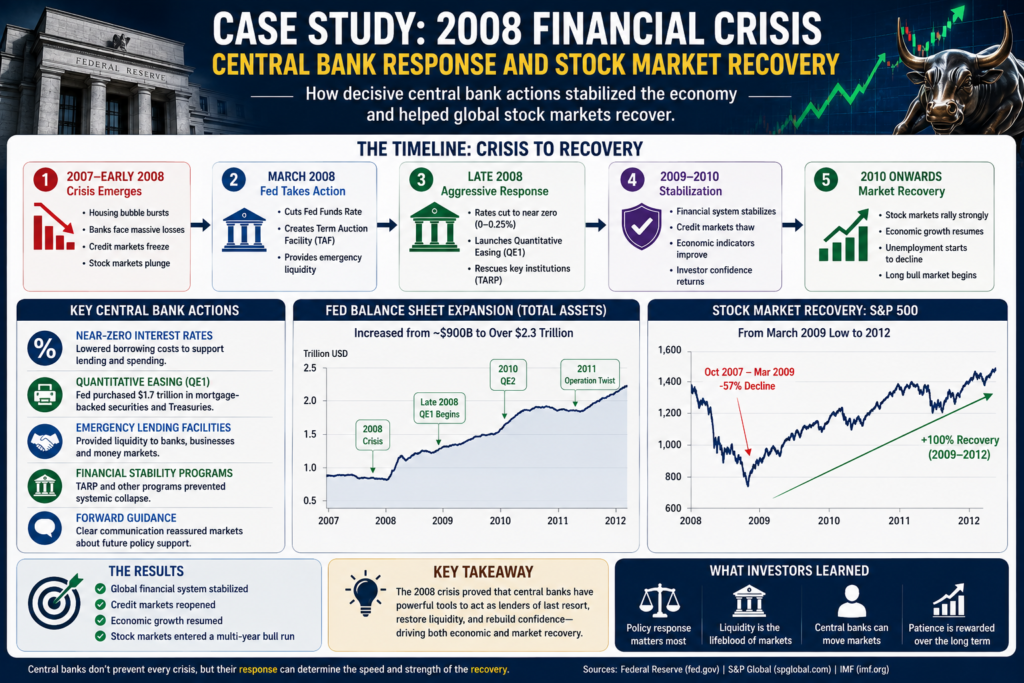
The global financial crisis was driven by severe problems in the U.S. housing and financial system. Credit markets became extremely stressed, financial institutions faced major losses, and global stock markets plunged.
The Federal Reserve reduced interest rates dramatically and introduced extraordinary measures, including emergency lending facilities and quantitative easing.
Financial markets eventually stabilized, and the U.S. stock market began a major recovery from its March 2009 low.
Central-bank policy can be extremely important during financial crises because liquidity and confidence can influence the speed of market stabilization.
Chapter 10: Quantitative Tightening (QT)
QT is the reverse of QE.
Instead of injecting money:
The central bank removes liquidity.
Methods include:
- Selling bonds
- Allowing bonds to mature without replacement
Effects:
- Higher yields
- Less liquidity
- More volatility
QT can place pressure on asset valuations by reducing liquidity and increasing financial conditions, although stock-market performance also depends on earnings, economic growth, and investor expectations.
Quantitative tightening can involve allowing securities to mature without full reinvestment, gradually reducing the central bank’s balance sheet. Investors can monitor the Federal Reserve balance sheet to understand changes in the size and composition of the Fed’s assets.
What Is the Yield Curve?
The yield curve is a graph showing interest rates or yields on bonds with different maturities, particularly government bonds.
For example, investors may compare short-term Treasury yields with intermediate- and long-term Treasury yields.
The yield curve is important because it provides information about market expectations for interest rates, inflation, economic growth, and financial conditions. Investors can also monitor U.S. Treasury yield data when evaluating changes in short-term and long-term government bond yields.
Short-Term Yields
Short-term yields are strongly influenced by expectations about monetary policy.
If investors expect the Federal Reserve to maintain restrictive policy, short-term yields can remain elevated.
Long-Term Yields
Long-term yields reflect a broader combination of factors, including:
- Expected future interest rates
- Inflation expectations
- Economic growth
- Treasury supply and demand
- Investor demand for longer-term bonds
Normal Yield Curve
A normal or upward-sloping yield curve generally means longer-term yields are higher than shorter-term yields.
This can occur when investors expect economic growth and inflation over the longer term.
Inverted Yield Curve
An inverted yield curve occurs when shorter-term yields are higher than longer-term yields.
Investors often watch an inversion because it can indicate expectations of slower economic growth or future interest-rate reductions.
An inverted curve does not guarantee a recession or stock-market decline.
Yield-Curve Steepening
Steepening means the difference between short- and long-term yields becomes larger.
This can happen for different reasons, so investors should examine what is causing the steepening rather than treating it as automatically bullish or bearish.
Yield-Curve Flattening
Flattening means the difference between short- and long-term yields becomes smaller.
This can occur when short-term yields rise toward long-term yields or when long-term yields decline relative to short-term yields.
Why Investors Watch the Yield Curve
The yield curve helps investors understand changing expectations about monetary policy and the economy.
It can provide another piece of information alongside:
Inflation + Employment + Economic Growth + Interest Rates + Corporate Earnings
Investors should therefore use the yield curve as an indicator rather than as a standalone market-timing tool.
Chapter 11: The Wealth Effect
Central banks also influence stock markets through psychology.
When stocks rise:
People feel wealthier.
This is known as the Wealth Effect.
When investors see:
- Retirement accounts growing
- Home values increasing
- Portfolio gains
They spend more money.
Higher spending supports economic growth.
This creates a feedback loop.
Over longer periods, understanding these market cycles can help investors make more informed decisions as part of a broader wealth building strategy.
Chapter 12: The Credit Channel
Banks play a crucial role.
Lower interest rates can encourage borrowing and lending, although actual credit growth also depends on bank capital, borrower demand, credit risk, and financial conditions.
Businesses borrow for:
- Expansion
- Research
- New factories
- Acquisitions
Consumers borrow for:
- Homes
- Cars
- Education
This stimulates economic activity.
Higher activity often leads to higher stock prices.
Chapter 13: The Portfolio Rebalancing Effect
Investors constantly compare opportunities.
Imagine:
Government bonds yield 1%.
Stocks offer expected returns of 8%.
Most investors choose stocks.
Now imagine:
Government bonds yield 6%.
The attractiveness of stocks declines.
Money flows into bonds.
This affects stock prices.
How Liquidity Influences Stock Markets
Financial liquidity refers broadly to the availability and ease of obtaining money and credit within financial markets.
When financial conditions are highly liquid, banks, businesses, and investors may have greater access to financing. When liquidity becomes tighter, borrowing and financing can become more difficult or expensive.
The basic process can be summarized as:
Central Bank Policy → Banking System → Credit & Liquidity → Investors → Asset Prices
What Is Financial Liquidity?
Liquidity affects how easily financial institutions and market participants can obtain funding and transact in financial markets.
Central-bank policy can influence liquidity through:
- Interest-rate policy
- Asset purchases
- Balance-sheet policies
- Lending facilities
- Other monetary-policy tools
How Does Liquidity Reach Financial Markets?
When monetary policy becomes more accommodative, financing conditions can become easier.
Banks may have greater access to funding, borrowing costs can decline, and investors may become more willing to allocate capital toward riskier assets.
This does not mean every dollar created by a central bank goes directly into stocks.
Instead, monetary policy changes the financial environment in which banks, businesses, and investors make decisions.
Why Can Liquidity Support Asset Prices?
When financing conditions are easier, investors may seek assets offering higher potential returns.
This can increase demand for:
- Equities
- Corporate bonds
- Real estate
- Other risk assets
Lower interest rates can also reduce the discount rate used in asset valuation.
Together, these effects can provide support for asset prices.
Why Can Tightening Liquidity Increase Volatility?
When central banks tighten financial conditions, borrowing can become more expensive and available liquidity can decline.
Investors may become more cautious, while highly leveraged companies and speculative assets can face greater pressure.
This can contribute to increased market volatility.
However, liquidity is only one factor. Corporate earnings, economic growth, inflation, and investor expectations can sometimes be more important.
Understanding these changes can help investors develop a more disciplined portfolio strategy instead of reacting emotionally to every central-bank announcement.
Chapter 14: Inflation and Stock Markets
Inflation refers to rising prices.
Moderate inflation is normal.
Excessive inflation is dangerous.
Low Inflation (1–2%)
Generally positive for stocks.
Moderate Inflation (2–4%)
Usually manageable.
High Inflation (5–10%)
Often negative.
Why?
Because central banks typically raise rates to combat inflation.
Higher rates reduce stock valuations.
Investors can use U.S. inflation data from the Bureau of Labor Statistics to monitor changes in consumer prices and inflation trends.
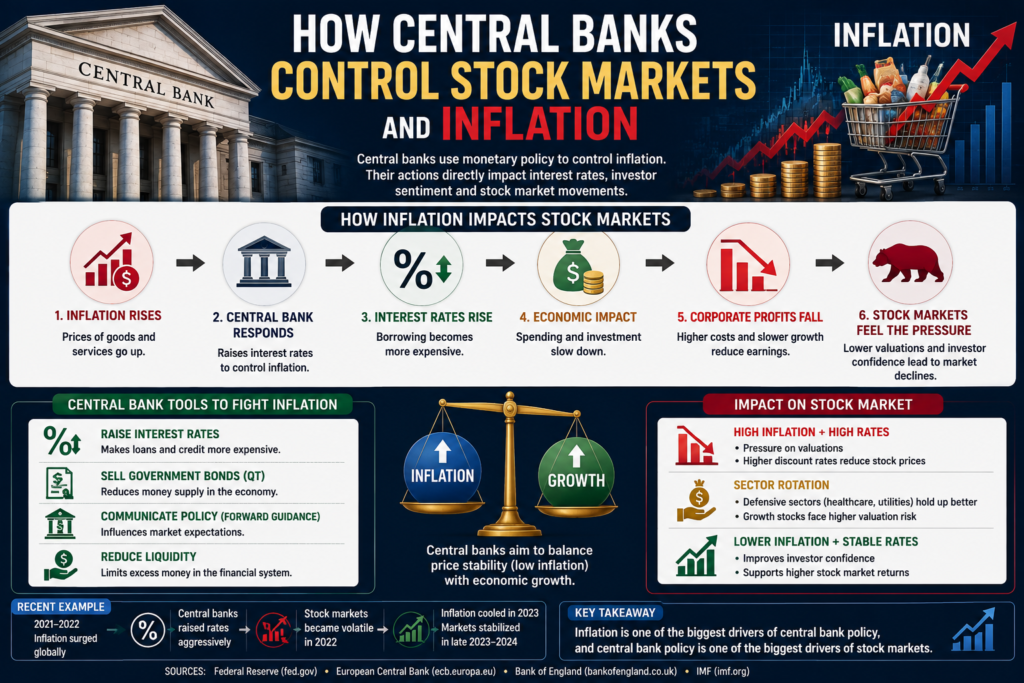
Case Study: Inflation Surge of 2021–2023
After the COVID-19 shock, economies reopened while demand recovered rapidly. Supply constraints and other factors contributed to a significant increase in inflation across several major economies.
Major central banks shifted from highly accommodative monetary policy toward aggressive tightening. They increased interest rates and, in some cases, began reducing their balance sheets.
Higher interest rates contributed to significant pressure on many growth and technology stocks, while bond yields increased and market volatility rose.
Monetary policy can change quickly when inflation becomes the priority. Investors should therefore monitor inflation trends as well as central-bank decisions.
Chapter 15: Forward Guidance
Forward Guidance refers to communication from central banks regarding future policy.
Examples include:
- Future rate cuts
- Future rate hikes
- Inflation expectations
Markets react instantly.
Often the speech itself matters more than the actual policy action.
Why Investors Watch Every Word
When central bank leaders speak:
Trillions of dollars may move.
Investors analyze:
- Tone
- Language
- Economic outlook
- Policy hints
Even small wording changes can move global markets.
Chapter 16: Central Banks and Investor Psychology
Markets are not purely mathematical.
Human emotions matter.
Investors experience:
- Fear
- Greed
- Optimism
- Panic
Central banks influence these emotions.
When central banks appear supportive:
Confidence rises.
When they appear aggressive:
Fear increases.
Chapter 17: How Central Bank Policy Affects Different Stock Market Sectors
Central-bank policy does not affect every company or sector in exactly the same way.
The impact depends on factors such as debt levels, valuation, consumer demand, commodity prices, cash flows, and sensitivity to economic growth.
| Sector | Falling Rates | Rising Rates |
|---|---|---|
| Technology | Often supportive | Often negative |
| Banks | Mixed | Can be supportive |
| Real Estate | Often supportive | Often negative |
| Consumer Discretionary | Often supportive | Often negative |
| Utilities | Can benefit | Can face competition from higher bond yields |
| Healthcare | Generally more defensive | Generally less rate-sensitive |
| Energy | Depends heavily on commodity prices | Depends heavily on commodity prices |
These are general relationships, not guaranteed outcomes.
Technology
Technology and growth companies can be sensitive to interest rates because their valuations may depend heavily on future earnings.
Lower discount rates can support their valuations, while higher discount rates can create pressure.
Banks
Banks can have a more complicated relationship with interest rates.
Higher rates can potentially increase lending yields, but they can also increase funding costs and weaken loan demand.
Therefore, the impact depends on the broader banking and economic environment.
Real Estate
Real estate can be sensitive to borrowing costs because property purchases and development often involve significant financing.
Higher rates can increase financing costs and potentially reduce demand.
Consumer Discretionary
Consumer-discretionary companies depend heavily on household spending.
Higher borrowing costs can reduce disposable income and consumer demand, while lower rates can potentially provide support.
Utilities
Utilities are often considered relatively defensive businesses, but they can also compete with bonds for income-oriented investors.
When bond yields rise significantly, income-oriented investors may find bonds more attractive.
Healthcare
Healthcare companies can be relatively defensive because demand for many healthcare products and services may be less sensitive to economic cycles.
However, individual healthcare companies can still respond differently to interest rates, regulation, earnings, and other factors.
Energy
Energy stocks are heavily influenced by oil, natural gas, commodity prices, supply and demand, and geopolitical conditions.
Therefore, central-bank policy is only one factor affecting this sector.
Chapter 18: The COVID-19 Market Recovery
In early 2020, the COVID-19 pandemic caused an extraordinary economic shock. Stock markets around the world fell sharply as investors feared a global recession and widespread business disruption.
Central banks responded with emergency rate cuts, asset purchases, lending programs, and other measures designed to support financial-market functioning and the broader economy.
After the initial crash, global equity markets recovered rapidly. Technology and other growth-oriented sectors performed particularly strongly during the recovery.
During a crisis, monetary policy can change financial conditions extremely quickly. Investors should understand both the economic shock and the policy response rather than looking at either one in isolation.
Chapter 19: Why Some Investors Say Central Banks Drive Everything
Many institutional investors believe:
Liquidity drives markets more than fundamentals in the short term.
Reasons include:
- Easy money increases risk-taking.
- Low rates increase valuations.
- QE supports asset prices.
This belief became popular after:
- 2008 Financial Crisis
- European Debt Crisis
- COVID-19 Recovery
Chapter 20: The Limits of Central Bank Power
Central banks are powerful.
But they are not all-powerful.
They cannot fully control:
- Wars
- Natural disasters
- Political instability
- Technological disruption
- Corporate fraud
- Supply chain breakdowns
These factors can overwhelm monetary policy.
Investors can explore additional market guides to better understand how economic conditions, valuations, earnings, and monetary policy interact.
Case Study: 2022 Market Decline
Inflation remained elevated across major economies, creating pressure on central banks to tighten monetary policy.
Major central banks raised interest rates significantly and moved away from the ultra-low-rate policies used during the pandemic.
Higher yields and tighter financial conditions contributed to substantial declines in many equity markets, particularly among companies with high-growth valuations.
A transition from easy monetary policy to restrictive monetary policy can change the investment environment dramatically.
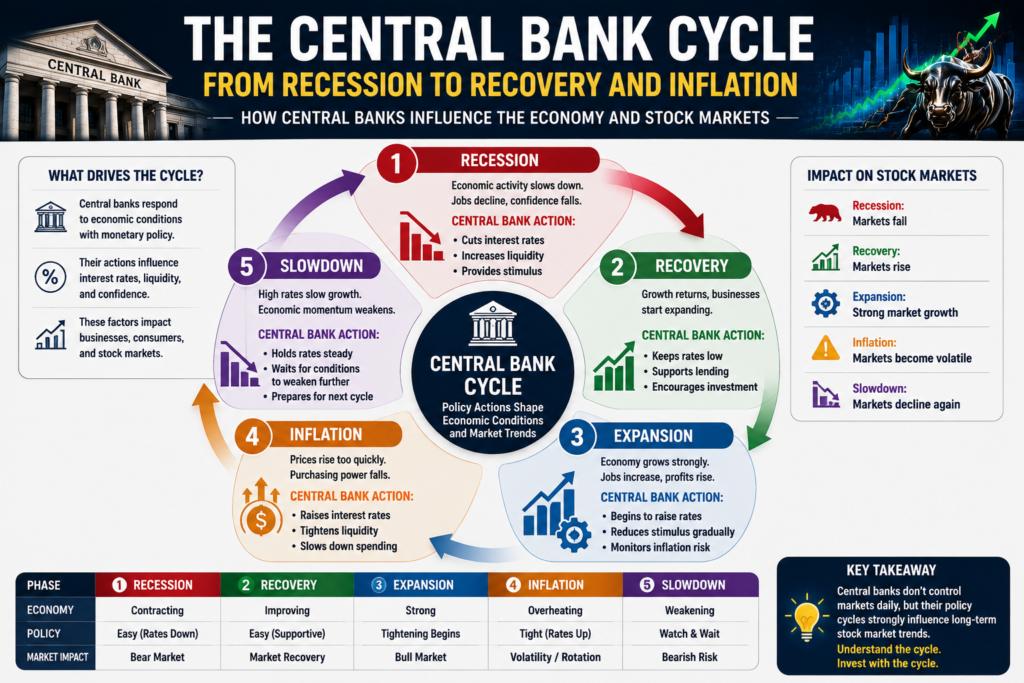
Chapter 21: The Central Bank Cycle
Every major economy generally moves through a repeating cycle:
Phase 1: Recession
- Growth weakens
- Unemployment rises
Central bank cuts rates.
Phase 2: Recovery
- Lending improves
- Markets rebound
Phase 3: Expansion
- Economic growth accelerates
- Corporate profits rise
Stocks perform strongly.
Phase 4: Inflation
- Prices rise rapidly
Central bank raises rates.
Phase 5: Slowdown
- Growth weakens
Cycle repeats.
Understanding this cycle is one of the most valuable skills an investor can develop.
How Investors Can Respond to Central Bank Cycles
Investors should generally avoid building an entire investment strategy around predicting the next central-bank decision.
Instead, investors can monitor several economic and financial indicators simultaneously.
1. Inflation
Inflation is one of the most important inputs into monetary policy.
Investors should monitor whether inflation is:
- Rising
- Falling
- Stable
- Becoming persistent
Persistent inflation can increase the likelihood of tighter monetary policy.
2. Interest Rates
Investors should monitor both current rates and expectations for future rates.
The direction of rates can influence:
- Borrowing costs
- Bond yields
- Valuations
- Consumer spending
- Corporate investment
3. Bond Yields
Treasury yields can provide useful information about market expectations and the relative attractiveness of bonds versus stocks.
Investors should pay attention to both short- and long-term yields.
4. Economic Growth
Central-bank policy cannot be understood without considering economic growth.
Strong economic growth may support corporate earnings, while a severe slowdown can create pressure on revenues and profits.
5. Corporate Earnings
Ultimately, stocks represent ownership in businesses.
Even if monetary policy becomes more supportive, declining corporate earnings can still hurt stock prices.
Investors should therefore monitor:
- Revenue growth
- Earnings growth
- Profit margins
- Cash flow
- Debt
- Forward earnings expectations
6. Central-Bank Guidance
Investors should read beyond the headline interest-rate decision.
Central-bank statements and speeches can provide clues about future policy.
The important question is often:
What does the central bank expect to do next?
7. Market Valuations
Interest rates and valuations are closely connected, but investors should consider both separately.
A company can be an excellent business and still be an expensive investment.
Investors should evaluate metrics such as:
- P/E ratio
- Price-to-sales ratio
- Free-cash-flow yield
- Earnings growth
- Debt levels
8. Liquidity Conditions
Liquidity can influence risk appetite and financial-market conditions.
Investors can monitor whether monetary policy is becoming:
More accommodative → Neutral → More restrictive
rather than focusing only on individual rate announcements.
Investors approaching or planning for retirement should consider these interest-rate and market cycles as part of a long-term retirement investing strategy rather than attempting to predict every central-bank decision.
Considerations for Different Types of Investors
Long-Term Investors
Long-term investors generally benefit from maintaining a disciplined strategy rather than attempting to predict every monetary-policy move.
Diversification, appropriate asset allocation, regular investing, and a long investment horizon can be more important than correctly forecasting the next rate decision.
Dividend Investors
Dividend investors should consider whether companies can maintain and grow their dividends.
Higher rates can make bonds and other fixed-income investments more competitive with dividend-paying stocks.
Investors should therefore examine:
- Dividend yield
- Dividend growth
- Payout ratio
- Free cash flow
- Debt levels
Growth Investors
Growth investors should pay particular attention to:
- Interest rates
- Bond yields
- Discount rates
- Valuation multiples
- Expected earnings growth
Growth stocks can be more sensitive to changes in the valuation environment.
ETF Investors
ETF investors should understand the underlying exposure of their funds.
For example, an investor holding a technology ETF may have greater sensitivity to interest-rate changes than someone holding a broad-market ETF.
Investors should therefore examine:
- Sector concentration
- Geographic exposure
- Valuation
- Bond duration, if applicable
- Underlying holdings
Retirement Investors
Retirement investors should place greater emphasis on their time horizon, income requirements, diversification, and risk capacity.
Someone approaching retirement may have different needs from someone with several decades before retirement.
Central-bank cycles should therefore be considered within the broader context of a long-term retirement plan rather than used as a reason to make frequent portfolio changes.
21. Frequently Asked Questions About How Central Banks Control Stock Markets
1. How do central banks control stock markets?
Central banks influence stock markets through interest rates, liquidity, monetary policy, QE, QT, and forward guidance.
These tools affect borrowing costs, valuations, corporate earnings, and investor sentiment.
2. Why do interest rate cuts affect stock prices?
Rate cuts can lower borrowing costs and make stocks relatively more attractive than bonds.
They can also increase liquidity and support economic activity and corporate earnings.
3. How do interest rate hikes affect stocks?
Rate hikes increase borrowing costs and can reduce economic demand and corporate profits.
They can also lower stock valuations by increasing the discount rate applied to future earnings.
4. What is quantitative easing?
Quantitative easing (QE) is a policy in which a central bank purchases financial assets to support liquidity and financial conditions.
QE can encourage investors to move toward riskier assets such as stocks.
5. What is quantitative tightening?
Quantitative tightening (QT) reduces a central bank’s balance sheet and can decrease financial-system liquidity.
Tighter liquidity and higher yields can create pressure on stock valuations.
6. Which central bank has the biggest influence on global stock markets?
The U.S. Federal Reserve generally has one of the largest influences on global financial markets.
Its decisions can affect U.S. stocks, Treasury yields, the dollar, and international capital flows.
7. How does inflation affect central bank policy and stocks?
High and persistent inflation can encourage central banks to raise interest rates and tighten financial conditions.
Higher rates can increase costs and put pressure on stock valuations and corporate earnings.
8. Should investors change their portfolio when central banks raise interest rates?
Investors should not automatically change their entire portfolio whenever rates rise.
Instead, they should consider their time horizon, risk tolerance, diversification, valuations, and financial goals.
9. How do central banks affect technology stocks?
Technology and growth stocks can be sensitive to interest rates because their valuations often depend heavily on future earnings.
Higher discount rates can reduce the present value of those future earnings.
10. Can central banks prevent a stock market crash?
Central banks can provide liquidity and emergency support during financial crises, but they cannot prevent every market crash.
Economic recessions, wars, earnings declines, and other shocks can still cause major market declines.
11. Why can stocks fall after a central bank cuts interest rates?
A rate cut may signal that the central bank is concerned about weakening economic conditions.
Stocks can therefore fall if recession fears or declining corporate earnings outweigh the benefit of lower rates.
12. How should investors monitor central bank policy?
Investors should watch interest-rate decisions, inflation data, economic forecasts, bond yields, and central-bank statements.
Understanding these indicators can help investors assess changing market conditions and portfolio risks.
Sources / References
Then list your authoritative sources.
For example:
Federal Reserve — Monetary Policy
Official information on U.S. monetary policy, the federal funds rate, FOMC decisions, quantitative easing, and other policy tools.
Federal Reserve — Monetary Policy
European Central Bank — Monetary Policy
Official information about monetary policy in the euro area.
Bank of England — Monetary Policy
Official information about UK monetary policy and interest-rate decisions.
Bank of Japan — Monetary Policy
Official information about Japan’s monetary policy.
Bank of Canada — Monetary Policy
Official information about Canada’s monetary policy.
Reserve Bank of Australia — Monetary Policy
Official information about Australia’s monetary policy.
The Federal Reserve’s own explanation is particularly useful for this article because it explains how monetary policy affects financial conditions and ultimately household and business decisions.
Investor.gov — Investment Advisers
Information about investment advice, investment professionals, fees, conflicts of interest, and checking adviser registration.
Final Conclusion
Central banks are the architects of modern monetary systems. Through interest rates, quantitative easing, quantitative tightening, money supply management, and forward guidance, they profoundly influence stock markets across Tier-1 economies.
The relationship works through several mechanisms:
- Interest rates affect valuations.
- Liquidity affects asset prices.
- Credit affects economic growth.
- Investor psychology affects risk-taking.
- Inflation determines monetary policy.
History repeatedly shows that major stock market movements often coincide with central bank actions. The recoveries after the 2008 Financial Crisis, the European Debt Crisis, and the COVID-19 crash demonstrate how monetary policy can reshape financial markets.
For investors, understanding central banks is not optional—it is essential. Whether investing in growth stocks, dividend stocks, index funds, ETFs, or retirement portfolios, the ability to interpret central bank policy can provide a significant advantage.
The most important lesson is simple:
Central banks do not directly control stock prices, but by controlling the cost and availability of money, they influence nearly every factor that determines stock market performance. Understanding that relationship is one of the foundations of successful long-term investing.