
Introduction: Why Most People Fail at Saving (And Why You Won’t)
Saving $10,000 a year without sacrificing your lifestyle may sound impossible — but with the right system, it becomes predictable and achievable.
In surveys across Tier-1 countries, the majority of adults:
- Live paycheck to paycheck,
- Have less than three months of emergency savings,
- Feel constant financial stress,
- Believe saving requires extreme sacrifice.
This belief is not only wrong — it is dangerous, because it stops people from even trying.
Let’s be honest.
Most financial advice feels like this:
“Cancel Netflix.”
“Stop eating out.”
“Never buy coffee.”
“Cut everything fun.”
That advice works on paper, but fails in real life, because humans are emotional, habitual, and comfort-seeking creatures. We don’t live on spreadsheets — we live in routines, relationships, and environments.
The moment saving feels like punishment, motivation collapses.
But here’s the truth:
You can save $10,000 a year without downgrading your lifestyle — if you change your system instead of your happiness.
This guide is designed for people living in Tier-1 economies, where:
- The cost of living is high,
- Convenience is built into daily life,
- Subscriptions are invisible but constant,
- Lifestyle inflation is normalized,
- And financial pressure is continuous.
Instead of teaching you how to “spend less,” this guide teaches you how to:
- Spend intentionally,
- Eliminate waste without eliminating joy,
- Optimize your financial flow,
- Automate your savings,
- Increase your income strategically, not exhaustingly.
This is not a budgeting guide.
👉 “If you’re new to budgeting, check out our guide on How to Create a Budget That Works.”
This is a financial system design guide.
Let’s build a $10,000-a-year savings system that works with your life, not against it.
Section 1: Why $10,000 a Year Is a Life-Changing Number
Before we talk about tactics, we need to talk about meaning.
Saving $10,000 a year isn’t just a number — it’s a psychological and financial threshold.
Let’s break it down:
- $833 per month
- $192 per week
- $27 per day
At first glance, that might feel overwhelming. But when you zoom out, most people unknowingly waste far more than $27 per day on:
- Convenience purchases,
- Overpriced subscriptions,
- Lifestyle creep,
- Unoptimized bills,
- Impulse spending.
In other words, this money is not missing — it’s leaking.
Why $10,000 Matters
Saving $10,000 a year changes your life in three major ways:
Scenario 1: Emergency Fund Security
An emergency fund is money set aside for unexpected expenses such as:
- Medical bills,
- Car repairs,
- Job loss,
- Home repairs,
- Family emergencies.
Financial experts recommend having 3–6 months of living expenses saved.
For example:
If your monthly expenses are $3,000:
- 3 months = $9,000,
- 6 months = $18,000.
Saving $10,000 a year means:
- You can fully fund your emergency buffer within 12–18 months,
- You no longer panic when life throws surprises,
- You stop relying on high-interest debt during emergencies.
This alone can eliminate financial anxiety.
👉 “Learn: How to Build an Emergency Fund Fast”
Scenario 2: Debt Freedom
Debt is one of the biggest barriers to wealth.
Let’s say you have:
- $8,000 in credit card debt at 22% interest,
- $12,000 in personal loans at 12% interest,
- $15,000 in auto loans at 7% interest.
Every year, you’re losing thousands in interest — money that produces no value.
Applying $10,000 annually toward debt means:
- Faster payoff,
- Less interest,
- More monthly cash flow,
- Higher credit score,
- Lower stress.
For example:
Paying off a $10,000 credit card balance at 22% saves you over $2,000 in interest over time.
Scenario 3: Wealth Building Through Investing
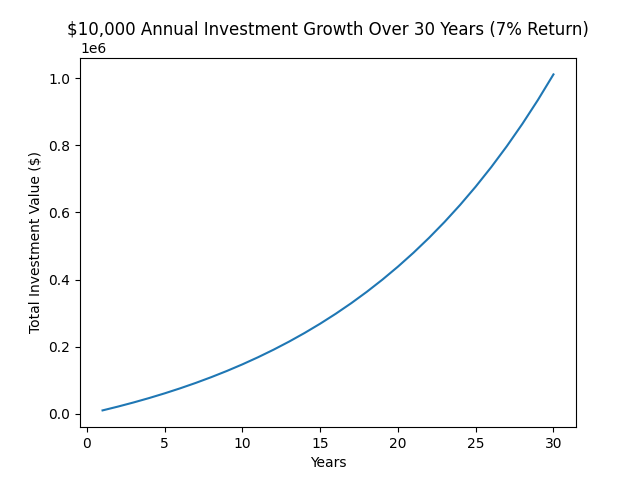
Let’s assume you invest $10,000 per year at a conservative 7% average annual return.
Here’s what happens:
- After 8 years → ~$100,000
- After 15 years → ~$230,000
- After 25 years → ~$470,000
- After 30 years → ~$1,000,000+
That’s not magic — that’s compound interest, where your money earns money, and that money earns more money.
This is not about saving money.
This is about buying your future freedom.
Section 2: The Lifestyle-Preserving Savings Framework
Most people think saving money is about cutting spending.
In reality, saving money is about optimizing flow.
Instead of:
“Stop spending.”
We use:
“Spend intentionally and optimize silently.”
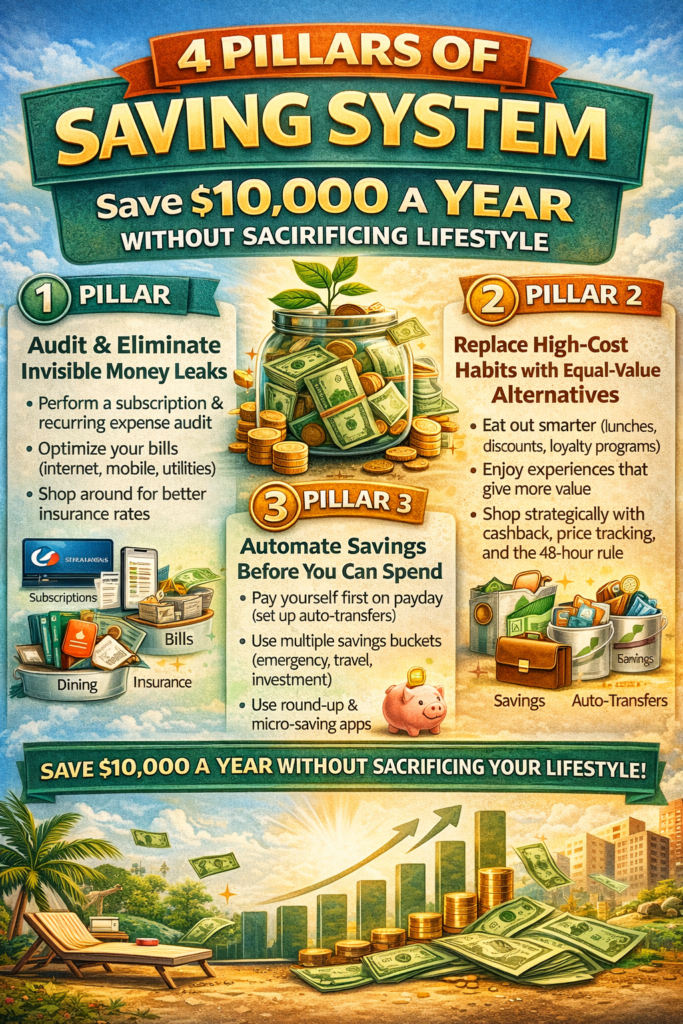
This framework has four pillars:
- Audit & Eliminate Invisible Money Leaks
- Replace High-Cost Habits with Equal-Value Alternatives
- Automate Savings Before You Can Spend
- Increase Income Without Increasing Burnout
Each pillar addresses a different part of your financial system:
- Pillar 1 removes waste,
- Pillar 2 preserves joy,
- Pillar 3 builds discipline through automation,
- Pillar 4 expands capacity through income growth.
Together, they create a system that saves $10,000+ per year without sacrificing lifestyle.
Let’s examine each pillar in depth.
Section 3: Pillar 1 — Audit & Eliminate Invisible Money Leaks
What Is a Money Leak?
A money leak is any recurring expense or spending habit that:
- Provides little to no real value,
- Goes unnoticed or unquestioned,
- Slowly drains your financial resources over time.
Unlike big purchases (like rent or a car), money leaks are:
- Small,
- Frequent,
- Invisible,
- Emotionally insignificant,
- But financially devastating over time.
Think of money leaks like a dripping faucet — one drop doesn’t matter, but over a year, it floods the room.
Step 1: Perform a Subscription & Recurring Expense Audit
In Tier-1 countries, the average adult spends $1,200–$2,500 per year on forgotten or underused subscriptions.
Examples include:
- Streaming services (Netflix, Hulu, Prime, Disney+, etc.)
- Cloud storage (Google Drive, iCloud, Dropbox)
- Gym memberships
- App subscriptions
- News or magazine sites
- Software tools
- Meal kits
- Delivery memberships
- Meditation apps
- Fitness apps
- Language apps
Many people subscribe during:
- Free trials,
- Promotions,
- Emotional moments (“I’ll start tomorrow”),
- Convenience decisions,
- Impulse actions.
And then… they forget.
Action Step:
Pull your bank and credit card statements for the last 3 months and list every recurring charge.
Create three columns:
- Service name
- Monthly cost
- Actual usage
Then ask:
- Do I use this weekly?
- Does this genuinely improve my life?
- Would I miss it in 30 days?
Cancel everything that:
- You rarely use,
- You forgot about,
- You don’t care about,
- You only keep out of habit.
But — and this is important — do not cancel things you truly value.
This is not about deprivation.
This is about alignment.
Example:
Sarah pays:
- $15/month for Netflix (uses daily),
- $12/month for Hulu (rarely uses),
- $10/month for a fitness app (never uses),
- $9/month for cloud storage she no longer needs.
She cancels Hulu, the fitness app, and cloud storage.
Monthly savings: $31
Annual savings: $372
And she didn’t lose anything she cared about.
Typical savings: $30–$150/month
Annual impact: $360–$1,800
Step 2: Optimize Utilities Without Downgrading Lifestyle
Utilities are essential — but that doesn’t mean they’re optimized.
Common utilities include:
- Internet
- Mobile plans
- Electricity
- Gas
- Water
- Trash services
- Insurance (auto, renters/home, health)
Most people:
- Stay with the same provider for years,
- Accept price increases passively,
- Never renegotiate,
- Assume switching is difficult,
- Fear losing service quality.
In reality, utility companies:
- Offer better deals to new customers,
- Provide loyalty discounts if asked,
- Have retention departments trained to offer savings,
- Compete aggressively for customers.
Action Plan:
Once per year:
- Call each provider.
- Ask for:
- Loyalty discounts,
- Promotional rates,
- Competitor matching.
- Compare rates online.
- Switch providers if necessary.
This does not reduce your quality — it reduces overpricing.
Example:
John pays:
- $95/month for internet,
- $110/month for mobile plans,
- $220/month for electricity.
He calls his providers and negotiates:
- Internet reduced to $70,
- Mobile plan reduced to $85,
- Electricity supplier switched to a lower rate.
Monthly savings: $170
Annual savings: $2,040
No lifestyle change — just smarter contracts.
Typical savings: $50–$200/month
Annual impact: $600–$2,400
Step 3: Optimize Insurance Without Losing Coverage
Insurance is necessary — but rarely optimized.
Most people:
- Overpay for coverage,
- Keep the same policies for years,
- Never shop around,
- Fear switching providers,
- Don’t understand their deductibles,
- Are unaware of bundling discounts.
Common insurance types:
- Auto
- Homeowners or renters
- Health
- Life
- Disability
- Travel
Action Plan:
Once per year:
- Get quotes from at least 3 providers,
- Compare coverage apples-to-apples,
- Increase deductibles slightly if you have an emergency fund,
- Bundle auto + home/renters where beneficial,
- Ask about loyalty, safety, and multi-policy discounts.
Example:
Maria pays:
- $210/month for auto insurance,
- $45/month for renters insurance.
She shops around and finds:
- Same coverage for $155/month auto,
- $28/month renters,
- With bundling discounts.
Monthly savings: $72
Annual savings: $864
No reduction in protection — only in price.
Typical savings: $40–$150/month
Annual impact: $480–$1,800
Total Pillar 1 Savings Potential:
$1,500 – $5,000 per year, with zero lifestyle downgrade.
This alone could get you halfway to your $10,000 goal.
Section 4: Pillar 2 — Replace, Don’t Remove
Most financial advice focuses on removal:
- Remove dining out,
- Remove entertainment,
- Remove shopping,
- Remove comfort.
But humans are not designed for constant removal.
Instead, we use replacement:
- Replace high-cost habits with equal-value alternatives,
- Replace low-value spending with high-value experiences,
- Replace impulse with intention.
This preserves your lifestyle while optimizing your finances.
Example 1: Dining & Food
Instead of:
“Stop eating out.”
Use:
“Eat out intentionally.”
Food is emotional, social, cultural, and enjoyable. Cutting it completely is unrealistic and unnecessary.
Optimization Strategies:
- Shift Timing
- Eat lunch instead of dinner at premium restaurants.
- Lunch menus are often 30–50% cheaper.
- Use Loyalty Programs
- Many restaurants offer:
- Points,
- Free meals,
- Birthday rewards,
- Referral bonuses.
- Many restaurants offer:
- Replace Low-Value Takeout
- Replace 2 takeout meals per week with 2 high-quality home meals.
- This doesn’t mean boring meals — it means intentional cooking.
- Use Grocery Delivery
- Prevent impulse purchases,
- Stick to your list,
- Save time and mental energy.
- Meal Prep Strategically
- Prep only the meals you dislike cooking.
- Keep variety — don’t eat the same meal all week.
Example:
Alex spends $700/month on dining and takeout.
He:
- Keeps his weekend restaurant dinners,
- Replaces 2 weekday takeouts with home meals,
- Uses lunch menus for premium restaurants,
- Uses grocery delivery.
New food spending: $450/month
Monthly savings: $250
Annual savings: $3,000
No lifestyle downgrade — just optimized habits.
Savings: $100–$300/month
Annual impact: $1,200–$3,600
Example 2: Entertainment & Experiences
Instead of:
“Stop going out.”
Use:
“Get more value per dollar.”
Entertainment includes:
- Movies,
- Concerts,
- Sports events,
- Theaters,
- Museums,
- Travel,
- Hobbies,
- Experiences.
You don’t need less entertainment — you need better value.
Optimization Strategies:
- Use Memberships & Passes
- Museums, zoos, theaters, gyms, and parks often offer annual passes that:
- Cost less than 3–4 visits,
- Provide unlimited access,
- Offer guest privileges.
- Museums, zoos, theaters, gyms, and parks often offer annual passes that:
- Attend Matinees
- Matinee shows and movies are often 30–60% cheaper than evening performances.
- Leverage Community Events
- Many cities offer:
- Free concerts,
- Free festivals,
- Outdoor movies,
- Cultural events,
- Public lectures.
- Many cities offer:
- Use Reward Points
- Travel rewards cards,
- Cashback programs,
- Credit card points,
- Loyalty programs.
- Plan Experiences in Advance
- Avoid last-minute pricing premiums.
Example:
Rachel spends $300/month on entertainment.
She:
- Switches to annual museum passes,
- Uses matinee tickets,
- Attends free city events,
- Uses reward points for concerts.
New spending: $180/month
Monthly savings: $120
Annual savings: $1,440
No less fun — just smarter fun.
Savings: $50–$150/month
Annual impact: $600–$1,800
Example 3: Shopping & Consumer Goods
Instead of:
“Stop buying things.”
Use:
“Buy smarter.”
Shopping includes:
- Clothing,
- Electronics,
- Home goods,
- Gadgets,
- Beauty products,
- Accessories.
Most waste comes from:
- Impulse purchases,
- Trend chasing,
- Low-quality items,
- Overbuying,
- Emotional shopping.
Optimization Strategies:
- Use Price Tracking Tools
- Track prices over time,
- Buy at historical lows,
- Avoid paying full price unnecessarily.
- Buy Off-Season
- Winter clothes in spring,
- Summer clothes in fall,
- Holiday decor after holidays.
- Choose Quality Over Quantity
- One high-quality item that lasts 5 years > five cheap items that break in 6 months.
- Use Cashback & Reward Cards
- Earn 1–5% back on purchases,
- Stack with discounts and coupons.
- Implement the 48-Hour Rule
- Wait 48 hours before buying non-essential items.
- Most impulse urges disappear within this time.
Example:
David spends $400/month on shopping.
He:
- Uses price tracking,
- Waits 48 hours before purchases,
- Buys higher-quality items,
- Uses cashback cards.
New spending: $250/month
Monthly savings: $150
Annual savings: $1,800
No reduction in enjoyment — just smarter buying.
Savings: $75–$200/month
Annual impact: $900–$2,400
Total Pillar 2 Savings Potential:
$2,700 – $7,800 per year, with no lifestyle downgrade — only smarter spending.
Section 5: Pillar 3 — Automate Your Savings Before You Can Spend
The biggest mistake people make is trying to save what’s left over at the end of the month.
The truth is:
There is never anything left over.
Spending expands to fill available money — a concept known as Parkinson’s Law.
So instead of:
“Save what’s left,”
We use:
“Save first, spend what remains.”
This is called Paying Yourself First.
Step 1: Pay Yourself First
Set up automatic transfers from your checking account to:
- A high-yield savings account,
- An investment account,
- An emergency fund.
Do this on payday — not after bills, not after spending, not when you “remember.”
Start with:
- $100–$200 per paycheck,
- Or 5–10% of your income,
- Increase gradually as your income grows.
You won’t miss what you never see.
Example:
Emma earns $4,000/month.
She sets:
- $300/month to savings,
- $200/month to investments.
Total: $500/month
Annual: $6,000 saved automatically.
She doesn’t “feel” poorer — her system simply adjusts.
Step 2: Use Multiple Savings Buckets
Instead of one giant savings account, create separate “buckets”:
- Emergency Fund
- Covers unexpected expenses.
- Goal: 3–6 months of expenses.
- Travel Fund
- For vacations and trips.
- Prevents debt-funded travel.
- Big Purchase Fund
- For cars, home upgrades, electronics, weddings, etc.
- Investing Fund
- For wealth building and retirement.
This creates:
- Psychological clarity,
- Motivation,
- Purpose-driven saving,
- Reduced guilt when spending from the right bucket.
Example:
Instead of thinking:
“I’m spending my savings,”
You think:
“I’m spending my travel fund — which is exactly what it’s for.”
Step 3: Use Round-Up & Micro-Saving Tools
These tools:
- Round your purchases to the nearest dollar,
- Transfer the difference to savings or investments,
- Sweep leftover balances at the end of the month.
For example:
- You buy coffee for $3.60,
- The app rounds up to $4.00,
- The extra $0.40 goes to savings.
Over time, these micro-savings add up without effort.
Typical savings: $500–$1,500 per year.
Total Pillar 3 Savings Potential:
$1,200 – $3,000 per year, entirely automated.
Section 6: Pillar 4 — Increase Income Without Increasing Burnout
Saving $10,000 per year doesn’t always require extreme frugality.
Sometimes, the fastest way to save more is to earn more — but in a way that doesn’t destroy your health, relationships, or mental well-being.
We avoid:
- 80-hour workweeks,
- Hustle culture,
- Burnout,
- Chronic stress,
- Sacrificing life for money.
Instead, we focus on:
- Leverage,
- Skills,
- Systems,
- Optimization,
- Scalability.
Strategy 1: Salary Optimization
Most people leave thousands of dollars on the table because they:
- Never negotiate,
- Stay in underpaid roles,
- Underestimate their market value,
- Fear rejection,
- Don’t research salaries.
Action Steps:
- Benchmark Your Role
- Use salary websites,
- Talk to recruiters,
- Network within your industry.
- Prepare a Data-Driven Case
- Document achievements,
- Quantify results,
- Show impact.
- Ask for Raises Regularly
- Annually or after major accomplishments.
- Apply Externally Every 2–3 Years
- Job switching often results in 10–30% pay increases.
Example:
Michael earns $60,000/year.
He researches his role and discovers the market range is $70,000–$85,000.
He applies externally and receives an offer for $75,000.
Increase: $15,000/year.
Even if he saves only 50% of that increase:
Savings: $7,500/year — without changing spending habits.
Typical increase: $3,000–$10,000 per year (often more).
Strategy 2: Skill-Based Side Income
Side income doesn’t have to mean:
- Driving all night,
- Working weekends,
- Sacrificing rest,
- Constant hustling.
Instead, we focus on skill leverage.
Examples:
- Freelancing (writing, design, coding, marketing),
- Consulting,
- Coaching,
- Tutoring,
- Teaching online,
- Content creation,
- Social media management,
- Virtual assistance,
- Copywriting,
- Data analysis,
- Web development.
The goal is:
- High value per hour,
- Low time investment,
- Flexible schedule,
- Skill-based compensation.
Even $200/week = $10,400/year.
Example:
Lisa works full-time in marketing.
She offers freelance social media management to two small businesses for $500/month each.
Side income: $1,000/month
Annual: $12,000.
Even saving half of this:
Savings: $6,000/year.
Strategy 3: Passive & Semi-Passive Income
Passive income means earning money with minimal ongoing effort after setup.
Examples:
- Dividend investing,
- Rental income,
- Digital products (ebooks, templates, courses),
- Affiliate marketing,
- Blogging,
- YouTube,
- Podcast monetization,
- Stock photography,
- Licensing.
While passive income often starts slow, it:
- Scales over time,
- Reduces dependency on labor,
- Creates financial resilience.
Example:
James creates a $29 online course and sells it to 10 people per month.
Monthly income: $290
Annual: $3,480.
Combined with other streams, this compounds into real wealth.
Total Pillar 4 Income Impact:
$3,000 – $15,000+ per year, depending on effort, skills, and strategy.
Section 7: The $10,000 System — Putting It All Together
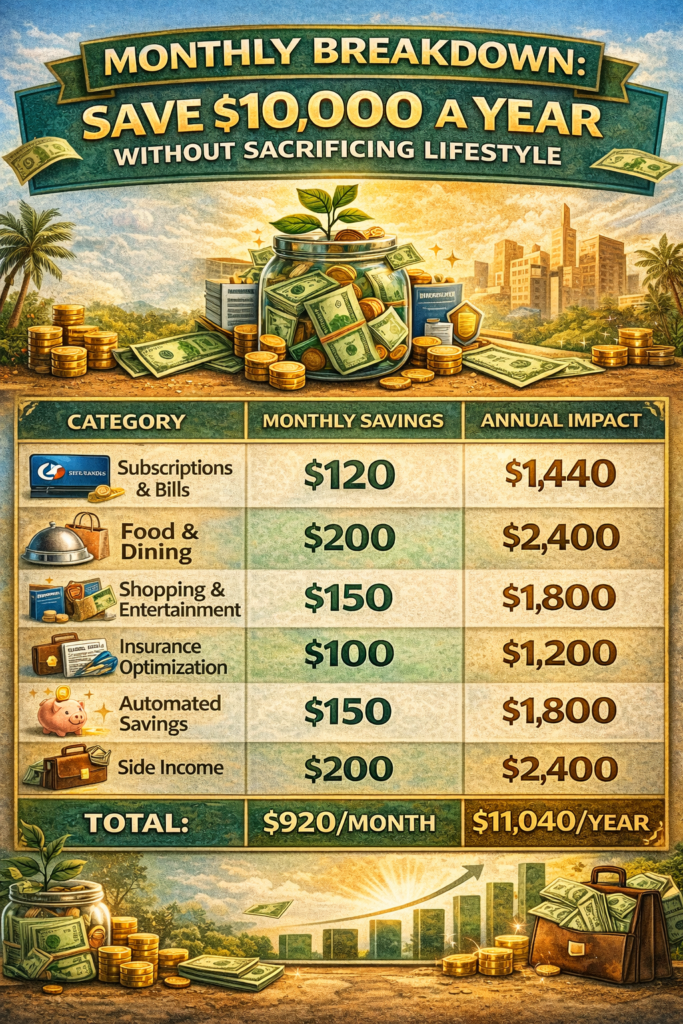
Let’s build a realistic, achievable system.
Monthly Optimization Breakdown
| Category | Monthly Savings | Annual Impact |
|---|---|---|
| Subscriptions & Bills | $120 | $1,440 |
| Food & Dining | $200 | $2,400 |
| Shopping & Entertainment | $150 | $1,800 |
| Insurance Optimization | $100 | $1,200 |
| Automated Savings | $150 | $1,800 |
| Side Income | $200 | $2,400 |
| Total | $920/month | $11,040/year |
No suffering.
No deprivation.
Just optimization.
This system:
- Preserves lifestyle,
- Removes waste,
- Builds automation,
- Increases income,
- Compounds over time.
Section 8: Psychology — The Secret to Saving Without Stress
Most financial failure isn’t due to math — it’s due to emotion.
Understanding your psychology is just as important as understanding your numbers.
1. Avoid the All-or-Nothing Trap
The all-or-nothing mindset says:
“If I can’t do this perfectly, I won’t do it at all.”
This leads to:
- Overambitious goals,
- Early burnout,
- Guilt,
- Quitting.
Instead, aim for:
- Progress, not perfection,
- Systems, not willpower,
- Consistency, not intensity.
Missing one goal doesn’t break the system.
Quitting does.
2. Make Saving Visible and Rewarding
Human brains are motivated by:
- Progress,
- Rewards,
- Visual feedback.
Track your savings:
- Use charts,
- Use apps,
- Use spreadsheets,
- Use visual trackers.
Celebrate milestones:
- First $1,000 saved,
- First month of automation,
- First debt paid off,
- First investment made.
Reward yourself — strategically:
- Small treats,
- Experiences,
- Not financial sabotage.
3. Detach Identity from Spending
Many people unconsciously equate:
- Spending with success,
- Luxury with worth,
- Appearance with achievement.
This leads to:
- Lifestyle inflation,
- Financial stress,
- Endless comparison,
- Never feeling “enough.”
True wealth is not:
- Expensive things,
- Flashy purchases,
- Social validation.
True wealth is:
- Optionality (you can choose),
- Security (you are safe),
- Peace (you are calm).
Section 9: Common Mistakes That Kill Savings Goals
Avoid these traps:
1. Budgeting Without Automation
Relying on willpower alone leads to failure.
Without automation:
- You forget,
- You procrastinate,
- You overspend,
- You abandon goals.
Automation turns discipline into default behavior.
2. Cutting Joy Instead of Waste
Cutting joy leads to:
- Resentment,
- Burnout,
- Rebound spending,
- Quitting.
Cutting waste leads to:
- Effortless savings,
- Higher satisfaction,
- Sustainable progress.
3. Ignoring Income Growth
You can only cut so much.
You can earn infinitely more.
Ignoring income growth:
- Limits progress,
- Increases stress,
- Slows wealth building.
4. Not Reviewing Finances Quarterly
Life changes.
Expenses change.
Income changes.
Goals change.
Without regular review:
- You drift,
- Leaks return,
- Goals fade.
Quarterly reviews keep your system aligned.
5. Letting Lifestyle Creep Erase Gains
Lifestyle creep is when spending rises automatically with income.
You get a raise → you upgrade your lifestyle → your savings stay the same.
Instead:
- Save first,
- Upgrade intentionally,
- Keep progress compounding.
6. Saving Without Investing
Saving protects money.
Investing grows money.
Without investing:
- Inflation erodes purchasing power,
- Long-term wealth stagnates.
Savings alone won’t make you wealthy — systems will.
Section 10: Advanced Tier-1 Strategies for High Earners
If you live in a Tier-1 economy and earn above the median, your opportunity is even greater — but so is your risk of waste.
1. Tax Optimization
Taxes are one of your largest expenses — and one of the most optimizable.
Strategies include:
- Using tax-advantaged accounts (401(k), IRA, RRSP, TFSA, ISA, superannuation),
- Maximizing employer matches,
- Using health savings accounts (HSA),
- Using flexible spending accounts (FSA),
- Harvesting capital losses,
- Optimizing filing status,
- Claiming eligible deductions and credits.
Potential savings: $2,000–$10,000/year.
2. Credit Optimization
Better credit leads to:
- Lower interest rates,
- Cheaper insurance premiums,
- Better loan terms,
- More financial flexibility.
Strategies include:
- Paying bills on time,
- Reducing credit utilization,
- Refinancing high-interest loans,
- Using 0% APR offers strategically,
- Optimizing reward structures.
3. Lifestyle Design
Lifestyle design means intentionally designing your life to:
- Minimize stress,
- Maximize satisfaction,
- Optimize finances,
- Align with values.
Design a lifestyle where:
- Fixed costs are low,
- Variable spending is intentional,
- Income grows automatically,
- Savings happen invisibly,
- Happiness is not dependent on spending.
Section 11: The One-Year $10,000 Action Plan
Let’s translate theory into action.
Month 1: Financial Audit
- Track every expense,
- Cancel unused subscriptions,
- Identify money leaks,
- Create a baseline.
Month 2: Automation Setup
- Set up savings buckets,
- Automate transfers,
- Use round-up tools,
- Start paying yourself first.
Month 3: Food & Shopping Optimization
- Implement meal strategies,
- Apply shopping rules,
- Set spending boundaries,
- Optimize rewards.
Month 4: Insurance & Utilities Review
- Shop insurance rates,
- Adjust deductibles,
- Bundle policies,
- Negotiate utilities.
Month 5: Income Optimization
- Benchmark salary,
- Prepare raise requests,
- Apply externally if needed,
- Launch side income.
Months 6–12: Optimization & Scaling
- Increase savings rate,
- Invest surplus,
- Eliminate remaining inefficiencies,
- Review finances quarterly,
- Scale income streams.
Section 12: What Saving $10,000 a Year Actually Gives You
Let’s move beyond numbers.
Saving $10,000 a year gives you:
- Freedom from paycheck-to-paycheck stress
- Freedom to walk away from toxic jobs
- Freedom to invest in yourself
- Freedom to travel without guilt
- Freedom to handle emergencies without panic
- Freedom to help family
- Freedom to build generational wealth
It’s not about money.
It’s about control, choice, and peace.
Trusted Financial Resources
- Financial data from the Federal Reserve shows that a large percentage of households lack sufficient emergency savings.
- Tax strategies recommended by the Internal Revenue Service can help reduce liabilities and improve long-term financial planning.
- Long-term investing principles promoted by Vanguard Group emphasize low-cost index investing and disciplined wealth building.
- Budgeting and savings frameworks highlighted by the Organisation for Economic Co-operation and Development demonstrate the importance of consistent saving behavior.
Conclusion: You Don’t Need a New Lifestyle — You Need a New System
You don’t need to:
- Eat worse,
- Live smaller,
- Cancel your happiness,
- Or become financially obsessed.
You need a system that:
- Removes waste,
- Automates savings,
- Optimizes income,
- Preserves joy,
- Compounds over time.
Saving $10,000 a year without sacrificing your lifestyle isn’t just possible — it’s predictable when you design your financial system intentionally.
Start today.
Optimize silently.
And let your future self thank you.