1. Investing vs Saving: What’s the Difference?
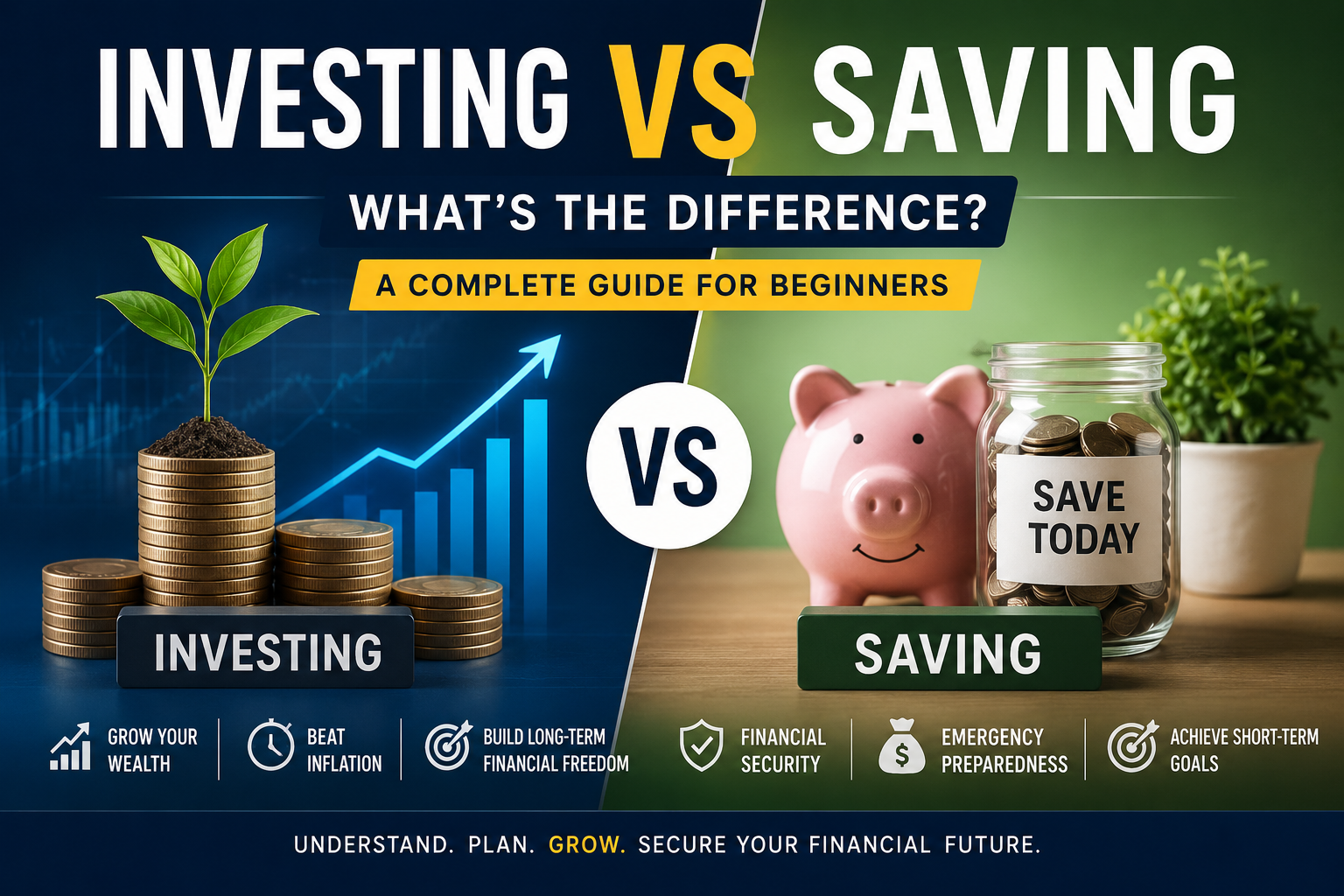
If you want to build a strong financial life, one of the most important concepts to understand is the difference between investing and saving. People often use the two words as if they mean the same thing. They do not. Both involve putting money aside for the future, but they serve different purposes, come with different levels of risk, and are best used for different financial goals.
Understanding Investing vs Saving is one of the most important financial skills every beginner should learn. Knowing when to save and when to invest can help you build wealth, protect your money, and achieve both short-term and long-term financial goals.
If you’re completely new to investing, start with our Beginner’s Guide to Investing to understand the fundamentals before exploring the differences between investing and saving.
Throughout this guide, you’ll learn Investing vs Saving in simple terms, including their benefits, risks, similarities, differences, and how to use both strategies together.
Saving is generally about protecting money you will need soon. Investing is generally about growing money you will need later.
That sounds simple, but the real decision is more nuanced than that. Should you save or invest if you want to buy a home in three years? What if inflation is high? What if you have debt? What if your employer offers a retirement match? What if you are afraid of losing money? And what if you have no emergency fund yet but do not want to “miss out” on the market?
This guide answers all of those questions in depth.
Investing vs Saving refers to two different ways of managing money. Saving focuses on protecting cash for short-term goals and emergencies, while investing aims to grow wealth over the long term by purchasing assets such as stocks, ETFs, bonds, or mutual funds. Most financial plans require both saving and investing.
By the end of this article, you will understand:
- What saving really means
- What investing really means
- The exact differences between investing and saving
- When to save first and when to invest first
- How risk, return, liquidity, inflation, and time horizon affect your choice
- How to use both saving and investing together in one financial system
- Common mistakes beginners make
- Real-life case studies showing how different people should divide money between savings and investments
- A step-by-step framework to decide what to do with every dollar you earn
This is not just a beginner article. It is a pillar guide designed to help you make practical money decisions for years to come.
2. What Is Saving?
Simple definition of saving
Saving means setting aside money in a safe, accessible place for future use, usually for short-term needs, emergencies, or planned expenses.
When comparing Investing vs Saving, saving focuses on protecting your money for short-term goals, emergencies, and planned expenses rather than generating high long-term returns.
When you save money, your main goal is capital preservation. In simple words, that means you want to protect the money rather than take big risks with it.
One of the biggest lessons in Investing vs Saving is recognizing that savings provide financial stability while investments provide long-term growth potential.
Building an emergency fund is one of the first steps toward financial security. Learn how much you should save in our Emergency Fund Explained guide.
Examples of saving:
- Putting money into a savings account every month
- Building an emergency fund
- Keeping cash for a down payment you need in two years
- Saving for a vacation, wedding, or car repair
- Setting aside money for taxes or insurance payments
The main purpose of saving
Saving is usually for money that must be:
- Safe
- Stable
- Available soon
- Easy to access without market risk
If you will need money in the near future, the goal is not maximum growth. The goal is certainty.
For example, if you are planning to pay a house down payment in 18 months, you usually do not want that money sitting in a volatile stock fund that could fall 20% right before you need it. That money belongs in savings or a low-risk cash equivalent.
Key characteristics of savings
Savings generally have these characteristics:
1. Low risk
Savings accounts, high-yield savings accounts, and short-term cash vehicles usually do not fluctuate in value the way stocks do.
2. High liquidity
Liquidity means how quickly and easily you can turn an asset into spendable cash without losing value. Savings are highly liquid.
3. Lower returns
The trade-off for safety is that savings usually earn less than long-term investments.
4. Shorter time horizon
Savings are often used for goals in the next few months to five years, depending on the goal and the person.
5. Psychological security
Savings reduce financial stress because they give you a cushion against uncertainty.
3. What Is Investing?
Simple definition of investing
Investing means putting money into assets with the expectation that those assets will grow in value or generate income over time.
The discussion around Investing vs Saving isn’t about choosing one over the other. Instead, it’s about understanding which approach best matches your financial goals and timeline.
When you invest, your main goal is long-term growth, not short-term safety.
For most people, Investing vs Saving should work together as part of a balanced financial strategy rather than competing with each other.
Examples of investing:
- Buying stocks or stock index funds
- Buying bonds or bond funds
- Contributing to retirement accounts invested in diversified funds
- Investing in real estate
- Buying ETFs for long-term wealth building
The main purpose of investing
Investing is for money that you do not need immediately and can leave alone for years. The purpose is to:
- Grow wealth
- Beat inflation
- Build retirement assets
- Increase future income
- Reach large long-term goals
Key characteristics of investing
1. Higher return potential
Investments can grow much more than cash over long periods.
2. Higher risk
Investments can go down in value, sometimes sharply, especially in the short run.
3. Lower short-term predictability
Even a strong long-term investment portfolio can lose value in a bad year.
4. Longer time horizon
Investing is usually most appropriate for goals five or more years away, especially 10+ year goals like retirement.
5. Compounding potential
Investing allows your money to earn returns, and those returns can earn returns too. This is one of the main engines of wealth building.
If you’re new to investing in stocks, our Stock Market Basics guide explains how the market works, common investment types, and beginner-friendly strategies.
4. Investing vs Saving: The Core Difference in One Sentence
Here is the simplest way to understand it:
Saving is for money you need to protect. Investing is for money you want to grow.
That one sentence captures the heart of the difference.
Another way to say it:
- Save for short-term certainty
- Invest for long-term growth
Neither is “better” in every situation. The right choice depends on:
- when you need the money,
- how much risk you can handle,
- how stable your finances are,
- and what the goal is.
5. Why People Confuse Saving and Investing
People confuse these terms for three reasons.
Reason 1: Both involve not spending money today
In both cases, you are delaying consumption. You are deciding not to spend all your income now because you want future benefit.
Reason 2: Both are “for the future”
Saving and investing are both future-oriented behaviors. That makes them sound similar, even though their job is different.
Reason 3: Some accounts blur the line
A retirement account can be called a “savings account” in everyday language, even though the money inside is actually invested. For example, many people say they are “saving for retirement,” but the actual retirement assets are invested in stocks, bonds, or funds.
So the language overlaps, but the financial function does not.
6. The 7 Biggest Differences Between Investing and Saving
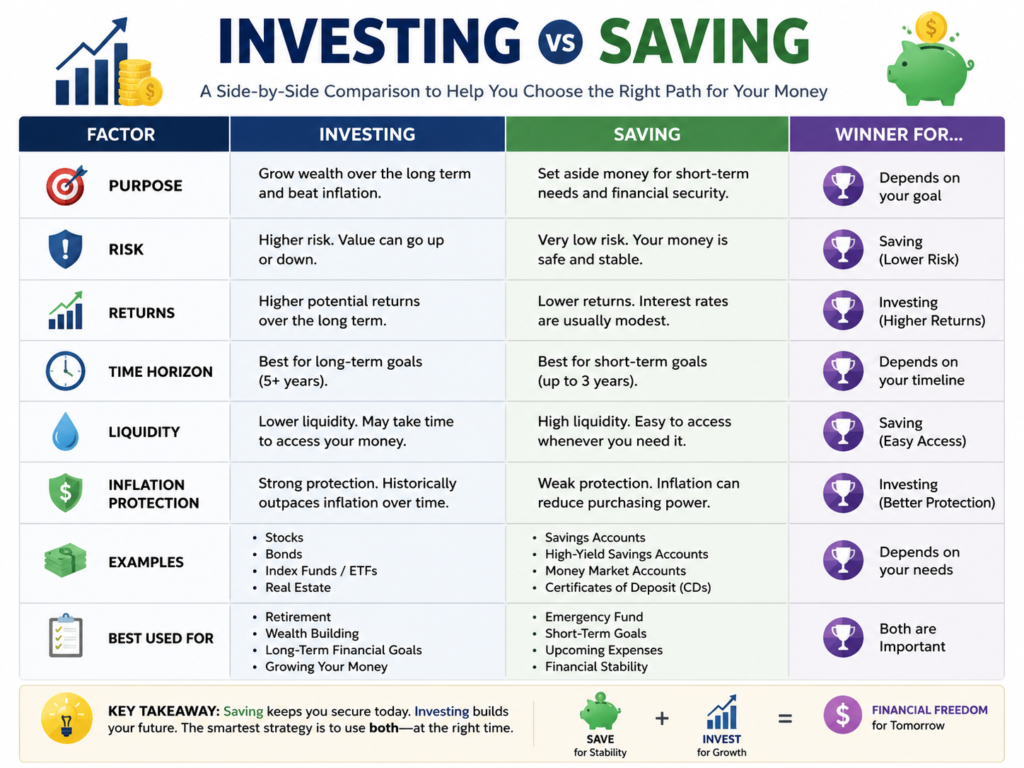
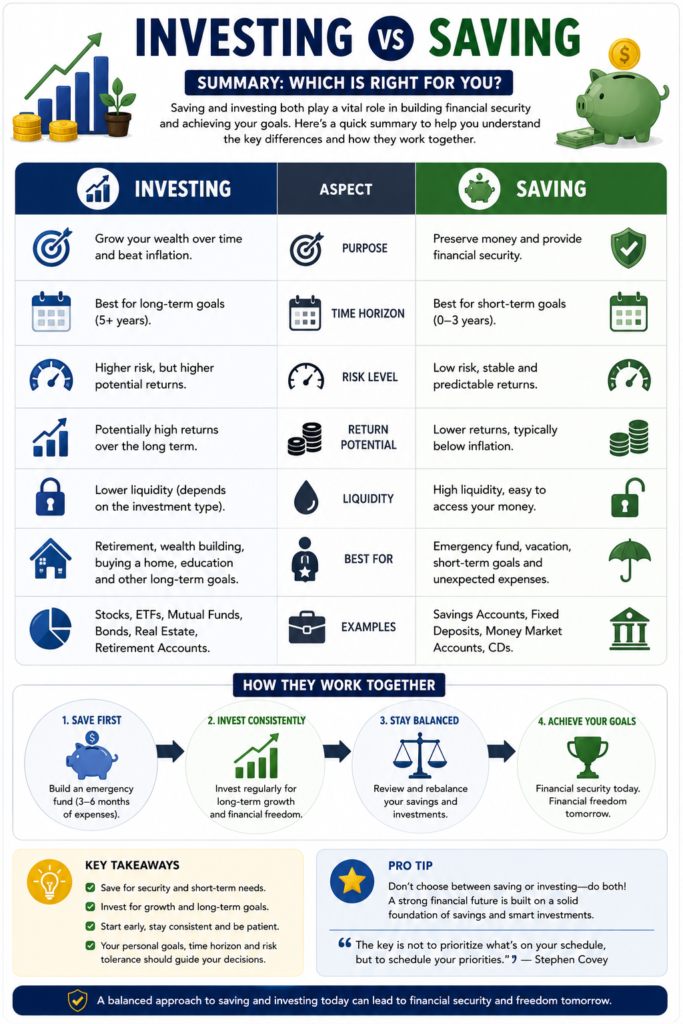
One of the easiest ways to understand Investing vs Saving is to compare them side by side. While both help improve your financial future, they serve different purposes. The table below highlights the key differences to help you decide when to save and when to invest.
Let’s break down the major differences clearly.
| Factor | Saving | Investing |
|---|---|---|
| Primary goal | Protect money | Grow money |
| Time horizon | Short-term or near-term | Long-term |
| Risk level | Low | Medium to high depending on assets |
| Return potential | Low to moderate | Higher over long periods |
| Liquidity | Usually high | Varies; can be lower or more volatile |
| Value fluctuation | Usually stable | Can rise and fall significantly |
| Best use cases | Emergency fund, bills, planned purchases | Retirement, wealth building, long-term goals |
| Liquidity | High | Depends on the investment |
| Common Examples | Savings account, high-yield savings account | Stocks, ETFs, index funds, bonds |
As you can see, Investing vs Saving is not about choosing one over the other. Saving provides security and liquidity for short-term needs, while investing focuses on long-term growth and building wealth. Most successful financial plans combine both strategies. This comparison makes Investing vs Saving much easier to understand because each serves a completely different purpose in personal finance.
Now let’s go deeper into each one.
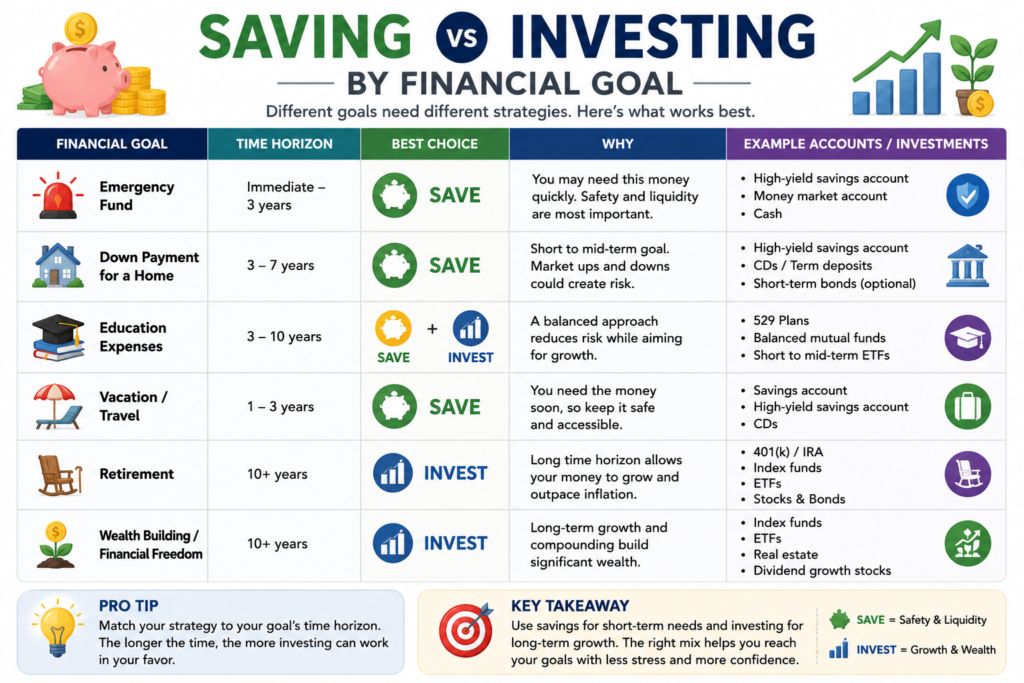
7. Saving vs Investing by Financial Goal
| Financial Goal | Save | Invest |
|---|---|---|
| Emergency Fund | ✅ | ❌ |
| Vacation (1 year) | ✅ | ❌ |
| Home Down Payment (2–3 years) | ✅ | ❌ |
| Car Purchase | ✅ | ❌ |
| Retirement | ❌ | ✅ |
| Financial Independence | ❌ | ✅ |
| Children’s Education (10+ years) | ❌ | ✅ |
| Wealth Building | ❌ | ✅ |
Choosing between Investing vs Saving depends largely on your financial goal and the time horizon. Short-term goals generally belong in savings, while long-term goals are usually better suited for investments.
The easiest way to decide between saving and investing is to ask:
“What is this money for, and when will I need it?”
That one question solves a lot of confusion.
Goals that usually belong in savings
Use savings for:
- Emergency fund
- Rent buffer
- Medical deductible
- Car repairs
- Vacation next year
- Wedding in 18 months
- House down payment in 2–4 years
- Tax payments
- Tuition due soon
- Job-loss reserve
- Cash buffer for freelancers or business owners
Goals that usually belong in investments
Use investing for:
- Retirement in 20 years
- Financial independence
- Building wealth over decades
- Children’s education if the timeline is long enough
- Legacy planning
- Long-term charitable giving funds
- Wealth growth beyond cash reserves
Mixed goals
Some goals use both.
Example: Buying a house in 7 years
- Down payment needed in 7 years
- You might invest part of it if your risk tolerance is high and your plan is flexible
- But you may move the money gradually to cash as the purchase date gets closer
Example: Starting a business in 5 years
- Keep the first layer of capital in safe savings
- Invest only the portion you can afford to leave untouched if markets fall
8. The Role of Time Horizon
What is a time horizon?
A time horizon is the amount of time before you need the money.
This is one of the most important concepts in personal finance.
Short time horizon
If you need the money soon, market volatility becomes dangerous. A stock portfolio could be down exactly when you need to sell.
Long time horizon
If you do not need the money for 10, 20, or 30 years, you have time to ride through market declines and benefit from long-term growth.
A practical rule of thumb
Consider saving if:
- You need the money in the next 0–5 years
- The goal is essential and non-negotiable
- A market drop would ruin the plan
Consider investing if:
- You do not need the money for 5+ years
- You can tolerate temporary declines
- Your goal is long-term wealth growth
This is not a perfect rule, but it is a very good starting point.
9. The Role of Risk
What is risk?
In personal finance, risk means the possibility that your money could lose value, fail to grow enough, or be unavailable when needed.
Saving and investing deal with different kinds of risk.
The risk of saving
People often think savings have “no risk.” That is not completely true.
Savings usually have low market risk, but they still have:
- Inflation risk: your money may lose purchasing power over time
- opportunity cost: you may miss the growth that investing could have delivered
- reinvestment risk in some fixed-income products when rates change
The risk of investing
Investing introduces:
- market volatility
- temporary or permanent loss of capital
- behavioral risk, such as panic-selling
- sequence risk if withdrawals happen during downturns
- concentration risk if you invest in too few assets
Risk tolerance vs risk capacity
These are different.
Risk tolerance
How comfortable you feel emotionally with ups and downs.
Risk capacity
How much risk your financial situation can actually afford.
You may feel brave enough to invest your house down payment in stocks, but if you need that money in one year, your risk capacity is low even if your emotional risk tolerance feels high.
10. The Role of Inflation
What is inflation?
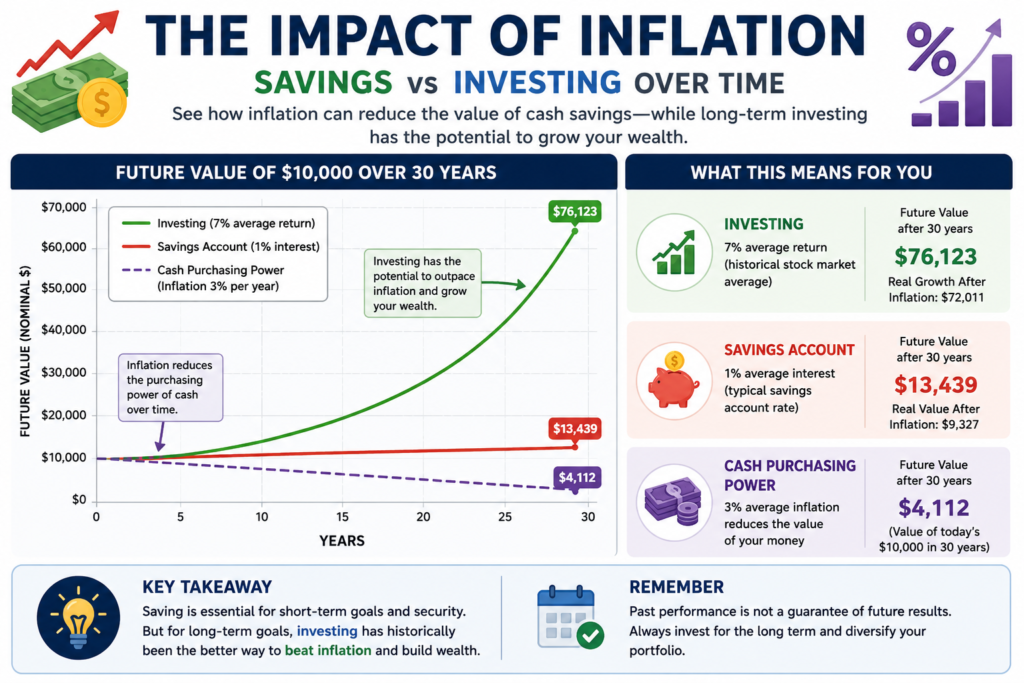
Inflation is the general rise in prices over time. It means the same amount of money buys less in the future.
If inflation averages 3% a year, a basket of goods that costs $100 today may cost about $103 next year and more after that. Over many years, this matters a lot.
Why inflation matters in saving vs investing
Inflation is one of the biggest reasons people need to invest.
If you only save forever
Your cash may remain numerically stable, but its purchasing power can shrink.
Example:
- You keep $100,000 in cash for 15 years
- The number still says $100,000
- But if prices rise steadily, that $100,000 buys much less than it used to
If you invest wisely over long periods
Investments, especially diversified equity investments, have historically had a better chance of outpacing inflation over long time horizons.
This does not mean investing always wins in every year. It means that over long periods, investing has generally offered a stronger chance of preserving and growing real purchasing power.
The hidden cost of staying too safe for too long
A lot of people think the biggest danger is losing money in the market. But for long-term goals, another danger is not growing enough.
If you save for retirement entirely in cash, you may avoid volatility but still fail to build enough wealth.
That is why the real question is not just:
“Can I lose money by investing?”
It is also:
“Can I fail to reach my future goals by not investing enough?”
Inflation is one of the biggest reasons why Investing vs Saving should be viewed differently for short-term and long-term financial goals.
Inflation reduces purchasing power over time, making it important to understand how markets and economies influence your investments. Read our Inflation Explained guide for a deeper understanding.
To better understand how inflation affects purchasing power and interest rates, readers can review the Federal Reserve inflation data and the U.S. Consumer Price Index (CPI) published by the Bureau of Labor Statistics. These official sources provide reliable information on inflation trends and economic conditions.
Saving vs Investing During Inflation
| Factor | Saving | Investing |
|---|---|---|
| Purchasing Power | Declines over time | Better long-term growth potential |
| Inflation Impact | Higher | Lower over long periods |
| Returns | Lower | Historically higher potential |
| Risk | Low | Moderate to High |
| Best Use | Short-term goals | Long-term wealth building |
11. The Role of Liquidity
What is liquidity?
Liquidity is the ability to access your money quickly without losing value.
Cash in a savings account is highly liquid.
A stock portfolio is also relatively liquid in the sense that you can sell shares, but the value may be lower at the moment you need the money. So the issue is not only access, but access at a stable value.
Why liquidity matters
If you lose your job tomorrow, you need money you can use immediately.
That is not the time to hope the market is up.
This is why emergency funds belong in savings, not in volatile investments.
12. The Role of Compounding
What is compounding?
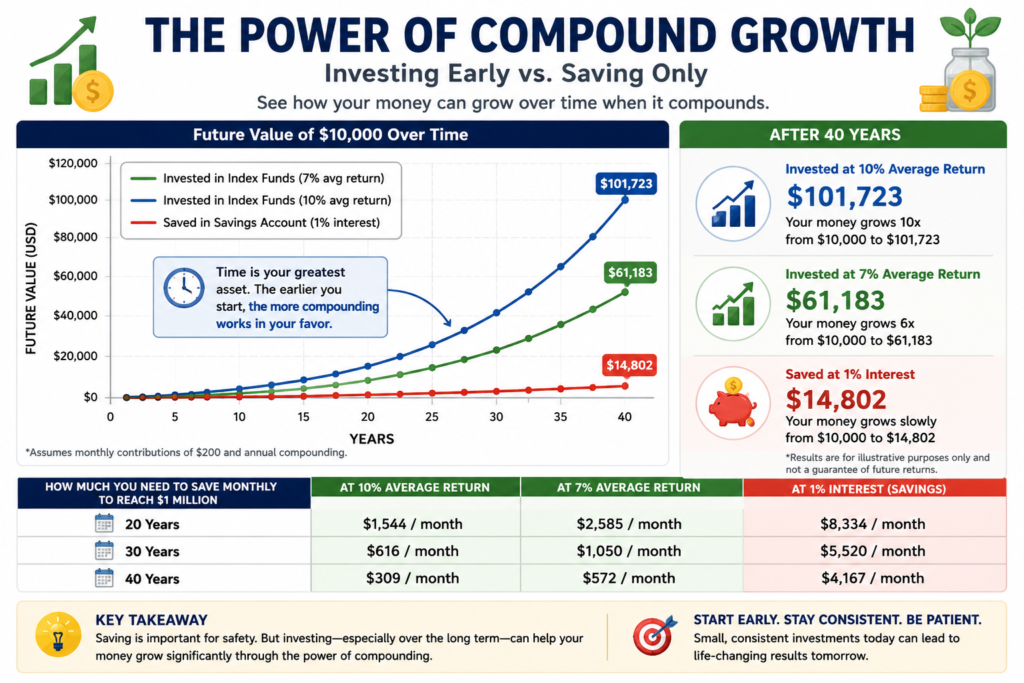
Compounding means your money earns returns, and then those returns begin earning returns too.
It is one of the most powerful forces in finance. Compound growth is one of the biggest drivers of long-term wealth. Learn more in our Power of Compounding guide.
Example of compounding in savings
If you keep $10,000 in a savings account earning interest, the interest can also earn interest over time.
Example of compounding in investing
If you invest in a diversified stock fund and it grows, the growth remains invested and can generate more growth in the future.
Why compounding matters more in investing
Savings can compound, but the rate is often much lower than the long-term return potential of diversified investments. That difference becomes enormous over decades.
Example
Let’s imagine two people each put away $500 per month for 30 years.
Person A saves at 2% average annual growth
Person B invests at 7% average annual growth
Over long periods, the difference can be dramatic. Person B may end up with far more wealth even though both contributed the same amount.
This is why time matters so much. The earlier you invest for long-term goals, the more compounding can work in your favor.
13. Where to Save Money
Saving does not just mean “keep cash under the mattress.” Good savings tools balance safety, accessibility, and at least some yield.
Common places to keep savings
1. Savings account
Basic bank savings account. Good for liquidity, but rates may vary widely.
2. High-yield savings account
Often a better option than traditional low-rate savings accounts because it may offer higher interest while still keeping funds accessible.
3. Money market account
Can be a good cash-management tool depending on rates and features.
4. Certificates of deposit (CDs) or term deposits
These can offer higher yields than savings accounts, but the money may be locked for a period.
5. Treasury bills or short-term government securities
In some countries, these can be a place for near-cash reserves, especially for larger balances.
What belongs in savings?
- Emergency fund
- Planned expense in the next 12–24 months
- Cash buffer for self-employment
- Insurance deductibles
- Near-term tuition
- Home maintenance reserve
- Short-term travel fund
14. Where to Invest Money
Investing should be matched to your goal, timeline, and risk tolerance.
Common long-term investment options
1. Stocks
Ownership in companies. High long-term growth potential, but volatile.
2. Bonds
Loans to governments or companies. Typically lower expected return than stocks, but often lower volatility.
3. Index funds
Funds that track a market index. Often used as a low-cost way to build diversified exposure. Investors looking to reduce risk should learn about building a diversified portfolio. Read our Diversified Portfolio Guide for practical strategies.
4. ETFs
Exchange-traded funds that can hold stocks, bonds, or other assets. Often popular for diversification and lower costs.
5. Retirement accounts invested in funds
For many people in Tier 1 countries, workplace retirement plans or tax-advantaged accounts are the primary investing vehicle.
6. Real estate
Can provide income and appreciation, but comes with illiquidity, concentration risk, and operating complexity.
Important point
Investing is not just “buying random stocks.”
For most beginners, investing usually works best when it is:
- diversified,
- low-cost,
- long-term,
- consistent,
- and aligned with a clear plan.
If you’re new to investing, it’s important to learn from trusted government resources. The Investor.gov investing basics guide explains fundamental investing concepts, while the U.S. SEC Investor Education section provides information on investor protection, diversification, and avoiding investment scams.
15. Should You Save First or Invest First?
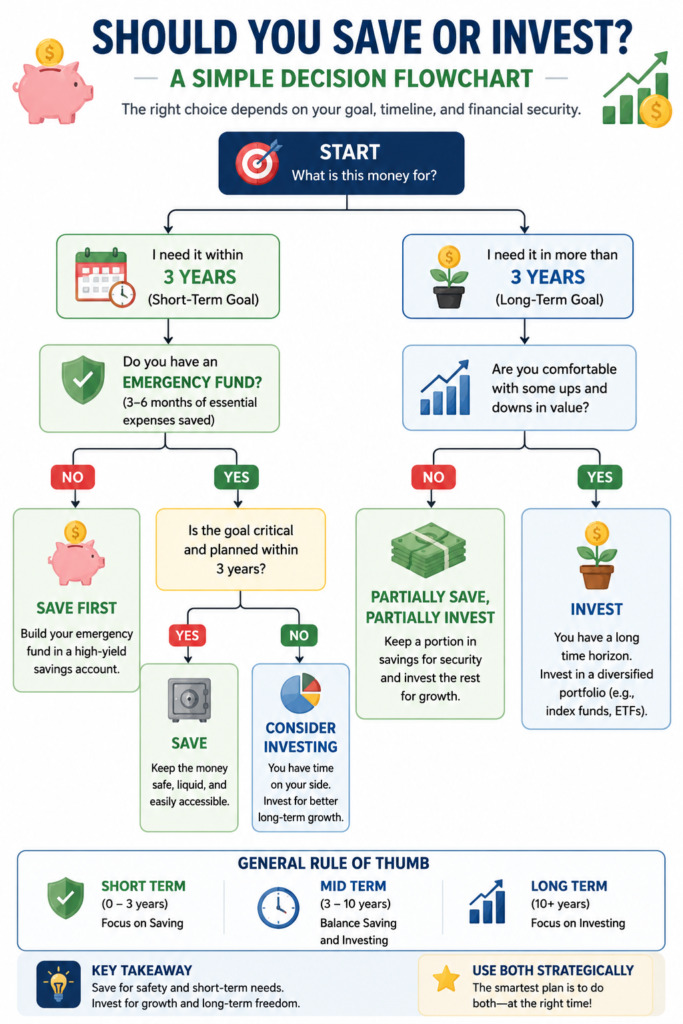
This is one of the most common questions in personal finance. A common question beginners ask about Investing vs Saving is whether they should build savings first or start investing immediately.
The short answer
In most cases, you should do both, but in the right order.
A practical priority system
Step 1: Cover essential cash flow and bills
Your finances must be stable enough that you are not constantly borrowing to survive.
Step 2: Build a starter emergency fund
Even a small starter fund can prevent debt spirals when something goes wrong.
Step 3: Capture free employer retirement match if available
If your employer matches retirement contributions, that is often a very high-priority investment opportunity.
Step 4: Build a fuller emergency fund
Aim for a reserve appropriate to your job stability, family situation, and monthly expenses.
Step 5: Pay down toxic high-interest debt
Very high-interest debt can destroy financial progress.
Step 6: Invest for long-term goals
Retirement, wealth building, future education, and other long-term priorities belong here.
Step 7: Save separately for planned near-term expenses
Vacations, car replacement, annual insurance, and similar goals need dedicated savings buckets.
So the question is not “saving or investing?” It is often:
How much of each, in what order, for which purpose?
If your goal is financial independence after retirement, our Retirement Investing Guide explains long-term investment strategies for building retirement wealth.
16. The Best Order of Operations for Your Money
Here is a practical framework many people can adapt.
Money allocation framework
1. Essential expenses
Housing, food, utilities, transport, minimum debt payments, insurance.
2. Starter emergency fund
Enough to stop small crises from turning into debt.
3. Employer match
If you have access to a retirement match, contribute enough to get the full match if possible.
4. High-interest debt payoff
Credit card debt or similar debt often deserves aggressive attention.
5. Full emergency fund
Typically several months of essential expenses, adjusted for your risk profile.
6. Retirement investing
Use tax-advantaged accounts where available.
7. Mid-term savings goals
Home down payment, education payments, planned life events.
8. Additional taxable investing
For goals beyond retirement accounts or for early financial independence.
9. Lifestyle goals
Travel, hobbies, gifts, or luxury spending—ideally funded after the foundation is in place.
17. How Much Should Be in Savings vs Investments?
There is no universal percentage because it depends on age, goals, income stability, and personality. But here is a useful framework.
Your savings amount depends on:
1. Emergency fund needs
Common guideline: 3 to 6 months of essential expenses
But some people need more:
- freelancers
- commission-based workers
- single-income households
- people with dependents
- people in volatile industries
2. Near-term obligations
If you know you will need $25,000 in 18 months, that money generally belongs in savings, not stocks.
3. Stress tolerance
Some people sleep better with a larger cash buffer. That is not always mathematically optimal, but peace of mind matters.
Your investment amount depends on:
1. Long-term goals
Retirement, financial independence, children’s education, future housing upgrades.
2. Time horizon
The longer the horizon, the more room you usually have to invest.
3. Existing cash cushion
If your cash reserves are weak, you may need to prioritize saving before increasing investment risk.
18. Case Studies: 13 Real-Life Examples
Below are detailed case studies to show how the saving vs investing decision changes depending on the person and the goal. These real-world examples demonstrate how Investing vs Saving decisions change depending on income, age, financial goals, and risk tolerance.
Case Study 1: Emma, age 26, first full-time job
Situation
Emma has just started a marketing job in London. She earns a decent salary, has student debt, and only £1,200 in cash. Her employer offers a retirement match. She wants to travel next summer and eventually buy a flat.
Problem
Should Emma save or invest first?
Best approach
Emma should do both, but with priorities:
- Build a small emergency fund
- Contribute enough to get the employer match
- Pay down any high-interest debt
- Build a larger emergency fund
- Save separately for the summer trip
- Invest long-term for retirement and future wealth
Why?
If Emma ignores savings and invests everything, a surprise expense may force her into debt or force her to sell investments at the wrong time. If she ignores investing completely, she may miss years of compounding and employer matching.
Lesson
When you are early in your career, the smartest move is often not choosing one side. It is building a financial base with savings while starting long-term investing early.
Case Study 2: Daniel and Sofia, married, buying a home in 2 years
Situation
Daniel and Sofia live in Toronto. They want to buy a home in two years and need a down payment. They already have an emergency fund and retirement accounts.
Problem
Should the house down payment be invested in stocks to “grow faster”?
Best approach
No. A two-year home down payment should generally stay in safe savings or near-cash instruments.
Why?
If the market drops 25% right before they want to buy, their plan could be delayed or destroyed. The purpose of this money is not long-term growth. It is capital preservation.
Lesson
Money with a short deadline and a non-negotiable purpose belongs in savings, not volatile investments.
Case Study 3: Marcus, age 42, behind on retirement
Situation
Marcus has focused on work and family but has only modest retirement savings. He has a stable job, no high-interest debt, and six months of expenses saved.
Problem
Should he keep building cash because it feels safer, or should he invest more aggressively for retirement?
Best approach
Marcus likely needs to prioritize investing for long-term retirement growth while maintaining his emergency fund.
Why?
His retirement goal is long-term. Keeping too much of his future in cash may not provide enough growth to catch up.
Lesson
Being “too safe” can become its own financial risk if your long-term goals require growth.
Case Study 4: Olivia, freelance designer with unstable income
Situation
Olivia works for herself in New York. Some months are great; some are weak. Her income fluctuates significantly.
Problem
Should she invest aggressively like salaried friends do?
Best approach
Olivia needs a larger savings cushion than many salaried workers before aggressively investing.
Why?
Irregular income increases the importance of liquidity. She may need:
- a larger emergency fund,
- a tax reserve,
- a business operating reserve,
- and a personal cash buffer.
Once those are in place, long-term investing becomes easier and safer.
Lesson
The right savings amount depends not only on personality but on income stability.
Case Study 5: Jason, age 31, wants to retire early
Situation
Jason earns well in San Francisco and wants financial independence by age 45. He has no debt and already holds six months of expenses in cash.
Problem
Should he keep adding to savings because it feels safe, or push more money into investments?
Best approach
Because Jason’s goal is long-term wealth building and early retirement, the marginal dollar beyond a reasonable cash reserve likely belongs in investments, not extra idle cash.
Why?
His goal requires growth, not just safety. Over-saving in cash may slow his path dramatically.
Lesson
Once your cash safety net is complete, additional dollars often work harder in long-term investments.
Case Study 6: A family preparing for a recession
Situation
A two-income family in Chicago has children, a mortgage, and concerns about layoffs. They are already investing for retirement but feel uneasy about the economy.
Problem
Should they stop investing and pile everything into cash?
Best approach
Usually not. A better response may be:
- increase emergency reserves if needed,
- review monthly spending,
- keep long-term investing consistent,
- avoid panic changes based on headlines.
Why?
Stopping long-term investing entirely because of fear can hurt long-term outcomes. But modestly increasing cash reserves for a period may be reasonable if job risk has risen.
Lesson
During uncertain periods, you do not need an all-or-nothing decision. You can strengthen savings without abandoning investing.
Case Study 7: Priya, age 24, saving for graduate school in 4 years
Situation
Priya plans to start graduate school in four years. She also wants to begin retirement investing early.
Problem
Should she invest the tuition fund?
Best approach
Her graduate-school money should mostly be in savings or conservative vehicles, while retirement money can be invested separately.
Why?
The school timeline is relatively short and fixed. Retirement is long-term and flexible. These are different buckets with different jobs.
Lesson
One person can and should use different strategies for different goals at the same time.
Case Study 8: Robert, retired, living off portfolio withdrawals
Situation
Robert is 68 and retired. He uses investments to fund part of his living expenses.
Problem
How much should be in savings now?
Best approach
Retirees often benefit from keeping a cash reserve or short-term bond reserve to reduce the need to sell stocks during downturns.
Why?
When you are withdrawing from investments, sequence risk matters. Cash reserves can provide flexibility during market declines.
Lesson
Saving is not only for beginners. Even wealthy investors need cash reserves for stability, withdrawals, and planning.
Case Study 9 – Young Professional in the United States
Situation
Sarah is a 26-year-old software engineer in Texas earning $85,000 per year. She recently graduated, has paid off her student loans, and wants to build long-term wealth while preparing for future goals.
Challenge
Sarah is unsure whether to keep saving in her bank account or begin investing in the stock market.
Strategy
She:
- Builds a six-month emergency fund in a high-yield savings account.
- Contributes enough to receive her employer’s 401(k) match.
- Opens a Roth IRA.
- Invests monthly in low-cost index funds using dollar-cost averaging.
Result
Within several years, Sarah has:
- A fully funded emergency reserve.
- Retirement investments growing through compound returns.
- Greater confidence in her financial future.
Key Lesson
For young professionals in the United States, combining savings with long-term investing provides both financial security and wealth-building potential.
Case Study 10 – UK Couple Saving for Their First Home
Situation
James and Emma live in Manchester and plan to purchase their first home within three years.
Challenge
They wonder whether investing their house deposit is worthwhile.
Strategy
They:
- Keep their home deposit in cash savings because they need the money soon.
- Continue investing separately for retirement through workplace pensions and diversified investments.
Result
When housing prices change, their deposit remains stable and available when needed.
Key Lesson
Short-term goals are generally better suited for savings, while long-term goals benefit from investing.
Case Study 11 – Canadian Freelancer
Situation
Michael is a self-employed graphic designer in Toronto with income that varies from month to month.
Challenge
He worries about unstable cash flow.
Strategy
He:
- Saves eight months of living expenses.
- Invests excess cash in diversified ETFs.
- Makes monthly contributions whenever income allows.
Result
His savings provide stability during slower months, while investments continue growing over time.
Key Lesson
Freelancers often benefit from maintaining larger emergency savings before investing aggressively.
Case Study 12 – Australian Retiree
Situation
Margaret is 67 years old and recently retired in Sydney.
Challenge
She wants reliable income without taking excessive investment risk.
Strategy
She:
- Keeps two years of spending needs in savings.
- Invests the remainder in dividend-paying ETFs and government bonds.
- Reviews her portfolio annually.
Result
She can cover daily expenses without selling investments during market downturns.
Key Lesson
Retirees usually benefit from balancing liquidity with long-term investment growth.
Case Study 13 – High-Income Tech Worker Pursuing FIRE
Situation
David, a 33-year-old software architect in California, earns over $220,000 annually and wants to achieve Financial Independence, Retire Early (FIRE).
Challenge
He wants to maximize long-term wealth while remaining financially secure.
Strategy
He:
- Maintains a six-month emergency fund.
- Invests about 50% of his income.
- Prioritizes diversified index funds and tax-advantaged retirement accounts.
- Reviews his asset allocation each year.
Result
David builds a portfolio capable of supporting early retirement while maintaining adequate cash reserves.
Key Lesson
High earners pursuing FIRE often rely on disciplined investing while keeping sufficient savings for unexpected expenses.
Saving vs Investing by Age
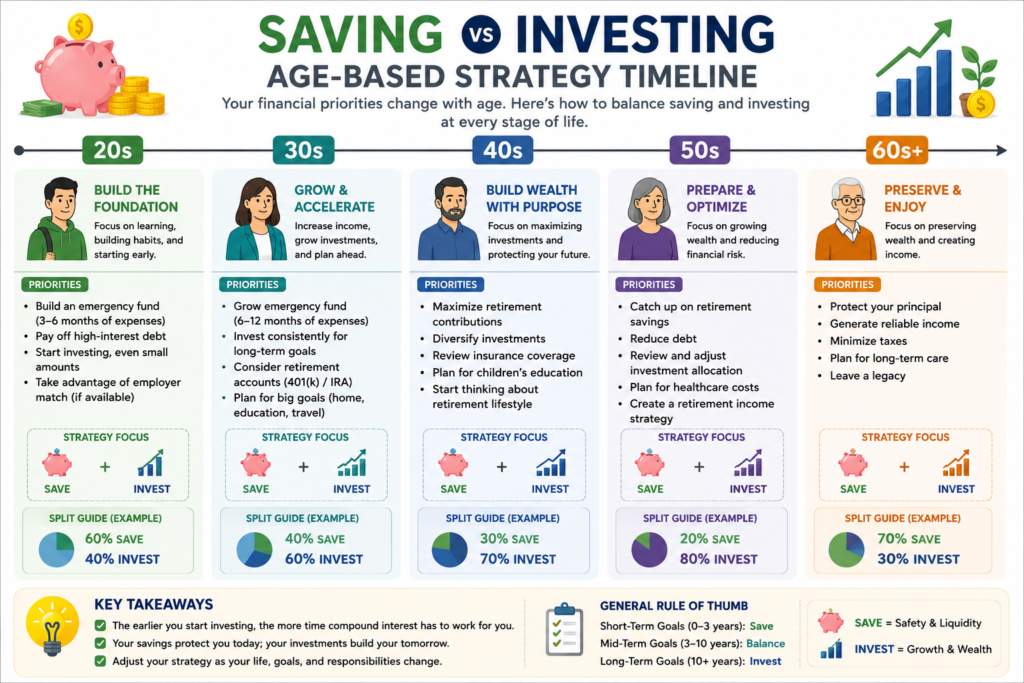
One of the most common questions beginners ask is how the balance between saving and investing should change throughout life. While there is no one-size-fits-all approach, age often influences financial priorities, risk tolerance, and investment time horizon. Younger individuals typically have more time to recover from market fluctuations, while older adults may prioritize capital preservation and income. The table below provides an illustrative example of how saving and investing priorities may evolve with age.
Comparison Table
| Age Group | Saving Priority | Investing Priority | Primary Financial Goal |
|---|---|---|---|
| 18–25 | 40% | 60% | Build an emergency fund and start investing early |
| 26–35 | 30% | 70% | Grow wealth while saving for major life goals |
| 36–50 | 25% | 75% | Maximize long-term investments and retirement savings |
| 51–65 | 40% | 60% | Balance growth with preserving accumulated wealth |
| 65+ | 60% | 40% | Maintain income, liquidity, and financial stability |
Note: These percentages are illustrative examples only and should not be interpreted as universal financial advice. The appropriate balance depends on your income, financial goals, time horizon, risk tolerance, debt obligations, and personal circumstances.
To learn how investment allocations and diversification strategies can change throughout different stages of life, read our Retirement Investing Guide and Diversified Portfolio Guide.
19. Common Mistakes to Avoid
Mistake 1: Investing your emergency fund
Your emergency fund is not there to maximize returns. It is there to protect you when life goes wrong.
Mistake 2: Keeping retirement money entirely in cash for decades
This may feel safe, but it can quietly destroy long-term purchasing power.
Mistake 3: Using one account for every goal
Mixing vacation money, emergency money, and retirement money creates confusion and bad decisions.
Mistake 4: Ignoring inflation
A savings balance that never falls in dollar terms can still lose real-world value.
Mistake 5: Investing money you may need next year
That can force you to sell in a downturn.
Mistake 6: Waiting for the “perfect time” to invest
Trying to perfectly time markets often leads to paralysis.
Mistake 7: Assuming more cash always means more safety
Too much idle cash can be risky if it prevents long-term wealth growth.
Mistake 8: Copying someone else’s plan
Your friend’s savings-investing split may be completely wrong for your income, job stability, and goals.
20. A Practical Decision Framework: Save or Invest?
When you receive money, ask these questions in order.
Question 1: Will I need this money within 5 years?
- Yes → lean toward saving
- No → continue to next question
Question 2: Is the goal essential and date-specific?
Examples:
- tuition due next year
- home down payment in 24 months
- tax bill in 8 months
If yes, saving is usually safer.
Question 3: Do I already have an emergency fund?
If no, savings should usually come before aggressive investing.
Question 4: Do I have high-interest debt?
If yes, that may deserve attention before more investing.
Question 5: Is this money for retirement or long-term wealth?
If yes, investing is usually appropriate.
Question 6: Can I emotionally and financially handle a market drop?
If no, you may need a more conservative investment mix or a bigger cash reserve.
21. Statistics and Market Reality: Why the Difference Matters
To understand investing vs saving, it helps to understand the broader financial environment.
Savings are essential because emergencies are common
Unexpected expenses, job loss, health costs, family responsibilities, and economic downturns happen regularly. That is why emergency savings are not optional for most households.
Investing matters because inflation and long life are real
If you are saving for retirement, you may need your money to last decades. Cash alone often struggles to maintain purchasing power over very long periods, especially after inflation and taxes.
Long-term stock investing has historically offered stronger growth than cash
Historically, diversified equity investing has produced higher long-term returns than cash savings, though with much higher short-term volatility. That is the trade-off at the center of this article.
But short-term volatility is not a side issue
It matters a lot when the goal is near-term. A house down payment, tuition payment, or emergency fund should not be treated like retirement money.
Readers interested in global economic trends, financial development, and long-term economic indicators can explore the World Bank economic data, which provides comprehensive statistics covering countries around the world.
22. Expert Principles That Help Clarify the Choice
Here are a few timeless principles used by financial planners and experienced investors.
Principle 1: Match the tool to the job
Emergency money should be safe.
Retirement money should be built for growth.
House down payment money should reflect the timeline.
Do not ask one account to do every job.
Principle 2: Cash protects your life; investments build your future
Savings and investing are not enemies. They are teammates.
Principle 3: The longer the timeline, the more useful investing becomes
Time is what allows compounding and market recovery to work in your favor.
Principle 4: Do not confuse comfort with strategy
Some people hold excessive cash because investing feels scary. Others invest recklessly because cash feels “wasteful.” Both can be mistakes.
Principle 5: A good plan uses both
Most healthy financial systems include:
- a cash safety reserve
- consistent long-term investing
- separate goal-based buckets
23. Saving vs Investing for Major Life Goals
Emergency fund
Best home: savings
Vacation in 12 months
Best home: savings
Home down payment in 2 years
Best home: savings or very conservative cash equivalents
Retirement in 30 years
Best home: investments
Child’s education in 15 years
Best home: mostly investments, depending on risk profile and local account options
Car replacement in 18 months
Best home: savings
Wealth building / financial independence
Best home: investments
Wedding in 10 months
Best home: savings
Future business fund in 8 years
Best home: likely a mix, depending on flexibility and risk tolerance
24. How Saving and Investing Work Together in a Healthy Financial Plan
The strongest financial plans do not choose one or the other. They assign each dollar a role.
Bucket 1: Safety bucket
This includes:
- emergency fund
- monthly bill buffer
- insurance deductibles
- near-term obligations
This is savings territory.
Bucket 2: Goal bucket
This includes:
- travel fund
- home down payment
- tuition due soon
- planned purchases
Usually savings territory if the timeline is short.
Bucket 3: Growth bucket
This includes:
- retirement
- long-term wealth building
- legacy planning
- long-term education funding
This is investment territory.
When people feel confused, it is often because all three buckets are mixed together.
25. Frequently Asked Questions (FAQs)
1. Is it better to save or invest?
Neither is universally better. Saving is better for short-term safety and liquidity. Investing is better for long-term growth.
2. Should I invest if I have no emergency fund?
Usually, build at least a starter emergency fund first. If your employer offers a retirement match, you may still want to capture that while building savings.
3. How much emergency savings do I need?
A common guideline is 3 to 6 months of essential expenses, but the right number depends on job stability, family responsibilities, health, and income variability.
4. Can I lose money in savings?
You may not lose nominal dollars in a standard savings account, but inflation can reduce purchasing power over time.
5. Can I lose money investing?
Yes. Investments can decline in value, especially over short periods. That is why investing should match long-term goals and risk tolerance.
6. Should I keep my house down payment invested?
Usually not if you need it in the next few years. Near-term goal money is generally safer in savings.
7. Can savings accounts beat inflation?
Sometimes cash yields improve, but over long periods savings often struggle to outpace inflation consistently.
8. Is retirement saving actually investing?
Usually yes. People often say they are “saving for retirement,” but retirement money is typically invested in funds, stocks, bonds, or similar assets.
9. What if I am afraid of investing?
Start by learning the basics, using diversified low-cost funds, and investing gradually. Fear often decreases when you understand the purpose and timeline of your investments.
10. Can I do both at the same time?
Yes, and many people should. For example, you might build an emergency fund while also contributing enough to get an employer retirement match.
11. Is Investing vs Saving better?
Neither is better in every situation. Investing vs Saving depends on your financial goals, time horizon, and risk tolerance.
12. Which is safer: Investing vs Saving?
When comparing Investing vs Saving, saving is generally safer because your money is protected from market volatility, while investing offers higher long-term growth potential with greater risk.
13. How do I decide between Investing vs Saving?
The easiest way to choose Investing vs Saving is by considering when you’ll need the money. Use savings for short-term goals and investing for long-term wealth building.
14. How much should I keep in savings?
A common recommendation is to keep three to six months of essential living expenses in an emergency fund. If your income is unpredictable or you are self-employed, you may want a larger cash reserve.
15. What happens if inflation is higher than savings interest?
If inflation is higher than the interest earned on your savings, your money gradually loses purchasing power. This is one reason long-term financial goals often require investing rather than relying entirely on cash savings.
16. Are ETFs better than savings accounts?
ETFs and savings accounts serve different purposes. Savings accounts are designed for safety and liquidity, while ETFs are investment products intended for long-term growth. Money needed within the next few years is generally better suited for savings accounts.
17. Can investing replace an emergency fund?
No. An emergency fund should remain separate from your investments. During market downturns, investment values may decline, making them unsuitable for covering unexpected expenses or emergencies.
18. Is investing risky?
Yes. Investing involves market risk, meaning the value of your investments can rise or fall. However, diversification, long-term investing, and disciplined investing strategies can help reduce overall risk.
19. How much should I invest every month?
There is no single amount that works for everyone. Many financial experts recommend investing a consistent percentage of your income after covering essential expenses, building an emergency fund, and paying off high-interest debt. The most important factor is investing regularly.
20. Can I lose money while investing?
Yes. Investments can lose value, especially over short periods or during market downturns. However, diversified long-term investors have historically had a better chance of recovering from temporary declines than those who invest for only a short period.
26. Final Verdict: Do You Need Saving, Investing, or Both?
The answer for most people is both.
You need saving because life is unpredictable. Bills appear, jobs change, health issues happen, cars break down, roofs leak, and economies wobble. Savings protect your stability, your sleep, and your ability to handle emergencies without panic.
You need investing because life is long. Retirement may last decades. Inflation erodes cash. Wages alone may not build enough wealth. Long-term goals require growth, and growth usually requires investing.
So the real question is not:
“Should I save or invest?”
The better question is:
“Which goal am I funding, when will I need the money, and what job should this money do for me?”
If the money’s job is protection, save it.
If the money’s job is growth, invest it.
If your financial life includes both short-term needs and long-term dreams, use both tools intentionally.
That is how smart money management works.
Quick Summary: Investing vs Saving in 10 Seconds
- Saving = money you need to protect, usually for short-term goals or emergencies
- Investing = money you want to grow, usually for long-term goals
- Save for emergency funds, near-term expenses, and fixed goals
- Invest for retirement, wealth building, and long-term growth
- Saving offers stability and liquidity
- Investing offers higher long-term growth potential but more volatility
- Inflation is one reason long-term money usually needs to be invested
- The best financial plans use both, not one or the other
Ultimately, Investing vs Saving is not a competition. Both are essential parts of a healthy financial plan. By understanding Investing vs Saving, you can confidently decide when to protect your money with savings and when to grow it through investing.
Saving vs Investing During a Recession
Economic recessions can create uncertainty for investors and savers alike. During periods of slower economic growth, stock markets may become more volatile, unemployment can rise, and consumer confidence may decline. Understanding when to rely on savings and when to continue investing can help you make informed financial decisions instead of reacting emotionally.
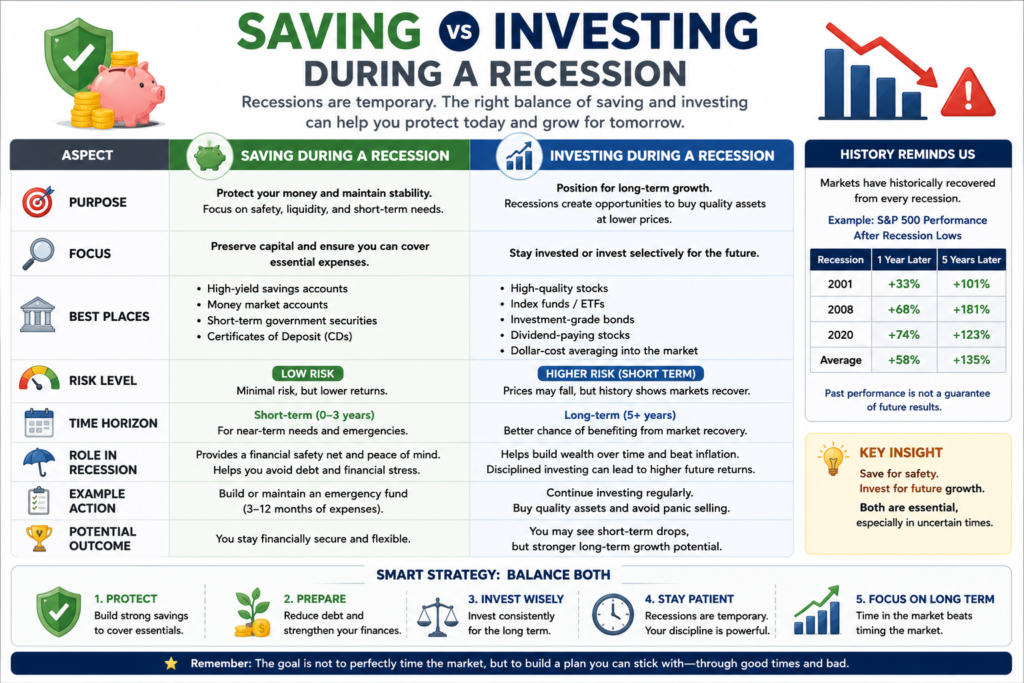
Comparison Table
| Situation | Saving | Investing |
|---|---|---|
| Emergency Expenses | ✅ Best Choice | ❌ Not ideal |
| Job Loss | ✅ Essential | ❌ Avoid selling investments if possible |
| Market Crash | Stable | Buying opportunities may exist for long-term investors |
| Long-Term Wealth | Limited | Potential for recovery and growth over time |
| Financial Security | High | Depends on investment horizon |
Why Savings Matter During a Recession
Cash savings provide financial stability during uncertain periods. A well-funded emergency fund can help cover essential expenses without forcing you to sell investments during a market downturn.
Why Investing Still Matters
Although markets may decline during recessions, long-term investors often continue investing according to their financial plan. Historically, diversified portfolios have recovered over time, though future performance is never guaranteed.
Finding the Right Balance
Rather than choosing between saving and investing, many people maintain an emergency fund while continuing long-term investments if their financial situation allows. The appropriate balance depends on income stability, financial goals, and personal risk tolerance.
If you want to understand how inflation and economic cycles affect investments, explore our Inflation Explained guide.
Conclusion
Saving and investing are two of the most important financial tools you will ever use. One protects your present. The other builds your future. If you understand when to use each, you will make better decisions with every paycheck, every bonus, every windfall, and every financial goal.
The smartest people with money do not ask whether saving is better than investing or whether investing is better than saving. They understand that each dollar needs a role.
Save for safety. Invest for growth. Build both on purpose.