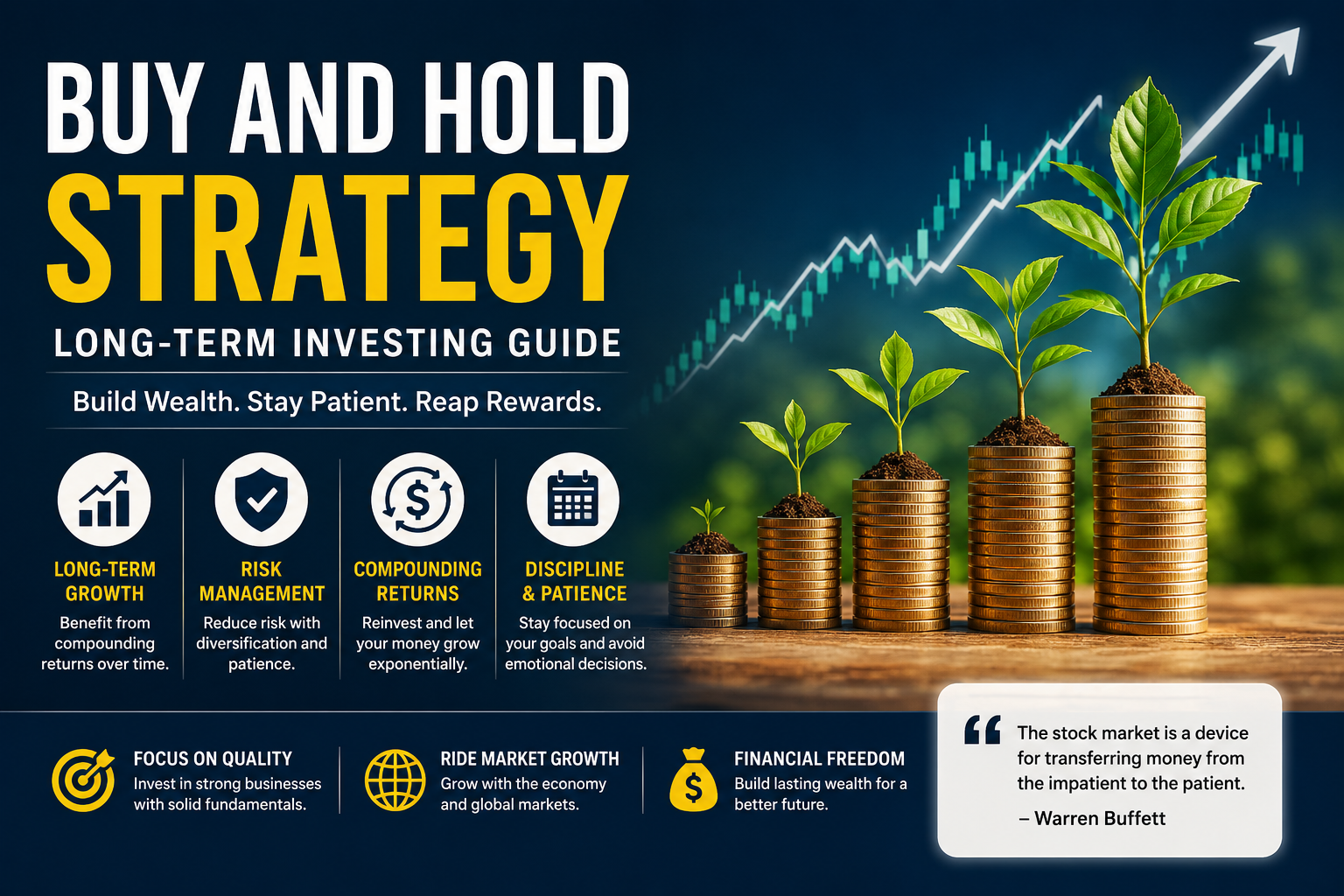
The Buy and Hold Strategy: The Complete Long-Term Investing Guide for Building Wealth
Introduction
The Buy and Hold Strategy is one of the most powerful and proven investment approaches ever created. It has helped millions of investors across the United States, Canada, the United Kingdom, Australia, Germany, and other developed economies build long-term wealth without constantly buying and selling stocks.
While many investors spend countless hours trying to predict market movements, identify the next hot stock, or time market crashes and recoveries, buy-and-hold investors follow a much simpler path:
Buy quality investments and hold them for many years, often decades.
This strategy may sound simple, but its effectiveness comes from understanding how businesses grow, how economies expand, and how compound returns create wealth over time.
Many of the world’s most successful investors have relied on some variation of the buy-and-hold strategy. Rather than attempting to outperform the market every week or month, they focus on owning excellent businesses and allowing time to work in their favor.
In this comprehensive guide, you will learn:
- What the Buy and Hold Strategy means
- The history behind the strategy
- Key investing terms and concepts
- Why the strategy works
- Real-world case studies
- Advantages and disadvantages
- Psychological challenges investors face
- Examples from Tier-1 countries
- How to build a buy-and-hold portfolio
- Common mistakes to avoid
What Is the Buy and Hold Strategy?
The Buy and Hold Strategy is an investment approach where investors purchase assets and keep them for an extended period regardless of short-term market fluctuations.
The philosophy is straightforward:
- Buy quality investments.
- Hold them through market ups and downs.
- Allow compounding and business growth to create wealth.
The strategy focuses on the long term rather than short-term price movements.
A buy-and-hold investor does not panic during market crashes, nor do they become overly excited during market booms.
Instead, they focus on:
- Business fundamentals
- Long-term growth
- Economic expansion
- Compounding returns
Understanding Each Word in “Buy and Hold”
Buy
The word “buy” means purchasing an investment asset.
An asset is anything that has the potential to generate future value.
Examples include:
- Stocks
- ETFs
- Mutual funds
- Bonds
- Real estate investment trusts (REITs)
When purchasing a stock, investors are buying ownership in a company.
For example, purchasing shares of a large technology company means owning a small percentage of that business.
Key Term: Equity
Equity represents ownership in a company.
When investors buy shares, they become shareholders.
Shareholders participate in:
- Company growth
- Potential dividends
- Capital appreciation
Hold
The word “hold” is the most important part of the strategy.
Holding means:
- Staying invested during recessions
- Ignoring short-term volatility
- Avoiding emotional decisions
- Maintaining a long-term perspective
Many investors know how to buy.
Very few know how to hold.
Holding requires patience, discipline, and confidence.
Strategy
A strategy is a planned approach designed to achieve a specific objective.
In investing, a strategy helps investors make decisions consistently rather than emotionally.
The objective of the Buy and Hold Strategy is:
Long-term wealth creation through ownership of productive assets.
The History of Buy and Hold Investing
The roots of buy-and-hold investing can be traced back to the early development of modern stock markets.
Historically, investors who owned strong businesses over long periods accumulated substantial wealth.
During the twentieth century, stock markets experienced:
- World wars
- Economic recessions
- Inflation crises
- Financial crashes
- Political uncertainty
Despite these challenges, broad stock markets continued to grow over the long term.
This growth occurred because businesses continued producing products and services that people needed.
Why the Buy and Hold Strategy Works
Reason 1: Compounding
Compounding is often called the eighth wonder of the world.
Compounding occurs when returns generate additional returns.
Consider this example:
Initial investment: $10,000
Annual return: 10%
Year 1:
$10,000 → $11,000
Year 2:
$11,000 → $12,100
Year 3:
$12,100 → $13,310
Each year, growth occurs on both the original investment and previous gains.
This creates exponential growth.
Over decades, compounding becomes extremely powerful.
Reason 2: Economic Growth
Developed countries generally experience long-term economic growth.
Economic growth is driven by:
- Innovation
- Productivity improvements
- Population growth
- Technological advancement
- Consumer spending
As economies grow, businesses often grow alongside them.
This growth benefits shareholders.
Reason 3: Corporate Earnings Growth
Stock prices generally follow corporate earnings over the long term.
When companies increase:
- Revenue
- Profit
- Cash flow
their value often rises.
Investors who hold quality businesses benefit from this growth.
Reason 4: Time Reduces Risk
In the short term, markets can be unpredictable.
In the long term, business performance becomes more important than daily price fluctuations.
A one-day stock movement is often random.
A twenty-year business trend is usually driven by fundamentals.
Important Terms Every Buy-and-Hold Investor Must Know
Capital Appreciation
Capital appreciation refers to an increase in the value of an investment.
Example:
Purchase price = $100
Current value = $150
Capital appreciation = $50
Dividend
A dividend is a payment made by a company to shareholders.
Some companies distribute a portion of profits to investors.
Dividend income can:
- Generate cash flow
- Increase total returns
- Be reinvested
Dividend Reinvestment
Dividend reinvestment means using dividends to purchase additional shares.
This accelerates compounding.
Many wealthy investors use this approach.
Portfolio
A portfolio is a collection of investments.
A portfolio may contain:
- Stocks
- ETFs
- Bonds
- Cash
Diversification
Diversification means spreading investments across multiple assets.
The goal is to reduce risk.
The saying:
“Don’t put all your eggs in one basket”
perfectly describes diversification.
Case Study 1: The Investor Who Stayed Invested
Imagine two investors in the United States.
Both invest $100,000 in a broad market index fund.
Investor A
- Panics during a market crash
- Sells after a 30% decline
- Waits years to re-enter
Investor B
- Remains invested
- Continues buying regularly
- Ignores short-term headlines
After twenty years, Investor B often ends up significantly wealthier because they captured the recovery and growth phases.
This illustrates one of the most important principles:
Market declines are temporary. Long-term ownership can be permanent.
Case Study 2: The Technology Revolution
In the early 2000s, many technology companies experienced extreme volatility.
Some investors sold because they feared uncertainty.
Others continued holding quality businesses.
Over the following decades, leading technology firms expanded globally.
Investors who remained patient benefited from:
- Revenue growth
- Profit growth
- International expansion
- Innovation
The lesson:
Short-term uncertainty does not necessarily destroy long-term opportunity.
Case Study 3: Index Fund Investing
Consider two friends.
Sarah
Actively trades stocks.
She buys and sells frequently.
She follows financial news daily.
Michael
Invests in a low-cost index fund.
He contributes monthly.
He rarely checks his portfolio.
After twenty years:
- Michael pays lower fees.
- Michael avoids emotional mistakes.
- Michael benefits from compounding.
In many cases, the simpler approach wins.
The Psychology of Buy and Hold Investing
Investing success depends heavily on behavior.
Many investors fail because of psychology rather than investment selection.
Fear
Fear appears during:
- Market crashes
- Recessions
- Negative news
Fear often causes investors to sell at the worst possible time.
Greed
Greed appears during:
- Bull markets
- Asset bubbles
- Speculative booms
Greed often causes investors to buy at excessively high prices.
Patience
Patience is a major advantage.
Most investors want immediate results.
Successful buy-and-hold investors understand that wealth often takes decades to build.
Benefits of the Buy and Hold Strategy
Simplicity
The strategy is easy to understand.
Investors do not need:
- Advanced technical analysis
- Constant monitoring
- Daily trading
Lower Costs
Frequent trading creates:
- Brokerage costs
- Transaction fees
- Tax liabilities
Buy-and-hold investors typically experience fewer costs.
Better Tax Efficiency
In many Tier-1 countries, long-term investments receive more favorable tax treatment than short-term trades.
This allows investors to keep more of their gains.
Reduced Stress
Constant trading can be emotionally exhausting.
Buy-and-hold investing encourages a calmer approach.
More Time Freedom
Investors can focus on:
- Family
- Career
- Education
- Personal development
instead of constantly watching markets.
Risks of the Buy and Hold Strategy
Although effective, buy and hold is not risk-free.
Business Risk
A company can fail.
Examples from history include companies that lost market leadership due to technological change.
This is why diversification is important.
Market Risk
Stock markets can decline significantly.
Large declines may last months or years.
Investors must remain patient.
Inflation Risk
Inflation reduces purchasing power.
Investments must grow faster than inflation to create real wealth.
Emotional Risk
The biggest threat is often the investor.
Poor decisions can damage long-term returns.
Building a Buy-and-Hold Portfolio
Step 1: Define Your Goals
Determine:
- Retirement objectives
- Wealth targets
- Investment horizon
Step 2: Choose Investments
Common choices include:
- Broad-market ETFs
- Index funds
- Blue-chip stocks
- Dividend stocks
Step 3: Diversify
A diversified portfolio may include:
- Domestic stocks
- International stocks
- Bonds
- Real estate funds
Step 4: Invest Regularly
Consistent investing helps reduce timing risk.
This approach is often called Dollar-Cost Averaging.
Step 5: Reinvest Dividends
Dividend reinvestment can significantly increase long-term returns.
Step 6: Stay Invested
This is where many investors fail.
Successful investors maintain discipline through both good and bad markets.
Common Mistakes Investors Make
Trying to Time the Market
Nobody consistently predicts market highs and lows.
Chasing Hot Stocks
Popular stocks can become overvalued.
Selling During Crashes
Market recoveries often occur unexpectedly.
Missing recovery periods can reduce returns dramatically.
Ignoring Diversification
Concentrated portfolios increase risk.
Focusing on Daily News
Most daily financial news has little impact on long-term wealth creation.
Buy and Hold vs Active Trading
| Buy and Hold | Active Trading |
|---|---|
| Long-term focus | Short-term focus |
| Lower costs | Higher costs |
| Less stress | More stress |
| Tax efficient | Less tax efficient |
| Easier to manage | Requires constant attention |
| Compounding benefits | Frequent interruptions |
For most investors, buy and hold is often more practical and sustainable.
Lessons from Successful Investors
Many successful investors share common principles:
- Think long term.
- Stay disciplined.
- Ignore short-term noise.
- Focus on quality assets.
- Let compounding work.
These principles form the foundation of long-term investing success.
Final Thoughts
The Buy and Hold Strategy remains one of the most effective wealth-building methods available to investors in Tier-1 countries. While markets will always experience volatility, recessions, corrections, and uncertainty, history has repeatedly shown that patient investors who own quality assets and remain invested over long periods are often rewarded.
The strategy is not about predicting tomorrow’s stock price.
It is not about finding the next market trend.
It is not about trading every week.
Instead, it is about understanding a simple but powerful truth:
Great businesses create value, economies grow, and time allows compounding to transform small investments into significant wealth.
For investors willing to stay patient, remain disciplined, and think in decades rather than days, the Buy and Hold Strategy can serve as a reliable path toward long-term financial independence and sustainable wealth creation.